
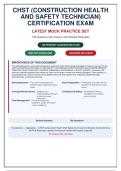
CHST (CONSTRUCTION HEALTH
AND SAFETY TECHNICIAN)
CERTIFICATION EXAM
LATEST MOCK PRACTICE SET
130 Questions with Answers and Detailed Rationales
100 PERCENT GUARANTEED PASS
INSTANT DOWNLOAD ANSWERS INCLUDED
IMPORTANCE OF THIS DOCUMENT
This comprehensive examination preparation guide has been meticulously developed to help you succeed in the
CHST (CONSTRUCTION HEALTH AND SAFETY TECHNICIAN) CERTIFICATION EXAM COMPREHENSIVE
PRACTICE QUESTIONS WITH VERIFIED ANSWERS & RATIONALES | LATEST UPDATE. It contains 130
carefully selected questions that reflect the most current exam content and testing strategies. Each question is
accompanied by a correct answer and a detailed rationale that explains the underlying pathophysiology,
pharmacology, or clinical reasoning.
Self-Assessment – Test your knowledge and Exam Preparation – Familiarize yourself with the
identify areas requiring further question format and content
study areas
Concept Reinforcement – Deepen your Confidence Building – Develop test-taking
understanding through strategies and reduce
evidence-based exam anxiety
rationales
Time Management – Practice answering
questions under simulated
exam conditions
Review Summary 130 Questions
Foundations - Application - CHST Construction Health AND Safety Technician Certification Comprehensive
WITH & Rationales Update Construction Health AND Safety Graduate
All answers with rationales
,Table of Contents
Content Area Questions Key Topics
CHST Construction Health 1-22 Construction, Safety, Crane, Required, Steel
AND Safety Technician
Certification Comprehensive
WITH & Rationales Update
Construction Health AND
Safety Graduate
Required 23-44 Construction, Worker, Safety, System, Exposed
Worker 45-66 Crane, Construction, Required, Hours, Exposed
Crane 67-88 Construction, Required, Safety, Worker, Program
Safety 89-110 Required, Construction, Maximum, Crane, Worker
Space 111-130 Hours, Construction, Worker, Noise, 8-hour
TOTAL 130 All questions include answers and detailed rationales
,Section A - CHST Construction Health AND Safety
Technician Certification Comprehensive WITH & Rationales
Update Construction Health AND Safety Graduate
Q1.
During a trenching operation, a competent person observes that the soil is saturated and
has been previously disturbed. The trench is 6 feet deep with no protective system in
place. Which type of soil is most likely present, and what immediate action is required?
A. Type A soil; no action needed if the B. Type B soil; the trench must be sloped at
trench is less than 8 feet deep. a 1:1 angle or less.
C. Type C soil; the trench must be sloped at D. Type B soil; the trench must be sloped at
a 1.5:1 angle or less, or be shored/shielded. a 1.5:1 angle or less.
Correct: C - Type C soil; the trench must be sloped at a 1.5:1 angle or less, or be
shored/shielded.
Rationale:Saturated and previously disturbed soil is classified as Type C, the least stable.
OSHA requires Type C soil to be sloped at a maximum angle of 1.5:1 (34 degrees) or
protected by a shield or shoring system. Type A and B soils are more stable and have
different slope requirements.
Q2.
A construction site uses a crane to lift prefabricated steel panels. The load capacity chart
indicates a maximum allowable load of 10,000 lbs at a specific radius, but the actual load
is 9,500 lbs. However, the wind speed is 25 mph. What is the most appropriate action?
A. Proceed with the lift because the load is B. Proceed with the lift but reduce the radius
within the chart capacity. to increase capacity.
C. Stop the lift because wind speed exceeds D. Proceed with the lift but use a tagline to
the manufacturer's recommended limit. control the load.
Correct: C - Stop the lift because wind speed exceeds the manufacturer's recommended
limit.
Rationale:Most crane manufacturers specify a maximum allowable wind speed (often 20
mph) for safe operation. Exceeding this limit creates a high risk of load instability and loss of
control. The load being within capacity does not mitigate the wind hazard, and reducing radius
may not be feasible or safe. Taglines do not address the wind issue.
Q3.
Which of the following best describes the hierarchy of controls as applied to controlling
silica dust on a construction site?
Page 3
, Section A - CHST Construction Health AND Safety Technician Certification Comprehensive WITH & Rationales Update Construction Health AND
Safety Graduate
A. Use respirators as the primary control, B. Eliminate silica by substituting a less
followed by administrative controls and then hazardous material, then use water
engineering controls. suppression or local exhaust ventilation, and
finally provide respirators.
C. Rotate workers to reduce exposure, then D. Use engineering controls first, then
use wet methods, and then provide training. personal protective equipment, and then
administrative controls.
Correct: B - Eliminate silica by substituting a less hazardous material, then use water
suppression or local exhaust ventilation, and finally provide respirators.
Rationale:The hierarchy of controls prioritizes elimination and substitution first, then
engineering controls (e.g., wet methods, ventilation), administrative controls (e.g., rotation),
and finally personal protective equipment (respirators) as the last resort. Option B correctly
orders these steps. Option D reverses the order of PPE and administrative controls.
Q4.
A safety manager is reviewing a fall protection plan for a residential roofing project.
Workers will be using personal fall arrest systems (PFAS) anchored to the roof. What is
the maximum free fall distance allowed before the PFAS must arrest the fall?
A. 6 feet B. 4 feet
C. 2 feet D. 8 feet
Correct: A - 6 feet
Rationale:OSHA requires that personal fall arrest systems limit the free fall distance to a
maximum of 6 feet. This ensures that the forces on the body are within safe limits. Exceeding
6 feet increases the risk of injury and may violate OSHA standards.
Q5.
In a confined space entry, the atmospheric testing results show oxygen concentration at
19.5%, flammable gas at 10% of the lower explosive limit (LEL), and carbon monoxide at
25 ppm. According to OSHA's permit-required confined space standard, what is the
classification of this space?
A. Non-permit confined space because all B. Permit-required confined space because
readings are within acceptable limits. oxygen is below 20.8%.
C. Permit-required confined space because D. Immediately dangerous to life or health
flammable gas is above 10% of the LEL. (IDLH) because of carbon monoxide levels.
Correct: B - Permit-required confined space because oxygen is below 20.8%.
Page 4
AND SAFETY TECHNICIAN)
CERTIFICATION EXAM
LATEST MOCK PRACTICE SET
130 Questions with Answers and Detailed Rationales
100 PERCENT GUARANTEED PASS
INSTANT DOWNLOAD ANSWERS INCLUDED
IMPORTANCE OF THIS DOCUMENT
This comprehensive examination preparation guide has been meticulously developed to help you succeed in the
CHST (CONSTRUCTION HEALTH AND SAFETY TECHNICIAN) CERTIFICATION EXAM COMPREHENSIVE
PRACTICE QUESTIONS WITH VERIFIED ANSWERS & RATIONALES | LATEST UPDATE. It contains 130
carefully selected questions that reflect the most current exam content and testing strategies. Each question is
accompanied by a correct answer and a detailed rationale that explains the underlying pathophysiology,
pharmacology, or clinical reasoning.
Self-Assessment – Test your knowledge and Exam Preparation – Familiarize yourself with the
identify areas requiring further question format and content
study areas
Concept Reinforcement – Deepen your Confidence Building – Develop test-taking
understanding through strategies and reduce
evidence-based exam anxiety
rationales
Time Management – Practice answering
questions under simulated
exam conditions
Review Summary 130 Questions
Foundations - Application - CHST Construction Health AND Safety Technician Certification Comprehensive
WITH & Rationales Update Construction Health AND Safety Graduate
All answers with rationales
,Table of Contents
Content Area Questions Key Topics
CHST Construction Health 1-22 Construction, Safety, Crane, Required, Steel
AND Safety Technician
Certification Comprehensive
WITH & Rationales Update
Construction Health AND
Safety Graduate
Required 23-44 Construction, Worker, Safety, System, Exposed
Worker 45-66 Crane, Construction, Required, Hours, Exposed
Crane 67-88 Construction, Required, Safety, Worker, Program
Safety 89-110 Required, Construction, Maximum, Crane, Worker
Space 111-130 Hours, Construction, Worker, Noise, 8-hour
TOTAL 130 All questions include answers and detailed rationales
,Section A - CHST Construction Health AND Safety
Technician Certification Comprehensive WITH & Rationales
Update Construction Health AND Safety Graduate
Q1.
During a trenching operation, a competent person observes that the soil is saturated and
has been previously disturbed. The trench is 6 feet deep with no protective system in
place. Which type of soil is most likely present, and what immediate action is required?
A. Type A soil; no action needed if the B. Type B soil; the trench must be sloped at
trench is less than 8 feet deep. a 1:1 angle or less.
C. Type C soil; the trench must be sloped at D. Type B soil; the trench must be sloped at
a 1.5:1 angle or less, or be shored/shielded. a 1.5:1 angle or less.
Correct: C - Type C soil; the trench must be sloped at a 1.5:1 angle or less, or be
shored/shielded.
Rationale:Saturated and previously disturbed soil is classified as Type C, the least stable.
OSHA requires Type C soil to be sloped at a maximum angle of 1.5:1 (34 degrees) or
protected by a shield or shoring system. Type A and B soils are more stable and have
different slope requirements.
Q2.
A construction site uses a crane to lift prefabricated steel panels. The load capacity chart
indicates a maximum allowable load of 10,000 lbs at a specific radius, but the actual load
is 9,500 lbs. However, the wind speed is 25 mph. What is the most appropriate action?
A. Proceed with the lift because the load is B. Proceed with the lift but reduce the radius
within the chart capacity. to increase capacity.
C. Stop the lift because wind speed exceeds D. Proceed with the lift but use a tagline to
the manufacturer's recommended limit. control the load.
Correct: C - Stop the lift because wind speed exceeds the manufacturer's recommended
limit.
Rationale:Most crane manufacturers specify a maximum allowable wind speed (often 20
mph) for safe operation. Exceeding this limit creates a high risk of load instability and loss of
control. The load being within capacity does not mitigate the wind hazard, and reducing radius
may not be feasible or safe. Taglines do not address the wind issue.
Q3.
Which of the following best describes the hierarchy of controls as applied to controlling
silica dust on a construction site?
Page 3
, Section A - CHST Construction Health AND Safety Technician Certification Comprehensive WITH & Rationales Update Construction Health AND
Safety Graduate
A. Use respirators as the primary control, B. Eliminate silica by substituting a less
followed by administrative controls and then hazardous material, then use water
engineering controls. suppression or local exhaust ventilation, and
finally provide respirators.
C. Rotate workers to reduce exposure, then D. Use engineering controls first, then
use wet methods, and then provide training. personal protective equipment, and then
administrative controls.
Correct: B - Eliminate silica by substituting a less hazardous material, then use water
suppression or local exhaust ventilation, and finally provide respirators.
Rationale:The hierarchy of controls prioritizes elimination and substitution first, then
engineering controls (e.g., wet methods, ventilation), administrative controls (e.g., rotation),
and finally personal protective equipment (respirators) as the last resort. Option B correctly
orders these steps. Option D reverses the order of PPE and administrative controls.
Q4.
A safety manager is reviewing a fall protection plan for a residential roofing project.
Workers will be using personal fall arrest systems (PFAS) anchored to the roof. What is
the maximum free fall distance allowed before the PFAS must arrest the fall?
A. 6 feet B. 4 feet
C. 2 feet D. 8 feet
Correct: A - 6 feet
Rationale:OSHA requires that personal fall arrest systems limit the free fall distance to a
maximum of 6 feet. This ensures that the forces on the body are within safe limits. Exceeding
6 feet increases the risk of injury and may violate OSHA standards.
Q5.
In a confined space entry, the atmospheric testing results show oxygen concentration at
19.5%, flammable gas at 10% of the lower explosive limit (LEL), and carbon monoxide at
25 ppm. According to OSHA's permit-required confined space standard, what is the
classification of this space?
A. Non-permit confined space because all B. Permit-required confined space because
readings are within acceptable limits. oxygen is below 20.8%.
C. Permit-required confined space because D. Immediately dangerous to life or health
flammable gas is above 10% of the LEL. (IDLH) because of carbon monoxide levels.
Correct: B - Permit-required confined space because oxygen is below 20.8%.
Page 4


