

GN 311 EXAM 2 STUDY UPDATED ACTUAL QUESTIONS
AND CORRECT ANSWERS
Question:
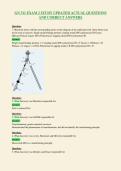
1. Match the terms with the corresponding items on this diagram of the replication fork. Some letters may
not be used as answers. Single strand binding proteins Leading strand DNA polymerase III Gyrase
Helicase Primase Ligase DNA Polymerase I Lagging strand DNA polymerase III
Answer:
Single strand binding proteins = C Leading strand DNA polymerase III = F Gyrase = I Helicase = H
Primase = G Ligase = A DNA Polymerase I Lagging strand = B DNA polymerase III = D
Question:
2. What discovery was Meischer responsible for
Answer:
First to isolate DNA
Question:
3. What discovery was Griffith responsible for
Answer:
Transformation; genetic material can move.
Demonstrated the phenomenon of transformation, but did not identify the transforming principle
Question:
4. What discovery was Avery, MacLeod, and McCarty responsible for
Answer:
Discovered DNA is a transforming principle
Question:
5. What discovery was Hershey and Chase responsible for
,Answer:
Identified DNA is the genetic material in bacteriophages
Question:
6. What discovery was Yanofsky responsible for
Answer:
Collinearity between DNA and protein
Question:
7. What discovery was Franklin and Wilkins responsible for
Answer:
X-ray crystallography
Question:
8. What discovery was Chargaff responsible for
Answer:
base composition
Determined that DNA for yeast consisted of an equal amount of puries and pyrimidines
Question:
9. What discovery was Watson and Crick responsible for
Answer:
Model of DNA structure published the structure of DNA
Question:
10. What did Franklin discover
Answer:
the helical structure of DNA
Question:
11. What discovery is Meselson and Stahl responsible for
Answer:
Determined that DNA replication is semiconservative
Question:
12. How do you tell recombinant versus non-rocombinant offspring?
Answer:
Non-recombinant are your double crossovers and no cross overs.
Recombinants are your single crossovers
Question:
13. How do you calculate map distance?
Answer:
number of recombinants / total x 100
Question:
14. What is linkage?
,Answer:
Occurs when genes reside on the same chromosome.
If the genes are close enough together, then they will not assort independently.
Question:
15. What does a chi-square test tell us about linkage?
Answer:
If independent assortment is rejected, it is likely that the genes are linked.
If it is failed to reject, it is likely that the genes are not linked and are sorted independently.
Question:
16. When do we fail to reject the null hypothesis
Answer:
When the p value is greater than the significance value (independently assorting)
Question:
17. When do we reject the null hypothesis
Answer:
When the p value is less than the significance value (not independently assorting)
Question:
18. What is your null hypothesis for independent assortment?
Answer:
The [blank] in [blank] will assort independently.
Question:
19. What does recombination frequency tell us about the distance between genes?
Answer:
It is proportional. Frequency depends on how far apart the genes are, more space = more recombination
Question:
20. What do we know about recombination %?
1% = 1cM
Answer:
% recombination will not exceed 50%
If loci assort independently, they will appear to have a map distance of 50 cM
Question:
21. What do we know about Manhattan plots and how to interpret them?
Answer:
We need to look for regions on the chromosomes that look different (have a higher presence on the
chromosome)
The higher the peak, the stronger the association of the trait
Question:
22. How do we use Genome wide association studies
, Answer:
-Use single nucleotide polymorphisms (SNPs) variations at a single base in the DNA
-Collect samples from two groups Genotype each sample at hundreds of thousands of sites
-Analyze data to see if certain SNPs are found more frequently in one group vs another
Question:
23. What does GWAS study
Answer:
populations of individuals, not pedigrees
Question:
24. In GWAS, what does a single nucleotide polymorphism tell us?
Answer:
If the SNP is associated with a phenotype, it may be linked (close) to a disease gene
Question:
25. The bases directly across from one another in the DNA molecule are __________
Answer:
complementary
Question:
26. As DNA is heated, UV absorption __________.
Answer:
increases
Question:
27. What statement describes the chemical structure?
Answer:
DNA
Question:
28. What ring structure has an OH on the second carbon
Answer:
RNA
AND CORRECT ANSWERS
Question:
1. Match the terms with the corresponding items on this diagram of the replication fork. Some letters may
not be used as answers. Single strand binding proteins Leading strand DNA polymerase III Gyrase
Helicase Primase Ligase DNA Polymerase I Lagging strand DNA polymerase III
Answer:
Single strand binding proteins = C Leading strand DNA polymerase III = F Gyrase = I Helicase = H
Primase = G Ligase = A DNA Polymerase I Lagging strand = B DNA polymerase III = D
Question:
2. What discovery was Meischer responsible for
Answer:
First to isolate DNA
Question:
3. What discovery was Griffith responsible for
Answer:
Transformation; genetic material can move.
Demonstrated the phenomenon of transformation, but did not identify the transforming principle
Question:
4. What discovery was Avery, MacLeod, and McCarty responsible for
Answer:
Discovered DNA is a transforming principle
Question:
5. What discovery was Hershey and Chase responsible for
,Answer:
Identified DNA is the genetic material in bacteriophages
Question:
6. What discovery was Yanofsky responsible for
Answer:
Collinearity between DNA and protein
Question:
7. What discovery was Franklin and Wilkins responsible for
Answer:
X-ray crystallography
Question:
8. What discovery was Chargaff responsible for
Answer:
base composition
Determined that DNA for yeast consisted of an equal amount of puries and pyrimidines
Question:
9. What discovery was Watson and Crick responsible for
Answer:
Model of DNA structure published the structure of DNA
Question:
10. What did Franklin discover
Answer:
the helical structure of DNA
Question:
11. What discovery is Meselson and Stahl responsible for
Answer:
Determined that DNA replication is semiconservative
Question:
12. How do you tell recombinant versus non-rocombinant offspring?
Answer:
Non-recombinant are your double crossovers and no cross overs.
Recombinants are your single crossovers
Question:
13. How do you calculate map distance?
Answer:
number of recombinants / total x 100
Question:
14. What is linkage?
,Answer:
Occurs when genes reside on the same chromosome.
If the genes are close enough together, then they will not assort independently.
Question:
15. What does a chi-square test tell us about linkage?
Answer:
If independent assortment is rejected, it is likely that the genes are linked.
If it is failed to reject, it is likely that the genes are not linked and are sorted independently.
Question:
16. When do we fail to reject the null hypothesis
Answer:
When the p value is greater than the significance value (independently assorting)
Question:
17. When do we reject the null hypothesis
Answer:
When the p value is less than the significance value (not independently assorting)
Question:
18. What is your null hypothesis for independent assortment?
Answer:
The [blank] in [blank] will assort independently.
Question:
19. What does recombination frequency tell us about the distance between genes?
Answer:
It is proportional. Frequency depends on how far apart the genes are, more space = more recombination
Question:
20. What do we know about recombination %?
1% = 1cM
Answer:
% recombination will not exceed 50%
If loci assort independently, they will appear to have a map distance of 50 cM
Question:
21. What do we know about Manhattan plots and how to interpret them?
Answer:
We need to look for regions on the chromosomes that look different (have a higher presence on the
chromosome)
The higher the peak, the stronger the association of the trait
Question:
22. How do we use Genome wide association studies
, Answer:
-Use single nucleotide polymorphisms (SNPs) variations at a single base in the DNA
-Collect samples from two groups Genotype each sample at hundreds of thousands of sites
-Analyze data to see if certain SNPs are found more frequently in one group vs another
Question:
23. What does GWAS study
Answer:
populations of individuals, not pedigrees
Question:
24. In GWAS, what does a single nucleotide polymorphism tell us?
Answer:
If the SNP is associated with a phenotype, it may be linked (close) to a disease gene
Question:
25. The bases directly across from one another in the DNA molecule are __________
Answer:
complementary
Question:
26. As DNA is heated, UV absorption __________.
Answer:
increases
Question:
27. What statement describes the chemical structure?
Answer:
DNA
Question:
28. What ring structure has an OH on the second carbon
Answer:
RNA


