
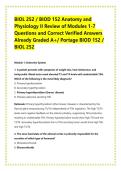
BIOL 252 / BIOD 152 Anatomy and
Physiology II Review of Modules 1-7
Questions and Correct Verified Answers
Already Graded A+/ Portage BIOD 152 /
BIOL 252
Module 1: Endocrine System
1. A patient presents with symptoms of weight loss, heat intolerance, and
tachycardia. Blood tests reveal elevated T3 and T4 levels with undetectable TSH.
Which of the following is the most likely diagnosis?
A. Primary hypothyroidism
B. Secondary hyperthyroidism
C. Primary hyperthyroidism (Graves' disease)
D. Pituitary adenoma secreting TSH
Rationale: Primary hyperthyroidism (often Graves' disease) is characterized by the
thyroid gland overproducing T3/T4 independently of TSH regulation. The high T3/T4
levels exert negative feedback on the anterior pituitary, suppressing TSH production,
resulting in undetectable TSH. Primary hypothyroidism would show high TSH and low
T3/T4. Secondary hyperthyroidism from a TSH-secreting tumor would show high TSH
and high T3/T4.
2. The zona fasciculata of the adrenal cortex is primarily responsible for the
secretion of which type of hormone?
A. Mineralocorticoids
B. Glucocorticoids
,C. Androgens
D. Catecholamines
Rationale: The adrenal cortex has three layers: zona glomerulosa (mineralocorticoids
like aldosterone), zona fasciculata (glucocorticoids like cortisol), and zona reticularis
(gonadocorticoids/androgens). Catecholamines (epinephrine/norepinephrine) are
produced by the adrenal medulla, not the cortex.
3. Vasopressin (ADH) and Oxytocin are synthesized in the hypothalamus but
stored and released from the posterior pituitary. Which transport mechanism is
responsible for moving these hormones from the hypothalamus to the posterior
pituitary?
A. The hypothalamic-hypophyseal portal system
B. Axonal transport via the hypothalamic-hypophyseal tract
C. Simple diffusion through the interstitial fluid
D. Active transport across the blood-brain barrier
Rationale: The posterior pituitary (neurohypophysis) is composed of neural tissue. It
stores and releases hormones that are synthesized in the hypothalamic nuclei
(supraoptic and paraventricular) and transported down the axons of the hypothalamic-
hypophyseal tract. The portal system is a vascular connection used to transport
releasing/inhibiting hormones from the hypothalamus to the anterior pituitary.
Module 2: Cardiovascular System - Heart
4. During the cardiac cycle, the 'dub' sound (S2) of the heart is produced by which
event?
A. The closing of the atrioventricular (AV) valves
B. The closing of the semilunar valves
C. The opening of the AV valves
D. Turbulent blood flow during ventricular ejection
,Rationale: The 'lub' sound (S1) is caused by the closure of the AV valves (tricuspid and
mitral) at the beginning of ventricular systole. The 'dub' sound (S2) is caused by the
closure of the semilunar valves (aortic and pulmonary) at the beginning of ventricular
diastole.
5. The QRS complex on an electrocardiogram (ECG) directly corresponds to which
physiological event?
A. Atrial depolarization
B. Ventricular depolarization
C. Atrial repolarization
D. Ventricular repolarization
Rationale: The P wave represents atrial depolarization. The QRS complex represents the
rapid depolarization of the ventricles, which triggers ventricular contraction. The T wave
represents ventricular repolarization. Atrial repolarization is a small signal that is
generally masked by the larger QRS complex.
6. If the stroke volume is 70 mL/beat and the heart rate is 72 beats per minute,
what is the cardiac output?
A. 5.0 L/min
B. 5.04 L/min
C. 4.9 L/min
D. 5040 mL/min
Rationale: Cardiac Output (CO) = Heart Rate (HR) x Stroke Volume (SV). CO = 72
beats/min * 70 mL/beat = 5040 mL/min. To convert to liters, divide by 1000:
= 5.04 L/min.
Module 3: Cardiovascular System - Blood Vessels and Circulation
7. In which type of blood vessel does the exchange of gases, nutrients, and wastes
primarily occur?
A. Arterioles
, B. Venules
C. Capillaries
D. Veins
Rationale: Capillaries are the smallest blood vessels and form extensive networks
(capillary beds) throughout the body. Their walls are only one cell thick (tunica intima),
which facilitates the diffusion of substances between the blood and the interstitial fluid
(tissue fluid).
8. A patient has a blood pressure reading of 140/90 mmHg. Which of the
following correctly identifies the systolic and diastolic pressures and the
corresponding phase of the cardiac cycle?
A. Systolic (90 mmHg) during ventricular diastole; Diastolic (140 mmHg) during
ventricular systole.
B. Systolic (140 mmHg) during ventricular diastole; Diastolic (90 mmHg) during
ventricular systole.
C. Systolic (140 mmHg) during ventricular systole; Diastolic (90 mmHg) during
ventricular diastole.
D. Systolic (90 mmHg) during atrial systole; Diastolic (140 mmHg) during ventricular
systole.
Rationale: Blood pressure is recorded as systolic over diastolic. Systolic pressure is the
maximum pressure in the arteries during ventricular systole (contraction). Diastolic
pressure is the minimum pressure in the arteries during ventricular diastole (relaxation).
The normal reading is around 120/80, so this reading is elevated.
Module 4: Lymphatic System and Immunity
9. The primary function of the lymphatic system includes all of the following
EXCEPT:
A. Returning interstitial fluid to the bloodstream
B. Transporting dietary lipids from the small intestine
Physiology II Review of Modules 1-7
Questions and Correct Verified Answers
Already Graded A+/ Portage BIOD 152 /
BIOL 252
Module 1: Endocrine System
1. A patient presents with symptoms of weight loss, heat intolerance, and
tachycardia. Blood tests reveal elevated T3 and T4 levels with undetectable TSH.
Which of the following is the most likely diagnosis?
A. Primary hypothyroidism
B. Secondary hyperthyroidism
C. Primary hyperthyroidism (Graves' disease)
D. Pituitary adenoma secreting TSH
Rationale: Primary hyperthyroidism (often Graves' disease) is characterized by the
thyroid gland overproducing T3/T4 independently of TSH regulation. The high T3/T4
levels exert negative feedback on the anterior pituitary, suppressing TSH production,
resulting in undetectable TSH. Primary hypothyroidism would show high TSH and low
T3/T4. Secondary hyperthyroidism from a TSH-secreting tumor would show high TSH
and high T3/T4.
2. The zona fasciculata of the adrenal cortex is primarily responsible for the
secretion of which type of hormone?
A. Mineralocorticoids
B. Glucocorticoids
,C. Androgens
D. Catecholamines
Rationale: The adrenal cortex has three layers: zona glomerulosa (mineralocorticoids
like aldosterone), zona fasciculata (glucocorticoids like cortisol), and zona reticularis
(gonadocorticoids/androgens). Catecholamines (epinephrine/norepinephrine) are
produced by the adrenal medulla, not the cortex.
3. Vasopressin (ADH) and Oxytocin are synthesized in the hypothalamus but
stored and released from the posterior pituitary. Which transport mechanism is
responsible for moving these hormones from the hypothalamus to the posterior
pituitary?
A. The hypothalamic-hypophyseal portal system
B. Axonal transport via the hypothalamic-hypophyseal tract
C. Simple diffusion through the interstitial fluid
D. Active transport across the blood-brain barrier
Rationale: The posterior pituitary (neurohypophysis) is composed of neural tissue. It
stores and releases hormones that are synthesized in the hypothalamic nuclei
(supraoptic and paraventricular) and transported down the axons of the hypothalamic-
hypophyseal tract. The portal system is a vascular connection used to transport
releasing/inhibiting hormones from the hypothalamus to the anterior pituitary.
Module 2: Cardiovascular System - Heart
4. During the cardiac cycle, the 'dub' sound (S2) of the heart is produced by which
event?
A. The closing of the atrioventricular (AV) valves
B. The closing of the semilunar valves
C. The opening of the AV valves
D. Turbulent blood flow during ventricular ejection
,Rationale: The 'lub' sound (S1) is caused by the closure of the AV valves (tricuspid and
mitral) at the beginning of ventricular systole. The 'dub' sound (S2) is caused by the
closure of the semilunar valves (aortic and pulmonary) at the beginning of ventricular
diastole.
5. The QRS complex on an electrocardiogram (ECG) directly corresponds to which
physiological event?
A. Atrial depolarization
B. Ventricular depolarization
C. Atrial repolarization
D. Ventricular repolarization
Rationale: The P wave represents atrial depolarization. The QRS complex represents the
rapid depolarization of the ventricles, which triggers ventricular contraction. The T wave
represents ventricular repolarization. Atrial repolarization is a small signal that is
generally masked by the larger QRS complex.
6. If the stroke volume is 70 mL/beat and the heart rate is 72 beats per minute,
what is the cardiac output?
A. 5.0 L/min
B. 5.04 L/min
C. 4.9 L/min
D. 5040 mL/min
Rationale: Cardiac Output (CO) = Heart Rate (HR) x Stroke Volume (SV). CO = 72
beats/min * 70 mL/beat = 5040 mL/min. To convert to liters, divide by 1000:
= 5.04 L/min.
Module 3: Cardiovascular System - Blood Vessels and Circulation
7. In which type of blood vessel does the exchange of gases, nutrients, and wastes
primarily occur?
A. Arterioles
, B. Venules
C. Capillaries
D. Veins
Rationale: Capillaries are the smallest blood vessels and form extensive networks
(capillary beds) throughout the body. Their walls are only one cell thick (tunica intima),
which facilitates the diffusion of substances between the blood and the interstitial fluid
(tissue fluid).
8. A patient has a blood pressure reading of 140/90 mmHg. Which of the
following correctly identifies the systolic and diastolic pressures and the
corresponding phase of the cardiac cycle?
A. Systolic (90 mmHg) during ventricular diastole; Diastolic (140 mmHg) during
ventricular systole.
B. Systolic (140 mmHg) during ventricular diastole; Diastolic (90 mmHg) during
ventricular systole.
C. Systolic (140 mmHg) during ventricular systole; Diastolic (90 mmHg) during
ventricular diastole.
D. Systolic (90 mmHg) during atrial systole; Diastolic (140 mmHg) during ventricular
systole.
Rationale: Blood pressure is recorded as systolic over diastolic. Systolic pressure is the
maximum pressure in the arteries during ventricular systole (contraction). Diastolic
pressure is the minimum pressure in the arteries during ventricular diastole (relaxation).
The normal reading is around 120/80, so this reading is elevated.
Module 4: Lymphatic System and Immunity
9. The primary function of the lymphatic system includes all of the following
EXCEPT:
A. Returning interstitial fluid to the bloodstream
B. Transporting dietary lipids from the small intestine


