

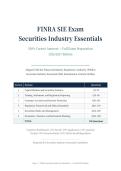
FINRA SIE Exam
Securities Industry Essentials
100% Correct Answers — Full Exam Preparation
2026/2027 Edition
Aligned with the Financial Industry Regulatory Authority (FINRA)
Securities Industry Essentials (SIE) Examination Content Outline
Section Domain Questions
1 Capital Markets and Securities Products Q1–50
2 Trading, Settlement, and Regulatory Reporting Q51–80
3 Customer Accounts and Investor Protection Q81–110
4 Regulatory Framework and Ethical Standards Q111–150
5 Investment Risks and Management Q151–180
6 Economics, Taxation, and Retirement Planning Q181–200
TOTAL 200 Questions
Cognitive Distribution: 25% Recall | 50% Application | 25% Analysis
Format: 70% Scenario-Based | 30% Direct Recall/Regulation
Prepared for Securities Industry Essentials Candidates
Page 1 | FINRA Securities Industry Essentials | © 2026/2027 Edition
,FINRA SIE Exam – 2026/2027 Edition 100% Correct Answers | Full Exam Preparation
Section 1: Capital Markets and Securities Products (Q1–50)
Domain coverage: Market Structure | Equity Securities | Debt Securities | Investment Products. Cognitive
mix: 25% recall | 50% application | 25% analysis.
Q1. A company issues 5 million shares of common stock to the public for the first time
through an investment bank that underwrites the offering on a firm-commitment basis.
This transaction occurs in which market?
A. Secondary market
B. Fourth market
C. Primary market [CORRECT]
D. Third market
Correct Answer: C
Rationale:
The primary market is where new securities are sold to investors for the first time, with proceeds going
to the issuer. A firm-commitment underwriting means the investment bank purchases the shares from
the issuer and resells them to the public, bearing the risk. The secondary market (e.g., NYSE, Nasdaq)
is for trading existing shares among investors. Third market involves exchange-listed securities traded
OTC, and fourth market is institutional trading without brokers.
Q2. An investor purchases 100 shares of ABC common stock at $50 per share in a cash
account. ABC pays a quarterly dividend of $0.50 per share. What is the investor's annual
dividend income from this position?
A. $50
B. $100
C. $200 [CORRECT]
D. $400
Correct Answer: C
Rationale:
Annual dividend = quarterly dividend x 4 quarters x number of shares. $0.50 x 4 = $2.00 annual
dividend per share; $2.00 x 100 shares = $200. Common stock dividends are not guaranteed and may be
reduced or eliminated at the board's discretion. The investor must also consider the ex-dividend date:
to receive the dividend, the investor must be the holder of record, which requires purchasing before
the ex-dividend date.
Page 2 | FINRA Securities Industry Essentials | © 2026/2027 Edition
,FINRA SIE Exam – 2026/2027 Edition 100% Correct Answers | Full Exam Preparation
Q3. Which feature distinguishes cumulative preferred stock from non-cumulative
preferred stock?
A. Cumulative preferred pays higher dividends
B. Cumulative preferred accumulates missed dividends that must be paid before common
dividends [CORRECT]
C. Cumulative preferred has voting rights
D. Cumulative preferred is convertible to common
Correct Answer: B
Rationale:
Cumulative preferred stock accumulates any dividends that are missed (in arrears) and must be paid in
full before any common stock dividends can be declared. Non-cumulative preferred does not
accumulate missed dividends—if a dividend is skipped, it is lost forever. This cumulative feature
makes cumulative preferred more protective of the investor during periods of corporate financial
difficulty. Convertibility and voting rights are separate features that may or may not be attached to
either type.
Q4. A corporation announces a 2-for-1 stock split. Prior to the split, an investor owns
200 shares at $80 per share. After the split, how many shares will the investor own and
what is the approximate price per share?
A. 100 shares at $160
B. 200 shares at $80
C. 400 shares at $40 [CORRECT]
D. 400 shares at $80
Correct Answer: C
Rationale:
In a 2-for-1 stock split, the number of shares doubles and the price per share is halved, keeping total
market value constant. 200 shares x 2 = 400 shares; $ = $40 per share. Total value remains 200 x
$80 = $16,000 = 400 x $40 = $16,000. Unlike a stock dividend, a split does not change the proportional
ownership or any accounting equity account balances—it just re-denominates the ownership units.
Page 3 | FINRA Securities Industry Essentials | © 2026/2027 Edition
, FINRA SIE Exam – 2026/2027 Edition 100% Correct Answers | Full Exam Preparation
Q5. A shareholder receives a right offering allowing them to purchase one new share for
every five shares held, at a subscription price of $30, when the market price is $40.
What is the approximate theoretical value of one right during the subscription period
(ex-rights)?
A. $1.67 [CORRECT]
B. $2.00
C. $10.00
D. $5.00
Correct Answer: A
Rationale:
The theoretical value of a right during the subscription period (cum-rights has already passed) is
calculated as: (Market price - Subscription price) / (Number of rights needed + 1). However, during the
ex-rights period, the formula is (Market price - Subscription price) / Number of rights needed.
Wait—the standard exam formula during the cum-rights period is (M - S) / (N + 1) = (40 - 30) / (5 + 1) =
$1.67. During ex-rights, the formula is (M - S) / N. The question asks during the subscription period
(cum-rights). Correct calculation: $1.67.
Q6. A warrant differs from a right in which of the following ways?
A. Warrants are short-term; rights are long-term
B. Warrants are long-term (often years); rights are short-term (weeks) [CORRECT]
C. Warrants give voting rights; rights do not
D. Warrants are issued only by governments; rights by corporations
Correct Answer: B
Rationale:
Warrants are long-term purchase rights to buy stock from the issuer, typically lasting several years
(often 2-5 years or longer). Rights are short-term (typically 2-4 weeks) subscription privileges allowing
existing shareholders to buy new shares at a discount before the public offering. Both give the holder
the right to buy stock at a fixed price. Warrants are often attached to bond issues as a 'sweetener,' while
rights preserve existing shareholders' proportionate ownership.
Q7. Which of the following is a characteristic of American Depositary Receipts (ADRs)?
A. ADRs represent ownership in U.S. companies held by foreign investors
B. ADRs are issued by U.S. banks and represent shares of foreign stock held on deposit
[CORRECT]
C. ADRs can only be purchased by institutional investors
D. ADRs pay dividends only in the foreign currency
Correct Answer: B
Rationale:
American Depositary Receipts (ADRs) are issued by U.S. banks and represent shares of foreign stock
held on deposit in the bank's foreign branch or custodian. ADRs trade in U.S. dollars on U.S. exchanges
and pay dividends in U.S. dollars, simplifying foreign investment for U.S. investors. They eliminate the
need for currency conversion and foreign custody arrangements. ADR holders may have reduced
voting rights compared to direct foreign share ownership.
Page 4 | FINRA Securities Industry Essentials | © 2026/2027 Edition
Securities Industry Essentials
100% Correct Answers — Full Exam Preparation
2026/2027 Edition
Aligned with the Financial Industry Regulatory Authority (FINRA)
Securities Industry Essentials (SIE) Examination Content Outline
Section Domain Questions
1 Capital Markets and Securities Products Q1–50
2 Trading, Settlement, and Regulatory Reporting Q51–80
3 Customer Accounts and Investor Protection Q81–110
4 Regulatory Framework and Ethical Standards Q111–150
5 Investment Risks and Management Q151–180
6 Economics, Taxation, and Retirement Planning Q181–200
TOTAL 200 Questions
Cognitive Distribution: 25% Recall | 50% Application | 25% Analysis
Format: 70% Scenario-Based | 30% Direct Recall/Regulation
Prepared for Securities Industry Essentials Candidates
Page 1 | FINRA Securities Industry Essentials | © 2026/2027 Edition
,FINRA SIE Exam – 2026/2027 Edition 100% Correct Answers | Full Exam Preparation
Section 1: Capital Markets and Securities Products (Q1–50)
Domain coverage: Market Structure | Equity Securities | Debt Securities | Investment Products. Cognitive
mix: 25% recall | 50% application | 25% analysis.
Q1. A company issues 5 million shares of common stock to the public for the first time
through an investment bank that underwrites the offering on a firm-commitment basis.
This transaction occurs in which market?
A. Secondary market
B. Fourth market
C. Primary market [CORRECT]
D. Third market
Correct Answer: C
Rationale:
The primary market is where new securities are sold to investors for the first time, with proceeds going
to the issuer. A firm-commitment underwriting means the investment bank purchases the shares from
the issuer and resells them to the public, bearing the risk. The secondary market (e.g., NYSE, Nasdaq)
is for trading existing shares among investors. Third market involves exchange-listed securities traded
OTC, and fourth market is institutional trading without brokers.
Q2. An investor purchases 100 shares of ABC common stock at $50 per share in a cash
account. ABC pays a quarterly dividend of $0.50 per share. What is the investor's annual
dividend income from this position?
A. $50
B. $100
C. $200 [CORRECT]
D. $400
Correct Answer: C
Rationale:
Annual dividend = quarterly dividend x 4 quarters x number of shares. $0.50 x 4 = $2.00 annual
dividend per share; $2.00 x 100 shares = $200. Common stock dividends are not guaranteed and may be
reduced or eliminated at the board's discretion. The investor must also consider the ex-dividend date:
to receive the dividend, the investor must be the holder of record, which requires purchasing before
the ex-dividend date.
Page 2 | FINRA Securities Industry Essentials | © 2026/2027 Edition
,FINRA SIE Exam – 2026/2027 Edition 100% Correct Answers | Full Exam Preparation
Q3. Which feature distinguishes cumulative preferred stock from non-cumulative
preferred stock?
A. Cumulative preferred pays higher dividends
B. Cumulative preferred accumulates missed dividends that must be paid before common
dividends [CORRECT]
C. Cumulative preferred has voting rights
D. Cumulative preferred is convertible to common
Correct Answer: B
Rationale:
Cumulative preferred stock accumulates any dividends that are missed (in arrears) and must be paid in
full before any common stock dividends can be declared. Non-cumulative preferred does not
accumulate missed dividends—if a dividend is skipped, it is lost forever. This cumulative feature
makes cumulative preferred more protective of the investor during periods of corporate financial
difficulty. Convertibility and voting rights are separate features that may or may not be attached to
either type.
Q4. A corporation announces a 2-for-1 stock split. Prior to the split, an investor owns
200 shares at $80 per share. After the split, how many shares will the investor own and
what is the approximate price per share?
A. 100 shares at $160
B. 200 shares at $80
C. 400 shares at $40 [CORRECT]
D. 400 shares at $80
Correct Answer: C
Rationale:
In a 2-for-1 stock split, the number of shares doubles and the price per share is halved, keeping total
market value constant. 200 shares x 2 = 400 shares; $ = $40 per share. Total value remains 200 x
$80 = $16,000 = 400 x $40 = $16,000. Unlike a stock dividend, a split does not change the proportional
ownership or any accounting equity account balances—it just re-denominates the ownership units.
Page 3 | FINRA Securities Industry Essentials | © 2026/2027 Edition
, FINRA SIE Exam – 2026/2027 Edition 100% Correct Answers | Full Exam Preparation
Q5. A shareholder receives a right offering allowing them to purchase one new share for
every five shares held, at a subscription price of $30, when the market price is $40.
What is the approximate theoretical value of one right during the subscription period
(ex-rights)?
A. $1.67 [CORRECT]
B. $2.00
C. $10.00
D. $5.00
Correct Answer: A
Rationale:
The theoretical value of a right during the subscription period (cum-rights has already passed) is
calculated as: (Market price - Subscription price) / (Number of rights needed + 1). However, during the
ex-rights period, the formula is (Market price - Subscription price) / Number of rights needed.
Wait—the standard exam formula during the cum-rights period is (M - S) / (N + 1) = (40 - 30) / (5 + 1) =
$1.67. During ex-rights, the formula is (M - S) / N. The question asks during the subscription period
(cum-rights). Correct calculation: $1.67.
Q6. A warrant differs from a right in which of the following ways?
A. Warrants are short-term; rights are long-term
B. Warrants are long-term (often years); rights are short-term (weeks) [CORRECT]
C. Warrants give voting rights; rights do not
D. Warrants are issued only by governments; rights by corporations
Correct Answer: B
Rationale:
Warrants are long-term purchase rights to buy stock from the issuer, typically lasting several years
(often 2-5 years or longer). Rights are short-term (typically 2-4 weeks) subscription privileges allowing
existing shareholders to buy new shares at a discount before the public offering. Both give the holder
the right to buy stock at a fixed price. Warrants are often attached to bond issues as a 'sweetener,' while
rights preserve existing shareholders' proportionate ownership.
Q7. Which of the following is a characteristic of American Depositary Receipts (ADRs)?
A. ADRs represent ownership in U.S. companies held by foreign investors
B. ADRs are issued by U.S. banks and represent shares of foreign stock held on deposit
[CORRECT]
C. ADRs can only be purchased by institutional investors
D. ADRs pay dividends only in the foreign currency
Correct Answer: B
Rationale:
American Depositary Receipts (ADRs) are issued by U.S. banks and represent shares of foreign stock
held on deposit in the bank's foreign branch or custodian. ADRs trade in U.S. dollars on U.S. exchanges
and pay dividends in U.S. dollars, simplifying foreign investment for U.S. investors. They eliminate the
need for currency conversion and foreign custody arrangements. ADR holders may have reduced
voting rights compared to direct foreign share ownership.
Page 4 | FINRA Securities Industry Essentials | © 2026/2027 Edition


