

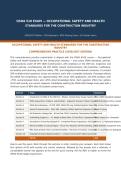
OSHA 510 EXAM — OCCUPATIONAL SAFETY AND HEALTH
STANDARDS FOR THE CONSTRUCTION INDUSTRY
2026/2027 Edition • 200 Questions • 80% Passing Score • 26 Contact Hours
OSHA 510 EXAM
OCCUPATIONAL SAFETY AND HEALTH STANDARDS FOR THE CONSTRUCTION
INDUSTRY
COMPREHENSIVE PRACTICE (2026/2027 EDITION)
This comprehensive practice examination is aligned with the OSHA #510 course — Occupational
Safety and Health Standards for the Construction Industry — and covers OSHA standards, policies,
and procedures under 29 CFR 1926 (Construction), with emphasis on the OSH Act, inspection and
citation policies, recordkeeping (29 CFR 1904), hazard communication, fall protection, scaffolding,
excavation and trenching, electrical safety, PPE, and integrated multi-domain scenarios. It contains
200 multiple-choice questions across ten sections, each with a complete rationale. Coverage reflects
the OSHA 510 competency mix: approximately 30% recall, 50% application, and 20% analysis, with
≈75% scenario-based items and ≈25% direct-knowledge items. Each question offers four options
(A–D) with exactly one correct response. Candidates seeking the OSHA #510 badge must pass with a
minimum score of 80% after 26 student contact hours.
Section Topic Questions
Section 1 Introduction to OSHA & The OSH Act – Mission, General Duty Clause, Section 11(c),
25 OSHA Standards Categorie
Section 2 OSHA Inspections, Citations, and Penalties – Inspection Process, Citation Types,
30Multi-Employer Policy, Penalty
Section 3 OSHA Recordkeeping – 29 CFR 1904, OSHA 300 Log, Fatality/Inpatient Reporting,
20 Incident Rate Calculation
Section 4 Hazard Communication – GHS, SDS, Labeling, Written HazCom Programs, Employee
15 Training
Section 5 Fall Protection (Subpart M) – 6-Foot Rule, PFAS, Guardrails, Deceleration Distance
25 Limit
Section 6 Scaffolding (Subpart L) – 4:1 Height-to-Base Ratio, 10-Foot Rule, Competent Person
20 Inspections, Guardrails
Section 7 Excavation & Trenching (Subpart P) – Competent Person Inspections, Soil Types
15 (A, B, C), Protective Systems
Section 8 Electrical Safety & Lockout/Tagout – Focus Four Hazards, 50-Volt Guarding, Circuit
15 Breakers, Equipment Groun
Section 9 PPE, Hand & Power Tools, and General Safety – Hierarchy of Controls, Competent
20 vs. Qualified, Fire Extinguish
Section 10 Integrated Scenario-Based Questions – Complex Construction Safety Scenarios
15
TOTAL 200
How to use this exam: Work through the sections in order, marking your answers. Each item shows
four options (A–D) with exactly one correct response, followed by the answer and a rationale. A
consolidated answer key appears at the end for quick scoring. Aim for 80% or higher to mirror the
OSHA #510 badge requirement.
,OSHA 510 EXAM — OCCUPATIONAL SAFETY AND HEALTH STANDARDS FOR THE CONSTRUCTION INDUSTRY 2026/2027 Edition
Section 1: Introduction to OSHA & The OSH Act – Mission, General Duty Clause,
Section 11(c), OSHA Standards Categories
Q1: The OSH Act was signed into law in which year?
A. 1968
B. 1970 [CORRECT]
C. 1975
D. 1980
Correct Answer: B
Rationale: President Nixon signed the OSH Act on December 29, 1970, creating OSHA.
Q2: The mission of OSHA is to:
A. provide health insurance for workers
B. assure safe and healthful working conditions by setting and enforcing standards and providing
training, outreach, education, and assistance [CORRECT]
C. regulate consumer product safety
D. manage workers' compensation claims
Correct Answer: B
Rationale: OSHA's mission is to assure safe and healthful working conditions through standards, enforcement,
training, outreach, and education.
Q3: The General Duty Clause is found in which section of the OSH Act?
A. Section 5(a)(1) [CORRECT]
B. Section 11(c)
C. Section 6(b)
D. Section 8(a)
Correct Answer: A
Rationale: Section 5(a)(1) is the General Duty Clause, requiring employers to furnish workplaces free from
recognized hazards.
Q4: Under the General Duty Clause, employers must:
A. furnish a place of employment free from recognized hazards that cause or are likely to cause death or
serious physical harm [CORRECT]
B. provide free PPE for all family members
C. eliminate every hazard regardless of cost
D. report minor injuries weekly
Correct Answer: A
Rationale: The General Duty Clause requires a workplace free from recognized hazards likely to cause death or
serious physical harm.
Q5: Section 11(c) of the OSH Act protects workers who:
A. refuse to work overtime
B. report safety concerns or file complaints from employer retaliation [CORRECT]
C. request higher pay
D. join a labor union
Correct Answer: B
Rationale: Section 11(c) prohibits retaliation against employees who exercise their OSHA rights, such as filing
complaints.
Page 2 of 37
,OSHA 510 EXAM — OCCUPATIONAL SAFETY AND HEALTH STANDARDS FOR THE CONSTRUCTION INDUSTRY 2026/2027 Edition
Q6: The four major categories of OSHA standards are:
A. General Industry, Construction, Maritime, and Agriculture [CORRECT]
B. Office, Retail, Manufacturing, and Farming
C. Federal, State, Local, and Private
D. Chemical, Electrical, Mechanical, and Structural
Correct Answer: A
Rationale: OSHA standards are organized into General Industry (1910), Construction (1926), Maritime, and
Agriculture.
Q7: Construction industry standards are published in:
A. 29 CFR 1926 [CORRECT]
B. 29 CFR 1910
C. 29 CFR 1904
D. 40 CFR
Correct Answer: A
Rationale: Construction standards appear in 29 CFR 1926; General Industry is 1910.
Q8: General industry standards are published in:
A. 29 CFR 1910 [CORRECT]
B. 29 CFR 1926
C. 29 CFR 1904
D. 29 CFR 1960
Correct Answer: A
Rationale: 29 CFR 1910 contains the general industry standards.
Q9: The OSHA poster that employers must display is titled:
A. Job Safety and Health: It's the Law [CORRECT]
B. Workers' Rights Handbook
C. OSHA 300 Log
D. Right to Know Act
Correct Answer: A
Rationale: Employers must display the 'Job Safety and Health: It's the Law' poster in a prominent location.
Q10: OSHA is an agency within which federal department?
A. Department of Labor [CORRECT]
B. Department of Health and Human Services
C. Department of Commerce
D. Department of Homeland Security
Correct Answer: A
Rationale: OSHA is an agency within the U.S. Department of Labor.
Q11: NIOSH is primarily responsible for:
A. research and recommendations for workplace safety and health [CORRECT]
B. issuing citations and fines
C. writing workers' compensation laws
D. certifying personal protective equipment
Correct Answer: A
Rationale: NIOSH conducts research and makes recommendations; OSHA sets and enforces standards.
Page 3 of 37
, OSHA 510 EXAM — OCCUPATIONAL SAFETY AND HEALTH STANDARDS FOR THE CONSTRUCTION INDUSTRY 2026/2027 Edition
Q12: A state may operate its own occupational safety and health program if:
A. the plan is approved by OSHA and is at least as effective as federal OSHA [CORRECT]
B. the governor requests it informally
C. it covers only construction
D. it exempts small employers
Correct Answer: A
Rationale: State plans must be approved by OSHA and be at least as effective as the federal program.
Q13: Which workers are generally NOT covered by federal OSHA?
A. Self-employed workers [CORRECT]
B. Private sector construction workers
C. Manufacturing employees
D. Retail employees
Correct Answer: A
Rationale: Self-employed workers are not covered by the OSH Act; private sector employees are covered.
Q14: A construction company has a recognized hazard with no specific OSHA standard covering it. OSHA
can still cite the employer using:
A. the General Duty Clause (Section 5(a)(1)) [CORRECT]
B. Section 11(c)
C. the Hazard Communication standard
D. the recordkeeping standard
Correct Answer: A
Rationale: When no specific standard applies, OSHA cites recognized hazards under the General Duty Clause.
Q15: An employer who receives a citation has how many working days to contest it?
A. 15 [CORRECT]
B. 7
C. 30
D. 60
Correct Answer: A
Rationale: Employers have 15 working days to file a Notice of Contest.
Q16: A worker reports a hazard to OSHA. Under Section 11(c), the employer:
A. may not retaliate against the worker [CORRECT]
B. may demote the worker
C. may reduce the worker's hours
D. may fire the worker
Correct Answer: A
Rationale: Section 11(c) prohibits retaliation against workers who report hazards.
Q17: An employee complaint to OSHA about a workplace hazard can trigger:
A. an inspection [CORRECT]
B. an automatic fine
C. immediate shutdown
D. criminal charges
Correct Answer: A
Rationale: OSHA may conduct an inspection in response to an employee complaint.
Page 4 of 37
STANDARDS FOR THE CONSTRUCTION INDUSTRY
2026/2027 Edition • 200 Questions • 80% Passing Score • 26 Contact Hours
OSHA 510 EXAM
OCCUPATIONAL SAFETY AND HEALTH STANDARDS FOR THE CONSTRUCTION
INDUSTRY
COMPREHENSIVE PRACTICE (2026/2027 EDITION)
This comprehensive practice examination is aligned with the OSHA #510 course — Occupational
Safety and Health Standards for the Construction Industry — and covers OSHA standards, policies,
and procedures under 29 CFR 1926 (Construction), with emphasis on the OSH Act, inspection and
citation policies, recordkeeping (29 CFR 1904), hazard communication, fall protection, scaffolding,
excavation and trenching, electrical safety, PPE, and integrated multi-domain scenarios. It contains
200 multiple-choice questions across ten sections, each with a complete rationale. Coverage reflects
the OSHA 510 competency mix: approximately 30% recall, 50% application, and 20% analysis, with
≈75% scenario-based items and ≈25% direct-knowledge items. Each question offers four options
(A–D) with exactly one correct response. Candidates seeking the OSHA #510 badge must pass with a
minimum score of 80% after 26 student contact hours.
Section Topic Questions
Section 1 Introduction to OSHA & The OSH Act – Mission, General Duty Clause, Section 11(c),
25 OSHA Standards Categorie
Section 2 OSHA Inspections, Citations, and Penalties – Inspection Process, Citation Types,
30Multi-Employer Policy, Penalty
Section 3 OSHA Recordkeeping – 29 CFR 1904, OSHA 300 Log, Fatality/Inpatient Reporting,
20 Incident Rate Calculation
Section 4 Hazard Communication – GHS, SDS, Labeling, Written HazCom Programs, Employee
15 Training
Section 5 Fall Protection (Subpart M) – 6-Foot Rule, PFAS, Guardrails, Deceleration Distance
25 Limit
Section 6 Scaffolding (Subpart L) – 4:1 Height-to-Base Ratio, 10-Foot Rule, Competent Person
20 Inspections, Guardrails
Section 7 Excavation & Trenching (Subpart P) – Competent Person Inspections, Soil Types
15 (A, B, C), Protective Systems
Section 8 Electrical Safety & Lockout/Tagout – Focus Four Hazards, 50-Volt Guarding, Circuit
15 Breakers, Equipment Groun
Section 9 PPE, Hand & Power Tools, and General Safety – Hierarchy of Controls, Competent
20 vs. Qualified, Fire Extinguish
Section 10 Integrated Scenario-Based Questions – Complex Construction Safety Scenarios
15
TOTAL 200
How to use this exam: Work through the sections in order, marking your answers. Each item shows
four options (A–D) with exactly one correct response, followed by the answer and a rationale. A
consolidated answer key appears at the end for quick scoring. Aim for 80% or higher to mirror the
OSHA #510 badge requirement.
,OSHA 510 EXAM — OCCUPATIONAL SAFETY AND HEALTH STANDARDS FOR THE CONSTRUCTION INDUSTRY 2026/2027 Edition
Section 1: Introduction to OSHA & The OSH Act – Mission, General Duty Clause,
Section 11(c), OSHA Standards Categories
Q1: The OSH Act was signed into law in which year?
A. 1968
B. 1970 [CORRECT]
C. 1975
D. 1980
Correct Answer: B
Rationale: President Nixon signed the OSH Act on December 29, 1970, creating OSHA.
Q2: The mission of OSHA is to:
A. provide health insurance for workers
B. assure safe and healthful working conditions by setting and enforcing standards and providing
training, outreach, education, and assistance [CORRECT]
C. regulate consumer product safety
D. manage workers' compensation claims
Correct Answer: B
Rationale: OSHA's mission is to assure safe and healthful working conditions through standards, enforcement,
training, outreach, and education.
Q3: The General Duty Clause is found in which section of the OSH Act?
A. Section 5(a)(1) [CORRECT]
B. Section 11(c)
C. Section 6(b)
D. Section 8(a)
Correct Answer: A
Rationale: Section 5(a)(1) is the General Duty Clause, requiring employers to furnish workplaces free from
recognized hazards.
Q4: Under the General Duty Clause, employers must:
A. furnish a place of employment free from recognized hazards that cause or are likely to cause death or
serious physical harm [CORRECT]
B. provide free PPE for all family members
C. eliminate every hazard regardless of cost
D. report minor injuries weekly
Correct Answer: A
Rationale: The General Duty Clause requires a workplace free from recognized hazards likely to cause death or
serious physical harm.
Q5: Section 11(c) of the OSH Act protects workers who:
A. refuse to work overtime
B. report safety concerns or file complaints from employer retaliation [CORRECT]
C. request higher pay
D. join a labor union
Correct Answer: B
Rationale: Section 11(c) prohibits retaliation against employees who exercise their OSHA rights, such as filing
complaints.
Page 2 of 37
,OSHA 510 EXAM — OCCUPATIONAL SAFETY AND HEALTH STANDARDS FOR THE CONSTRUCTION INDUSTRY 2026/2027 Edition
Q6: The four major categories of OSHA standards are:
A. General Industry, Construction, Maritime, and Agriculture [CORRECT]
B. Office, Retail, Manufacturing, and Farming
C. Federal, State, Local, and Private
D. Chemical, Electrical, Mechanical, and Structural
Correct Answer: A
Rationale: OSHA standards are organized into General Industry (1910), Construction (1926), Maritime, and
Agriculture.
Q7: Construction industry standards are published in:
A. 29 CFR 1926 [CORRECT]
B. 29 CFR 1910
C. 29 CFR 1904
D. 40 CFR
Correct Answer: A
Rationale: Construction standards appear in 29 CFR 1926; General Industry is 1910.
Q8: General industry standards are published in:
A. 29 CFR 1910 [CORRECT]
B. 29 CFR 1926
C. 29 CFR 1904
D. 29 CFR 1960
Correct Answer: A
Rationale: 29 CFR 1910 contains the general industry standards.
Q9: The OSHA poster that employers must display is titled:
A. Job Safety and Health: It's the Law [CORRECT]
B. Workers' Rights Handbook
C. OSHA 300 Log
D. Right to Know Act
Correct Answer: A
Rationale: Employers must display the 'Job Safety and Health: It's the Law' poster in a prominent location.
Q10: OSHA is an agency within which federal department?
A. Department of Labor [CORRECT]
B. Department of Health and Human Services
C. Department of Commerce
D. Department of Homeland Security
Correct Answer: A
Rationale: OSHA is an agency within the U.S. Department of Labor.
Q11: NIOSH is primarily responsible for:
A. research and recommendations for workplace safety and health [CORRECT]
B. issuing citations and fines
C. writing workers' compensation laws
D. certifying personal protective equipment
Correct Answer: A
Rationale: NIOSH conducts research and makes recommendations; OSHA sets and enforces standards.
Page 3 of 37
, OSHA 510 EXAM — OCCUPATIONAL SAFETY AND HEALTH STANDARDS FOR THE CONSTRUCTION INDUSTRY 2026/2027 Edition
Q12: A state may operate its own occupational safety and health program if:
A. the plan is approved by OSHA and is at least as effective as federal OSHA [CORRECT]
B. the governor requests it informally
C. it covers only construction
D. it exempts small employers
Correct Answer: A
Rationale: State plans must be approved by OSHA and be at least as effective as the federal program.
Q13: Which workers are generally NOT covered by federal OSHA?
A. Self-employed workers [CORRECT]
B. Private sector construction workers
C. Manufacturing employees
D. Retail employees
Correct Answer: A
Rationale: Self-employed workers are not covered by the OSH Act; private sector employees are covered.
Q14: A construction company has a recognized hazard with no specific OSHA standard covering it. OSHA
can still cite the employer using:
A. the General Duty Clause (Section 5(a)(1)) [CORRECT]
B. Section 11(c)
C. the Hazard Communication standard
D. the recordkeeping standard
Correct Answer: A
Rationale: When no specific standard applies, OSHA cites recognized hazards under the General Duty Clause.
Q15: An employer who receives a citation has how many working days to contest it?
A. 15 [CORRECT]
B. 7
C. 30
D. 60
Correct Answer: A
Rationale: Employers have 15 working days to file a Notice of Contest.
Q16: A worker reports a hazard to OSHA. Under Section 11(c), the employer:
A. may not retaliate against the worker [CORRECT]
B. may demote the worker
C. may reduce the worker's hours
D. may fire the worker
Correct Answer: A
Rationale: Section 11(c) prohibits retaliation against workers who report hazards.
Q17: An employee complaint to OSHA about a workplace hazard can trigger:
A. an inspection [CORRECT]
B. an automatic fine
C. immediate shutdown
D. criminal charges
Correct Answer: A
Rationale: OSHA may conduct an inspection in response to an employee complaint.
Page 4 of 37


