
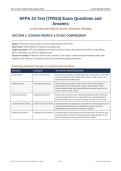
NFPA 24 TEST (TFM10) STUDY GUIDE & EXAM LATEST 2026-2027 UPDATE
NFPA 24 Test (TFM10) Exam Questions and
Answers
LATEST 2026-2027 UPDATE EXAM & TECHNICAL REVIEWS
SECTION 1: COURSE PROFILE & STUDY COMPENDIUM
Subject: Private Fire Service Mains and Their Appurtenances (NFPA 24)
Exam Code: TFM10 (State Fire Marshal Licensing Exam)
Target Standards: NFPA 24 (Installation of private fire service mains), with references to NFPA 13 (Sprinklers),
NFPA 20 (Pumps), and NFPA 25 (Maintenance).
Scope of Coverage: Private fire service mains, hydrants, hose outlets, control/check/post indicator valves, pipe
materials, joint restraints, thrust blocks, flushing, and hydrostatic testing procedures.
Commonly Confused Concepts in Private Fire Service Mains
Concept A Concept B The Crucial Technical Distinction
Control Valves Drain & Check Valves Control valves regulate or shut off water flow to the system. Under NFPA
24, they explicitly do NOT include drain, check, or relief valves, which
have independent auxiliary roles.
Hydrant Distance Post Indicator Distance Both must be located NOT LESS THAN 40 FT from the building to
prevent failure from wall collapse or radiant heat. However, their
physical heights above final grade differ (hydrant outlet center: 18-36
inches; PIV top: 32-40 inches).
Sub-Driveway Burial Standard Burial Cover Private mains crossing under roadways/driveways must be buried at a
minimum depth of 36 inches to bear traffic loads. Standard lawn/soil
burial where freezing is not a factor requires a minimum of 30 inches.
Combined Service Mains Private Fire Service Mains Combined mains are designed to carry water for both fire protection and
domestic/industrial processes. Dedicated fire service mains are
engineered solely to support fire protection systems.
System Flush Velocity Hydrostatic Test Pressure Flushing requires a high water velocity (not less than 10 ft/sec) to scour
and clear debris. Hydrostatic testing requires a gauge pressure of 200
psi (or 50 psi above working pressure) held for 2 hours.
NFPA 24 Private Fire Service Mains Test Bank Page 1 Technical Exam Prep
,NFPA 24 TEST (TFM10) STUDY GUIDE & EXAM LATEST 2026-2027 UPDATE
Core Learning Objectives & Licensing Competencies
• Submittal & AHJ Approval: Master the criteria for working plan preparation, review, and submittal prior to any
remodeling or new physical installation.
• Valving & Supervision: Correctly configure check valves, control valves, backflow preventers, and post indicator
valves. Identify where controls are prohibited (e.g., between the FDC and the main).
• Physical Foundations & Spacing: Memorize the critical physical heights, foundation elements (flat stones/slabs),
and distances (40 ft minimum) required for hydrants and post indicator valves.
• Piping Integrity & Burial: Calculate pressure ratings (minimum 150 psi), excavation depth limits, under-roadway
safety factors, and indoor covered trenches.
• Restraints & Thrust Controls: Specify the concrete mix ratios for thrust blocks (not leaner than 1:2.5:5) and steel
rod diameters (minimum 5/8 inch).
• Commissioning Protocol: Execute proper flushing (10 ft/sec until clear) and hydrostatic leakage testing (200 psi /
50 psi over working for 2 hours).
NFPA 24 Private Fire Service Mains Test Bank Page 2 Technical Exam Prep
, NFPA 24 TEST (TFM10) STUDY GUIDE & EXAM LATEST 2026-2027 UPDATE
SECTION 2: COMPREHENSIVE PRACTICE EXAM (50 QUESTIONS)
SECTION 1: GENERAL REQUIREMENTS, WORKING PLANS, AND APPROVALS
Question 1: According to NFPA 24, which type of piping system is specifically intended to carry water
for both fire service mains and domestic service mains?
A. Dedicated Fire Service Mains
B. Combined Service Mains
C. Primary Distribution Mains
D. Auxiliary Supply Mains
ANSWER : B — Combined Service Mains
Explanation: According to NFPA 24, a combined service main is a pipe system intended to carry water for both
fire service mains and domestic/industrial services. In contrast, dedicated fire service mains are reserved solely
for fire protection water supply.
Question 2: Before any private fire service main equipment is installed or remodeled, to which entity
must the working plans be submitted for approval?
A. The local plumbing inspector
B. The building owner's insurance underwriters
C. The Authority Having Jurisdiction (AHJ)
D. The general contracting company
ANSWER : C — The Authority Having Jurisdiction (AHJ)
Explanation: NFPA 24 explicitly states that working plans must be submitted for approval to the Authority Having
Jurisdiction (AHJ) before any equipment is installed or remodeled. This ensures compliance with local fire codes
and standard requirements prior to construction.
Question 3: Under the provisions of NFPA 24, which of the following devices are strictly prohibited from
being used in private fire service mains?
A. Pressure-Regulating devices
B. Post indicator valves
C. Check valves
D. Backflow preventers
ANSWER : A — Pressure-Regulating devices
Explanation: Pressure-regulating devices shall not be used in private fire service mains because they can restrict
water flow or fail under emergency conditions, potentially compromising the high-volume water supply required for
fire suppression. The other listed valves are standard components allowed under specific guidelines.
NFPA 24 Private Fire Service Mains Test Bank Page 3 Technical Exam Prep
NFPA 24 Test (TFM10) Exam Questions and
Answers
LATEST 2026-2027 UPDATE EXAM & TECHNICAL REVIEWS
SECTION 1: COURSE PROFILE & STUDY COMPENDIUM
Subject: Private Fire Service Mains and Their Appurtenances (NFPA 24)
Exam Code: TFM10 (State Fire Marshal Licensing Exam)
Target Standards: NFPA 24 (Installation of private fire service mains), with references to NFPA 13 (Sprinklers),
NFPA 20 (Pumps), and NFPA 25 (Maintenance).
Scope of Coverage: Private fire service mains, hydrants, hose outlets, control/check/post indicator valves, pipe
materials, joint restraints, thrust blocks, flushing, and hydrostatic testing procedures.
Commonly Confused Concepts in Private Fire Service Mains
Concept A Concept B The Crucial Technical Distinction
Control Valves Drain & Check Valves Control valves regulate or shut off water flow to the system. Under NFPA
24, they explicitly do NOT include drain, check, or relief valves, which
have independent auxiliary roles.
Hydrant Distance Post Indicator Distance Both must be located NOT LESS THAN 40 FT from the building to
prevent failure from wall collapse or radiant heat. However, their
physical heights above final grade differ (hydrant outlet center: 18-36
inches; PIV top: 32-40 inches).
Sub-Driveway Burial Standard Burial Cover Private mains crossing under roadways/driveways must be buried at a
minimum depth of 36 inches to bear traffic loads. Standard lawn/soil
burial where freezing is not a factor requires a minimum of 30 inches.
Combined Service Mains Private Fire Service Mains Combined mains are designed to carry water for both fire protection and
domestic/industrial processes. Dedicated fire service mains are
engineered solely to support fire protection systems.
System Flush Velocity Hydrostatic Test Pressure Flushing requires a high water velocity (not less than 10 ft/sec) to scour
and clear debris. Hydrostatic testing requires a gauge pressure of 200
psi (or 50 psi above working pressure) held for 2 hours.
NFPA 24 Private Fire Service Mains Test Bank Page 1 Technical Exam Prep
,NFPA 24 TEST (TFM10) STUDY GUIDE & EXAM LATEST 2026-2027 UPDATE
Core Learning Objectives & Licensing Competencies
• Submittal & AHJ Approval: Master the criteria for working plan preparation, review, and submittal prior to any
remodeling or new physical installation.
• Valving & Supervision: Correctly configure check valves, control valves, backflow preventers, and post indicator
valves. Identify where controls are prohibited (e.g., between the FDC and the main).
• Physical Foundations & Spacing: Memorize the critical physical heights, foundation elements (flat stones/slabs),
and distances (40 ft minimum) required for hydrants and post indicator valves.
• Piping Integrity & Burial: Calculate pressure ratings (minimum 150 psi), excavation depth limits, under-roadway
safety factors, and indoor covered trenches.
• Restraints & Thrust Controls: Specify the concrete mix ratios for thrust blocks (not leaner than 1:2.5:5) and steel
rod diameters (minimum 5/8 inch).
• Commissioning Protocol: Execute proper flushing (10 ft/sec until clear) and hydrostatic leakage testing (200 psi /
50 psi over working for 2 hours).
NFPA 24 Private Fire Service Mains Test Bank Page 2 Technical Exam Prep
, NFPA 24 TEST (TFM10) STUDY GUIDE & EXAM LATEST 2026-2027 UPDATE
SECTION 2: COMPREHENSIVE PRACTICE EXAM (50 QUESTIONS)
SECTION 1: GENERAL REQUIREMENTS, WORKING PLANS, AND APPROVALS
Question 1: According to NFPA 24, which type of piping system is specifically intended to carry water
for both fire service mains and domestic service mains?
A. Dedicated Fire Service Mains
B. Combined Service Mains
C. Primary Distribution Mains
D. Auxiliary Supply Mains
ANSWER : B — Combined Service Mains
Explanation: According to NFPA 24, a combined service main is a pipe system intended to carry water for both
fire service mains and domestic/industrial services. In contrast, dedicated fire service mains are reserved solely
for fire protection water supply.
Question 2: Before any private fire service main equipment is installed or remodeled, to which entity
must the working plans be submitted for approval?
A. The local plumbing inspector
B. The building owner's insurance underwriters
C. The Authority Having Jurisdiction (AHJ)
D. The general contracting company
ANSWER : C — The Authority Having Jurisdiction (AHJ)
Explanation: NFPA 24 explicitly states that working plans must be submitted for approval to the Authority Having
Jurisdiction (AHJ) before any equipment is installed or remodeled. This ensures compliance with local fire codes
and standard requirements prior to construction.
Question 3: Under the provisions of NFPA 24, which of the following devices are strictly prohibited from
being used in private fire service mains?
A. Pressure-Regulating devices
B. Post indicator valves
C. Check valves
D. Backflow preventers
ANSWER : A — Pressure-Regulating devices
Explanation: Pressure-regulating devices shall not be used in private fire service mains because they can restrict
water flow or fail under emergency conditions, potentially compromising the high-volume water supply required for
fire suppression. The other listed valves are standard components allowed under specific guidelines.
NFPA 24 Private Fire Service Mains Test Bank Page 3 Technical Exam Prep


