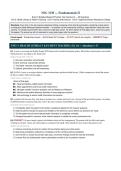
NSG 3130 — Fundamentals II
Exam 2 Syllabus Blueprint Practice Test (Version 2) — 50 Questions
Unit 3: Health Literacy & Patient Teaching · Unit 4: Activity and Exercise · Unit 5: Cognitive/Sensory Alterations & Sleep
Directions: Every item on this test requires interpreting findings, comparing similar clinical presentations, prioritizing nursing actions,
or recognizing subtle differences between disorders — no question can be answered by recalling a single definition. Read each stem
carefully. For standard and EXCEPT items, select the single best answer. For SATA (Select All That Apply) items, select every option
that applies. The answer key with full rationales for every option begins after the questions.
Format legend: Standard best-answer | [SATA] Select All That Apply | [EXCEPT] Identify the exception | [PRIORITY] Triage /
prioritization
UNIT 3: HEALTH LITERACY & PATIENT TEACHING (Ch. 14) — Questions 1–17
Q1. A nurse is reviewing the Healthy People 2030 framework for health information quality. Which three characteristics must health
information have according to this framework?
Healthy People 2030 - three A's
A. Accurate, accessible, and actionable
B. Brief, technical, and provider-directed
C. Translated, notarized, and digitally signed
D. Optional, generalized, and self-explanatory
Q2. [SATA] A nurse is assessing whether a patient demonstrates proficient health literacy. Which competencies should the patient
be able to exhibit? (Select all that apply.)
Health literacy competencies
Select all that apply.
■ 1. Read and identify credible health information
■ 2. Make appointments and fill out health-related forms
■ 3. Navigate complex insurance programs such as Medicare or Medicaid
■ 4. Memorize the medical dictionary definition of every diagnosis received
■ 5. Use technology to access health information and services
Q3. A patient tells the nurse they read about a treatment on a website and want to try it instead of the prescribed regimen. According
to QSEN principles for patient education, what is the nurse's primary responsibility in this situation?
Evaluating internet health sources
A. Immediately report the patient to the facility's compliance department for research purposes
B. Help the patient evaluate the quality and reliability of the electronic source before any decisions are made
C. Tell the patient that all internet-based health information is completely unreliable
D. Disregard the patient's comment, since internet research is outside the nurse's professional role
Q4. [PRIORITY] A nurse taught a patient with diabetes about sick-day management. The patient calls the office and reports
vomiting for the past 7 hours and a blood glucose reading of 320 mg/dL. What should the nurse instruct the patient to do?
Diabetic sick-day teaching
A. Continue monitoring at home for another 24 hours before taking any further action
B. Stop taking all diabetes medications immediately until the vomiting resolves completely
C. Go to the ED or contact the provider right away, since these findings exceed the sick-day thresholds
D. Increase fluid and carbohydrate intake substantially and wait to see if symptoms improve
,Q5. A discharge prescription is written using the abbreviation "PO" for an oral antibiotic. To prevent the kind of medication
misunderstanding described in the chapter, what should the nurse do when providing discharge instructions?
Preventing medication misunderstanding
A. Use the abbreviation as written, since caregivers are expected to already know standard medical abbreviations
B. Provide a printed handout with the abbreviation and skip any verbal review of the instructions
C. Assume the pharmacist will independently clarify the abbreviation without any nursing follow-up
D. Write out "by mouth" instead of using the abbreviation, and have the patient repeat the instructions back
Q6. A nurse combines a video, a printed handout, and a hands-on demonstration when teaching a patient a new skill, rather than
relying on just one teaching method. What is the primary rationale for this approach?
Multimodal teaching rationale
A. Most individuals learn through more than one method, and combining strategies and repetition enhances overall learning
B. Combining multiple methods is required just when a patient explicitly refuses all single-method teaching approaches
C. Using several methods guarantees the patient will retain 100% of the information taught in a single session
D. Combining methods is done mainly to reduce the total amount of time a teaching session takes
Q7. When presenting new health information to a patient, a nurse begins with concepts the patient already understands before
introducing more complex or abstract ideas. What principle of patient education does this approach reflect?
Sequencing content by complexity
A. Presenting the most complex information first ensures the patient stays engaged throughout the session
B. Presenting familiar concepts first and progressing to more complex ideas supports effective data integration
C. The order in which information is presented has no meaningful effect on a patient's ability to learn
D. Information should be presented in alphabetical order of topic to maintain consistency across sessions
Q8. A nurse is providing patient education during a home health visit. How does the home care setting change the nurse's approach to
patient teaching compared with the acute care setting?
Patient teaching in the home
A. The nurse has authority to make unilateral changes to the home environment without the patient's input
B. Patient teaching in the home requires no documentation, since usually one nurse is involved in care
C. The nurse is a guest in the home, visits are less frequent, and documentation must be available to all visiting staff
D. Insurance coverage for supplies and equipment is rarely a relevant consideration in home-based teaching
Q9. A nurse applies health literacy universal precautions when teaching every patient, regardless of their apparent education level.
What does this approach specifically involve?
Health literacy universal precautions
A. Providing detailed teaching just to patients who explicitly disclose a history of learning difficulties
B. Assuming that patients with advanced degrees rarely require any additional teaching support
C. Applying simplified teaching materials exclusively to pediatric patients and their caregivers
D. Presuming every patient may need some help with health literacy, similar to infection precautions
Q10. A nurse is delivering a lengthy patient education session covering several key points about a new diagnosis. According to
recommended practice, when should the nurse pause to reassess the patient's understanding?
Reassessing understanding during teaching
A. After every two to three key points, to confirm the patient remains engaged and ready to absorb more information
B. Just once, at the very end of the entire teaching session, regardless of its length
C. Just if the patient spontaneously interrupts the session to ask a question
D. Reassessment during a single teaching session is not a recommended or necessary practice
Q11. During a patient teaching session, a patient expresses confusion about instructions given earlier by another provider. What is
the most appropriate nursing action, consistent with the nurse's role in patient education?
Nurse as advocate in patient education
A. Tell the patient to simply guess at the intended meaning of the earlier instructions
B. Seek clarification from the other provider on the patient's behalf to ensure the instructions are accurate and understood
C. Avoid addressing the confusion, since clarifying another provider's instructions is outside the nurse's role
D. Instruct the patient to disregard the earlier instructions completely without further discussion
, Q12. A nurse is explaining to a colleague why addressing low health literacy is a patient safety priority. Which statement accurately
reflects the documented consequences of low health literacy?
Consequences of low health literacy
A. Low health literacy has been shown to have no measurable effect on hospitalization rates or health outcomes
B. Low health literacy primarily affects just the cost of care and has no relationship to patient mortality
C. Low health literacy is linked to higher death risk, more preventable hospitalizations, and greater care utilization
D. Low health literacy is a concern exclusively for pediatric patients and does not affect adult populations
Q13. A hospital offers a scheduled, structured class on managing a new ostomy, with defined learning objectives set in advance by
the nursing educator. Later, a different patient calls the outpatient clinic to ask an unplanned question about ostomy odor control.
How should the nurse categorize the second scenario?
Formal patient education settings
A. Formal education, since any interaction involving a nurse and clinical content is automatically considered formal
B. Neither formal nor informal education, since telephone-based teaching does not qualify as patient education
C. The same category as the ostomy class, since both scenarios involve the identical clinical topic
D. Informal education, since it is patient-initiated, situation specific, and not part of a preplanned session
Q14. A patient newly diagnosed with hypertension expresses that they now feel less afraid about managing the condition and are
willing to actively participate in developing their care plan. Which domain of learning does this response best reflect?
Domains of learning in practice
A. The affective domain, since it reflects the patient's feelings, attitudes, and willingness to engage
B. The cognitive domain, since it reflects the patient's ability to recall factual information about hypertension
C. The psychomotor domain, since it reflects the patient's ability to physically perform a health-related skill
D. None of the three domains of learning apply to this type of patient response
Q15. A nurse is preparing discharge materials for a patient with significant vision loss who cannot read standard printed handouts.
Which combination of materials would be most appropriate, based on recommended adaptations for this population?
Materials for vision loss
A. Standard-sized printed handouts alone, since font size does not affect accessibility for this population
B. Large-print material, Braille or audio materials, and verbal instructions with demonstration
C. Materials relying exclusively on captioned video content with no other adaptation offered
D. No materials at all, since patients with significant vision loss cannot benefit from any teaching aids
Q16. A nurse is developing a teaching plan for a patient whose cultural and religious beliefs affect attitudes toward a recommended
medical treatment. What is the most appropriate nursing approach?
Culturally sensitive patient teaching
A. Disregard the patient's cultural and religious beliefs completely when presenting the treatment information
B. Refuse to provide any education until the patient agrees to set aside their cultural or religious beliefs
C. Tailor education to align with the patient's cultural beliefs, since considered beliefs improve acceptance of care
D. Assume that cultural and religious beliefs rarely have any influence on a patient's acceptance of treatment
Q17. [PRIORITY] A nurse is about to begin discharge teaching for a patient who just received a new diagnosis of metastatic cancer
earlier that same morning. What is the priority consideration before proceeding with detailed teaching?
Complex teaching scenario prioritization
A. Proceed immediately with the full, detailed teaching plan regardless of the timing of the diagnosis
B. Assume the timing of the diagnosis has no bearing on the patient's readiness to receive new information
C. Delay all future teaching indefinitely without ever reassessing the patient's readiness to learn
D. Recognize that a patient who just received serious news will likely need more time to absorb new information
UNIT 4: ACTIVITY AND EXERCISE (Ch. 28) — Questions 18–34
Exam 2 Syllabus Blueprint Practice Test (Version 2) — 50 Questions
Unit 3: Health Literacy & Patient Teaching · Unit 4: Activity and Exercise · Unit 5: Cognitive/Sensory Alterations & Sleep
Directions: Every item on this test requires interpreting findings, comparing similar clinical presentations, prioritizing nursing actions,
or recognizing subtle differences between disorders — no question can be answered by recalling a single definition. Read each stem
carefully. For standard and EXCEPT items, select the single best answer. For SATA (Select All That Apply) items, select every option
that applies. The answer key with full rationales for every option begins after the questions.
Format legend: Standard best-answer | [SATA] Select All That Apply | [EXCEPT] Identify the exception | [PRIORITY] Triage /
prioritization
UNIT 3: HEALTH LITERACY & PATIENT TEACHING (Ch. 14) — Questions 1–17
Q1. A nurse is reviewing the Healthy People 2030 framework for health information quality. Which three characteristics must health
information have according to this framework?
Healthy People 2030 - three A's
A. Accurate, accessible, and actionable
B. Brief, technical, and provider-directed
C. Translated, notarized, and digitally signed
D. Optional, generalized, and self-explanatory
Q2. [SATA] A nurse is assessing whether a patient demonstrates proficient health literacy. Which competencies should the patient
be able to exhibit? (Select all that apply.)
Health literacy competencies
Select all that apply.
■ 1. Read and identify credible health information
■ 2. Make appointments and fill out health-related forms
■ 3. Navigate complex insurance programs such as Medicare or Medicaid
■ 4. Memorize the medical dictionary definition of every diagnosis received
■ 5. Use technology to access health information and services
Q3. A patient tells the nurse they read about a treatment on a website and want to try it instead of the prescribed regimen. According
to QSEN principles for patient education, what is the nurse's primary responsibility in this situation?
Evaluating internet health sources
A. Immediately report the patient to the facility's compliance department for research purposes
B. Help the patient evaluate the quality and reliability of the electronic source before any decisions are made
C. Tell the patient that all internet-based health information is completely unreliable
D. Disregard the patient's comment, since internet research is outside the nurse's professional role
Q4. [PRIORITY] A nurse taught a patient with diabetes about sick-day management. The patient calls the office and reports
vomiting for the past 7 hours and a blood glucose reading of 320 mg/dL. What should the nurse instruct the patient to do?
Diabetic sick-day teaching
A. Continue monitoring at home for another 24 hours before taking any further action
B. Stop taking all diabetes medications immediately until the vomiting resolves completely
C. Go to the ED or contact the provider right away, since these findings exceed the sick-day thresholds
D. Increase fluid and carbohydrate intake substantially and wait to see if symptoms improve
,Q5. A discharge prescription is written using the abbreviation "PO" for an oral antibiotic. To prevent the kind of medication
misunderstanding described in the chapter, what should the nurse do when providing discharge instructions?
Preventing medication misunderstanding
A. Use the abbreviation as written, since caregivers are expected to already know standard medical abbreviations
B. Provide a printed handout with the abbreviation and skip any verbal review of the instructions
C. Assume the pharmacist will independently clarify the abbreviation without any nursing follow-up
D. Write out "by mouth" instead of using the abbreviation, and have the patient repeat the instructions back
Q6. A nurse combines a video, a printed handout, and a hands-on demonstration when teaching a patient a new skill, rather than
relying on just one teaching method. What is the primary rationale for this approach?
Multimodal teaching rationale
A. Most individuals learn through more than one method, and combining strategies and repetition enhances overall learning
B. Combining multiple methods is required just when a patient explicitly refuses all single-method teaching approaches
C. Using several methods guarantees the patient will retain 100% of the information taught in a single session
D. Combining methods is done mainly to reduce the total amount of time a teaching session takes
Q7. When presenting new health information to a patient, a nurse begins with concepts the patient already understands before
introducing more complex or abstract ideas. What principle of patient education does this approach reflect?
Sequencing content by complexity
A. Presenting the most complex information first ensures the patient stays engaged throughout the session
B. Presenting familiar concepts first and progressing to more complex ideas supports effective data integration
C. The order in which information is presented has no meaningful effect on a patient's ability to learn
D. Information should be presented in alphabetical order of topic to maintain consistency across sessions
Q8. A nurse is providing patient education during a home health visit. How does the home care setting change the nurse's approach to
patient teaching compared with the acute care setting?
Patient teaching in the home
A. The nurse has authority to make unilateral changes to the home environment without the patient's input
B. Patient teaching in the home requires no documentation, since usually one nurse is involved in care
C. The nurse is a guest in the home, visits are less frequent, and documentation must be available to all visiting staff
D. Insurance coverage for supplies and equipment is rarely a relevant consideration in home-based teaching
Q9. A nurse applies health literacy universal precautions when teaching every patient, regardless of their apparent education level.
What does this approach specifically involve?
Health literacy universal precautions
A. Providing detailed teaching just to patients who explicitly disclose a history of learning difficulties
B. Assuming that patients with advanced degrees rarely require any additional teaching support
C. Applying simplified teaching materials exclusively to pediatric patients and their caregivers
D. Presuming every patient may need some help with health literacy, similar to infection precautions
Q10. A nurse is delivering a lengthy patient education session covering several key points about a new diagnosis. According to
recommended practice, when should the nurse pause to reassess the patient's understanding?
Reassessing understanding during teaching
A. After every two to three key points, to confirm the patient remains engaged and ready to absorb more information
B. Just once, at the very end of the entire teaching session, regardless of its length
C. Just if the patient spontaneously interrupts the session to ask a question
D. Reassessment during a single teaching session is not a recommended or necessary practice
Q11. During a patient teaching session, a patient expresses confusion about instructions given earlier by another provider. What is
the most appropriate nursing action, consistent with the nurse's role in patient education?
Nurse as advocate in patient education
A. Tell the patient to simply guess at the intended meaning of the earlier instructions
B. Seek clarification from the other provider on the patient's behalf to ensure the instructions are accurate and understood
C. Avoid addressing the confusion, since clarifying another provider's instructions is outside the nurse's role
D. Instruct the patient to disregard the earlier instructions completely without further discussion
, Q12. A nurse is explaining to a colleague why addressing low health literacy is a patient safety priority. Which statement accurately
reflects the documented consequences of low health literacy?
Consequences of low health literacy
A. Low health literacy has been shown to have no measurable effect on hospitalization rates or health outcomes
B. Low health literacy primarily affects just the cost of care and has no relationship to patient mortality
C. Low health literacy is linked to higher death risk, more preventable hospitalizations, and greater care utilization
D. Low health literacy is a concern exclusively for pediatric patients and does not affect adult populations
Q13. A hospital offers a scheduled, structured class on managing a new ostomy, with defined learning objectives set in advance by
the nursing educator. Later, a different patient calls the outpatient clinic to ask an unplanned question about ostomy odor control.
How should the nurse categorize the second scenario?
Formal patient education settings
A. Formal education, since any interaction involving a nurse and clinical content is automatically considered formal
B. Neither formal nor informal education, since telephone-based teaching does not qualify as patient education
C. The same category as the ostomy class, since both scenarios involve the identical clinical topic
D. Informal education, since it is patient-initiated, situation specific, and not part of a preplanned session
Q14. A patient newly diagnosed with hypertension expresses that they now feel less afraid about managing the condition and are
willing to actively participate in developing their care plan. Which domain of learning does this response best reflect?
Domains of learning in practice
A. The affective domain, since it reflects the patient's feelings, attitudes, and willingness to engage
B. The cognitive domain, since it reflects the patient's ability to recall factual information about hypertension
C. The psychomotor domain, since it reflects the patient's ability to physically perform a health-related skill
D. None of the three domains of learning apply to this type of patient response
Q15. A nurse is preparing discharge materials for a patient with significant vision loss who cannot read standard printed handouts.
Which combination of materials would be most appropriate, based on recommended adaptations for this population?
Materials for vision loss
A. Standard-sized printed handouts alone, since font size does not affect accessibility for this population
B. Large-print material, Braille or audio materials, and verbal instructions with demonstration
C. Materials relying exclusively on captioned video content with no other adaptation offered
D. No materials at all, since patients with significant vision loss cannot benefit from any teaching aids
Q16. A nurse is developing a teaching plan for a patient whose cultural and religious beliefs affect attitudes toward a recommended
medical treatment. What is the most appropriate nursing approach?
Culturally sensitive patient teaching
A. Disregard the patient's cultural and religious beliefs completely when presenting the treatment information
B. Refuse to provide any education until the patient agrees to set aside their cultural or religious beliefs
C. Tailor education to align with the patient's cultural beliefs, since considered beliefs improve acceptance of care
D. Assume that cultural and religious beliefs rarely have any influence on a patient's acceptance of treatment
Q17. [PRIORITY] A nurse is about to begin discharge teaching for a patient who just received a new diagnosis of metastatic cancer
earlier that same morning. What is the priority consideration before proceeding with detailed teaching?
Complex teaching scenario prioritization
A. Proceed immediately with the full, detailed teaching plan regardless of the timing of the diagnosis
B. Assume the timing of the diagnosis has no bearing on the patient's readiness to receive new information
C. Delay all future teaching indefinitely without ever reassessing the patient's readiness to learn
D. Recognize that a patient who just received serious news will likely need more time to absorb new information
UNIT 4: ACTIVITY AND EXERCISE (Ch. 28) — Questions 18–34