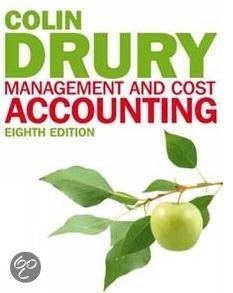
THE ELITE UNIVERSAL
TEST BANK: MANAGEMENT
AND COST ACCOUNTING
(DRURY 12TH EMEA
EDITION)
PART 0: THE TABLE OF CONTENTS
● PART I: THE PREVIEW
○ The Mission & The Intro
○ The "Critical Axioms" Cheat Sheet
● PART II: THE ELITE TEST BANK
○ Tier 1: Foundational Syntax & Application (Questions 1–10)
■ Q1: Cost Behaviour and Classification
■ Q2: Cost-Volume-Profit (CVP) Analysis and Breakeven
■ Q3: Cost Assignment and Two-Stage Allocation
■ Q4: Process Costing (Equivalent Units via FIFO)
■ Q5: Relevant Costing and Opportunity Costs
■ Q6: Flexible Budgeting Principles
■ Q7: Standard Costing (Material Usage Variances)
■ Q8: Capital Investment Appraisal (NPV vs. IRR)
■ Q9: Divisional Performance (Residual Income)
■ Q10: Quantitative Models for Inventory (EOQ)
○ Tier 2: Complex Application & Simulation (Questions 11–20)
■ Q11: Time-Driven Activity-Based Costing (TDABC)
■ Q12: Advanced Variances (Planning vs. Operational)
■ Q13: Advanced Variances (Market Size vs. Market Share)
■ Q14: Transfer Pricing (Capacity Constraints)
■ Q15: Linear Programming and Shadow Pricing
■ Q16: Decision-Making under Risk (EVPI)
■ Q17: Strategic Cost Management (Target vs. Kaizen Costing)
■ Q18: Material Flow Cost Accounting (MFCA)
■ Q19: The Budgeting Process (Beyond Budgeting)
■ Q20: Joint and By-Product Costing (Sell or Process Further)
○ Tier 3: Grandmaster Synthesis (Questions 21–30)
, ■ Q21: Management Accounting in the Digital Age (AI & RPA)
■ Q22: International Transfer Pricing (OECD & BEPS)
■ Q23: Total Life-Cycle Costing
■ Q24: Advanced TDABC (Unused Capacity Isolation)
■ Q25: Capital Rationing and Profitability Index
■ Q26: Advanced Variance Synthesis (Sales Margin Volume)
■ Q27: Throughput Accounting and Theory of Constraints (TOC)
■ Q28: Customer Profitability Analysis and the Whale Curve
■ Q29: Sustainability and Environmental Management Accounting (EMA)
■ Q30: The Grand Synthesis (Digitalization, EMA, and Strategic Costing)
PART I: THE PREVIEW
Mastering this Elite Test Bank transforms theoretical accounting knowledge into surgical,
high-stakes decision-making capability aligned with the highest global standards. By
synthesizing these 30 escalating scenarios—rooted in the definitive methodologies of the 12th
EMEA Edition of Management and Cost Accounting—you will forge the analytical stamina
required to engineer profitability, optimize systemic constraints, and lead global financial
strategy.
● The "Critical Axioms" Cheat Sheet
○ The Absolute Rule of Relevancy: Only future, incremental cash flows dictate
decisions; sunk costs and committed fixed overheads are mathematically invisible
to the optimal decision model.
○ The Constraint Imperative (TOC/Linear Programming): In the presence of a limiting
factor, you must maximize the contribution per unit of the limiting factor, and value
capacity expansion up to the exact limit of the shadow price.
○ The Capacity Axiom (TDABC): Always calculate capacity cost rates using practical
capacity, not theoretical. Unused capacity costs must be isolated as a management
responsibility, never arbitrarily absorbed into product costs.
○ The Planning/Operational Divide: Ex-post market shocks require revising the
standard. Planning variances measure the error in the original budget; Operational
variances measure the actual managerial performance against the revised reality.
○ The Value Chain Directive: Modern cost management (Target Costing, MFCA)
aggressively targets the pre-manufacturing design phase, recognizing that 80% of
life-cycle costs and environmental impacts are irrevocably locked in before
production begins.
PART II: THE ELITE TEST BANK
Q1: A manufacturing entity classifies its overheads during a period of fluctuating production
volume. The factory property tax remains constant in total, while the direct materials vary
proportionately. The company's Chief Executive Officer (CEO) commands a flat annual salary.
Based on the principles of An Introduction to Cost Terms and Concepts, which conclusion
regarding these costs is the MOST ACCURATE? A) The CEO's salary is a product cost that
should be inventoried, while the factory property tax is a period cost expensed immediately. B)
Both the factory property tax and the CEO salary are variable period costs because they do not
directly trace to a single unit of output. C) The factory property tax is a fixed manufacturing
, overhead treated as an inventoriable product cost under absorption costing, whereas the CEO
salary is a period cost. D) Under marginal costing, the factory property tax is treated as a
product cost since it directly relates to the manufacturing facility.
● Answer: C (The factory property tax is a fixed manufacturing overhead treated as an
inventoriable product cost under absorption costing, whereas the CEO salary is a period
cost.)
● Distractor Analysis:
○ A is incorrect: Administrative salaries are period costs, not product costs. Factory
property tax is a product cost under traditional absorption principles.
○ B is incorrect: Factory property tax is fixed, not variable, and neither cost qualifies
as a variable period cost.
○ D is incorrect: Marginal costing explicitly excludes all fixed manufacturing overhead
(including property tax) from product costs, treating it exclusively as a period cost.
The Mentor's Analysis: Precision in cost classification dictates the timing of expense
recognition and inventory valuation. Factory overheads are absorbed into inventory under
standard absorption costing, while non-manufacturing administrative costs bypass inventory
entirely. By utilizing Absorption Costing classification rules, you bypass the common trap of
mismatching fixed factory overheads to immediate income statement expenses.
Professional/Academic Intuition: Only manufacturing costs belong in inventory; all
non-manufacturing costs are expensed in the period incurred.
Q2: A company produces a single product and provides the following budgeted data for the
upcoming financial year:
Metric Value
Selling Price per unit $150
Variable Cost per unit $90
Total Fixed Costs $300,000
Target Operating Profit $120,000
Based on the principles of Cost-Volume-Profit (CVP) Analysis, which calculation represents the
FIRST logical step to determining the required sales volume to hit the target profit? A) Divide the
total fixed costs ($300,000) by the variable cost ratio (60%) to find the break-even point before
adding the target profit. B) Multiply the target profit ($120,000) by the contribution margin ratio
(40%) to ascertain the margin of safety. C) Divide the sum of total fixed costs and target profit
($420,000) by the unit contribution margin of $60. D) Subtract the target profit from the total
fixed costs ($180,000) and divide by the selling price ($150).
● Answer: C (Divide the sum of total fixed costs and target profit ($420,000) by the unit
contribution margin of $60.)
● Distractor Analysis:
○ A is incorrect: Dividing fixed costs by the variable cost ratio yields the sales revenue
required to cover variable costs, not the break-even point (which requires the
contribution margin ratio).
○ B is incorrect: The margin of safety requires knowing the actual or budgeted sales
volume first, which is the unknown variable being solved for here.
○ D is incorrect: Subtracting target profit from fixed costs contradicts the fundamental
CVP formula; they must be added to find the total required contribution pool.
The Mentor's Analysis: CVP analysis relies on the contribution margin to cover both fixed
costs and desired profits. When facing Volume-to-Profit Targets, the immediate priority is
isolating the unit contribution margin. By utilizing the Target Profit Formula [(FC + Profit) / UCM],
TEST BANK: MANAGEMENT
AND COST ACCOUNTING
(DRURY 12TH EMEA
EDITION)
PART 0: THE TABLE OF CONTENTS
● PART I: THE PREVIEW
○ The Mission & The Intro
○ The "Critical Axioms" Cheat Sheet
● PART II: THE ELITE TEST BANK
○ Tier 1: Foundational Syntax & Application (Questions 1–10)
■ Q1: Cost Behaviour and Classification
■ Q2: Cost-Volume-Profit (CVP) Analysis and Breakeven
■ Q3: Cost Assignment and Two-Stage Allocation
■ Q4: Process Costing (Equivalent Units via FIFO)
■ Q5: Relevant Costing and Opportunity Costs
■ Q6: Flexible Budgeting Principles
■ Q7: Standard Costing (Material Usage Variances)
■ Q8: Capital Investment Appraisal (NPV vs. IRR)
■ Q9: Divisional Performance (Residual Income)
■ Q10: Quantitative Models for Inventory (EOQ)
○ Tier 2: Complex Application & Simulation (Questions 11–20)
■ Q11: Time-Driven Activity-Based Costing (TDABC)
■ Q12: Advanced Variances (Planning vs. Operational)
■ Q13: Advanced Variances (Market Size vs. Market Share)
■ Q14: Transfer Pricing (Capacity Constraints)
■ Q15: Linear Programming and Shadow Pricing
■ Q16: Decision-Making under Risk (EVPI)
■ Q17: Strategic Cost Management (Target vs. Kaizen Costing)
■ Q18: Material Flow Cost Accounting (MFCA)
■ Q19: The Budgeting Process (Beyond Budgeting)
■ Q20: Joint and By-Product Costing (Sell or Process Further)
○ Tier 3: Grandmaster Synthesis (Questions 21–30)
, ■ Q21: Management Accounting in the Digital Age (AI & RPA)
■ Q22: International Transfer Pricing (OECD & BEPS)
■ Q23: Total Life-Cycle Costing
■ Q24: Advanced TDABC (Unused Capacity Isolation)
■ Q25: Capital Rationing and Profitability Index
■ Q26: Advanced Variance Synthesis (Sales Margin Volume)
■ Q27: Throughput Accounting and Theory of Constraints (TOC)
■ Q28: Customer Profitability Analysis and the Whale Curve
■ Q29: Sustainability and Environmental Management Accounting (EMA)
■ Q30: The Grand Synthesis (Digitalization, EMA, and Strategic Costing)
PART I: THE PREVIEW
Mastering this Elite Test Bank transforms theoretical accounting knowledge into surgical,
high-stakes decision-making capability aligned with the highest global standards. By
synthesizing these 30 escalating scenarios—rooted in the definitive methodologies of the 12th
EMEA Edition of Management and Cost Accounting—you will forge the analytical stamina
required to engineer profitability, optimize systemic constraints, and lead global financial
strategy.
● The "Critical Axioms" Cheat Sheet
○ The Absolute Rule of Relevancy: Only future, incremental cash flows dictate
decisions; sunk costs and committed fixed overheads are mathematically invisible
to the optimal decision model.
○ The Constraint Imperative (TOC/Linear Programming): In the presence of a limiting
factor, you must maximize the contribution per unit of the limiting factor, and value
capacity expansion up to the exact limit of the shadow price.
○ The Capacity Axiom (TDABC): Always calculate capacity cost rates using practical
capacity, not theoretical. Unused capacity costs must be isolated as a management
responsibility, never arbitrarily absorbed into product costs.
○ The Planning/Operational Divide: Ex-post market shocks require revising the
standard. Planning variances measure the error in the original budget; Operational
variances measure the actual managerial performance against the revised reality.
○ The Value Chain Directive: Modern cost management (Target Costing, MFCA)
aggressively targets the pre-manufacturing design phase, recognizing that 80% of
life-cycle costs and environmental impacts are irrevocably locked in before
production begins.
PART II: THE ELITE TEST BANK
Q1: A manufacturing entity classifies its overheads during a period of fluctuating production
volume. The factory property tax remains constant in total, while the direct materials vary
proportionately. The company's Chief Executive Officer (CEO) commands a flat annual salary.
Based on the principles of An Introduction to Cost Terms and Concepts, which conclusion
regarding these costs is the MOST ACCURATE? A) The CEO's salary is a product cost that
should be inventoried, while the factory property tax is a period cost expensed immediately. B)
Both the factory property tax and the CEO salary are variable period costs because they do not
directly trace to a single unit of output. C) The factory property tax is a fixed manufacturing
, overhead treated as an inventoriable product cost under absorption costing, whereas the CEO
salary is a period cost. D) Under marginal costing, the factory property tax is treated as a
product cost since it directly relates to the manufacturing facility.
● Answer: C (The factory property tax is a fixed manufacturing overhead treated as an
inventoriable product cost under absorption costing, whereas the CEO salary is a period
cost.)
● Distractor Analysis:
○ A is incorrect: Administrative salaries are period costs, not product costs. Factory
property tax is a product cost under traditional absorption principles.
○ B is incorrect: Factory property tax is fixed, not variable, and neither cost qualifies
as a variable period cost.
○ D is incorrect: Marginal costing explicitly excludes all fixed manufacturing overhead
(including property tax) from product costs, treating it exclusively as a period cost.
The Mentor's Analysis: Precision in cost classification dictates the timing of expense
recognition and inventory valuation. Factory overheads are absorbed into inventory under
standard absorption costing, while non-manufacturing administrative costs bypass inventory
entirely. By utilizing Absorption Costing classification rules, you bypass the common trap of
mismatching fixed factory overheads to immediate income statement expenses.
Professional/Academic Intuition: Only manufacturing costs belong in inventory; all
non-manufacturing costs are expensed in the period incurred.
Q2: A company produces a single product and provides the following budgeted data for the
upcoming financial year:
Metric Value
Selling Price per unit $150
Variable Cost per unit $90
Total Fixed Costs $300,000
Target Operating Profit $120,000
Based on the principles of Cost-Volume-Profit (CVP) Analysis, which calculation represents the
FIRST logical step to determining the required sales volume to hit the target profit? A) Divide the
total fixed costs ($300,000) by the variable cost ratio (60%) to find the break-even point before
adding the target profit. B) Multiply the target profit ($120,000) by the contribution margin ratio
(40%) to ascertain the margin of safety. C) Divide the sum of total fixed costs and target profit
($420,000) by the unit contribution margin of $60. D) Subtract the target profit from the total
fixed costs ($180,000) and divide by the selling price ($150).
● Answer: C (Divide the sum of total fixed costs and target profit ($420,000) by the unit
contribution margin of $60.)
● Distractor Analysis:
○ A is incorrect: Dividing fixed costs by the variable cost ratio yields the sales revenue
required to cover variable costs, not the break-even point (which requires the
contribution margin ratio).
○ B is incorrect: The margin of safety requires knowing the actual or budgeted sales
volume first, which is the unknown variable being solved for here.
○ D is incorrect: Subtracting target profit from fixed costs contradicts the fundamental
CVP formula; they must be added to find the total required contribution pool.
The Mentor's Analysis: CVP analysis relies on the contribution margin to cover both fixed
costs and desired profits. When facing Volume-to-Profit Targets, the immediate priority is
isolating the unit contribution margin. By utilizing the Target Profit Formula [(FC + Profit) / UCM],