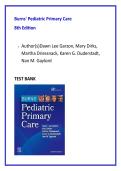
Burns' Pediatric Primary Care
8th Edition
• Author(s)Dawn Lee Garzon, Mary Dirks,
Martha Driessnack, Karen G. Duderstadt,
Nan M. Gaylord
TEST BANK
,
,Question 1
Question: A pediatric primary care provider explains to a parent that
primary care and primary prevention are related but not identical
concepts. Which statement best describes primary care?
A. Services directed only at preventing the first occurrence of disease
B. Continuous, accessible care that addresses a child's health needs
across time
C. Emergency treatment provided when a child develops an acute
illness
D. Screening performed only during scheduled well-child visits
Correct Answer: B. Continuous, accessible care that addresses a child's
health needs across time
Rationale: Primary care is a broad healthcare framework that includes
ongoing, accessible, coordinated care for health promotion, disease
prevention, assessment, diagnosis, treatment, and follow-up. Primary
prevention is narrower and refers specifically to interventions intended
to prevent disease or injury before it occurs.
Why the Other Options Are Incorrect:
A. This describes primary prevention rather than the broader concept of
primary care.
C. Emergency treatment addresses immediate problems but does not
represent the continuous scope of primary care.
D. Screening is one component of preventive care and does not
encompass the full range of primary care services.
, Question 2
Question: A family brings a 6-year-old child to a pediatric primary care
clinic for a routine visit. Which action best reflects the role of the
pediatric primary care provider?
A. Focus only on the child's presenting complaint
B. Address immediate illness while also assessing growth, development,
prevention, and family concerns
C. Refer all preventive-care decisions to a specialist
D. Limit care to laboratory testing and medication management
Correct Answer: B. Address immediate illness while also assessing
growth, development, prevention, and family concerns
Rationale: Pediatric primary care is comprehensive and longitudinal.
The provider considers the child's current health status while also
evaluating growth and development, preventive needs, safety, family
context, and future health risks.
Why the Other Options Are Incorrect:
A. Primary care is not limited to the reason for the visit; preventive and
developmental needs must also be considered.
C. Primary care providers routinely manage preventive care and
coordinate specialty services when needed.
D. Laboratory and medication management are only portions of
pediatric primary care.
Question 3
8th Edition
• Author(s)Dawn Lee Garzon, Mary Dirks,
Martha Driessnack, Karen G. Duderstadt,
Nan M. Gaylord
TEST BANK
,
,Question 1
Question: A pediatric primary care provider explains to a parent that
primary care and primary prevention are related but not identical
concepts. Which statement best describes primary care?
A. Services directed only at preventing the first occurrence of disease
B. Continuous, accessible care that addresses a child's health needs
across time
C. Emergency treatment provided when a child develops an acute
illness
D. Screening performed only during scheduled well-child visits
Correct Answer: B. Continuous, accessible care that addresses a child's
health needs across time
Rationale: Primary care is a broad healthcare framework that includes
ongoing, accessible, coordinated care for health promotion, disease
prevention, assessment, diagnosis, treatment, and follow-up. Primary
prevention is narrower and refers specifically to interventions intended
to prevent disease or injury before it occurs.
Why the Other Options Are Incorrect:
A. This describes primary prevention rather than the broader concept of
primary care.
C. Emergency treatment addresses immediate problems but does not
represent the continuous scope of primary care.
D. Screening is one component of preventive care and does not
encompass the full range of primary care services.
, Question 2
Question: A family brings a 6-year-old child to a pediatric primary care
clinic for a routine visit. Which action best reflects the role of the
pediatric primary care provider?
A. Focus only on the child's presenting complaint
B. Address immediate illness while also assessing growth, development,
prevention, and family concerns
C. Refer all preventive-care decisions to a specialist
D. Limit care to laboratory testing and medication management
Correct Answer: B. Address immediate illness while also assessing
growth, development, prevention, and family concerns
Rationale: Pediatric primary care is comprehensive and longitudinal.
The provider considers the child's current health status while also
evaluating growth and development, preventive needs, safety, family
context, and future health risks.
Why the Other Options Are Incorrect:
A. Primary care is not limited to the reason for the visit; preventive and
developmental needs must also be considered.
C. Primary care providers routinely manage preventive care and
coordinate specialty services when needed.
D. Laboratory and medication management are only portions of
pediatric primary care.
Question 3