

Written by students who passed Immediately available after payment Read online or as PDF Wrong document? Swap it for free 4.6 TrustPilot
logo-home
Document preview thumbnail
Preview 1 out of 3 pages
Exam (elaborations)

LIFEGUARD TEST Questions & Answers Updated 2026/2027 – Complete A+ Graded Lifeguard Certification Study Guide, CPR/AED, First Aid, Water Rescue, GID, Spinal Injury, EAP, Oxygen, Emergency Response & Surveillance – Instant Download

Document preview thumbnail
Preview 1 out of 3 pages

Prepare confidently for your LIFEGUARD TEST with this comprehensive, keyword-rich Lifeguard Certification Study Guide covering essential lifeguarding knowledge, emergency response procedures, CPR, AED, first aid, water rescue techniques, spinal motion restriction, guest-in-distress recognition, emergency action plans, oxygen administration, airway obstruction, drowning emergencies, and facility safety. This resource is designed for students and candidates preparing for lifeguard certification, written examinations, skills assessments, aquatic safety training, and lifeguarding courses. It brings together important concepts and question-and-answer material covering the responsibilities, rescue procedures, communication methods, emergency response skills, and first-aid principles commonly associated with lifeguard training. TOPICS COVERED INCLUDE: • Lifeguard responsibilities and primary job responsibilities • 10/20 scanning principles and effective surveillance • Guest in Distress (GID) recognition • Active drowning and passive drowning recognition • Signs and stages of drowning • Hypoxia and respiratory emergencies • Safe water entry techniques • Ease-in entry for suspected spinal injuries • Compact jump and water-entry techniques • Front hug, rear hug and other rescue techniques • Duck pluck rescue • Deepwater submerged rescue • Grab-and-lift rescue • Underarm vise grip • Rescue tube positioning and use • Pool-edge rapid extraction • Emergency Action Plan (EAP) activation • Lifeguard whistle codes and hand signals • Staff and guest communication • C.A.R.E. communication principles • D.E.A.L. decision-making concepts • Preventive lifeguarding and surveillance • Sun protection and outdoor lifeguard safety • Sunscreen and protective clothing • Polarized sunglasses and shade • Heat emergencies • Closed wound care • R.I.C.E. principles • Broken bones and splinting • Catastrophic bleeding and tourniquet considerations • Minor bleeding and wound care • PPE and infection-control precautions • Anaphylaxis and epinephrine auto-injectors • Naloxone and opioid overdose response • Supplemental oxygen administration • Non-rebreather mask use • Pulse oximetry and oxygen saturation • Labored breathing and respiratory distress • Airway obstruction and choking • Infant choking response • Back blows and chest thrusts • CPR for adults and children • Infant CPR techniques • Chest compression and ventilation ratios • Two-rescuer CPR procedures • AED operation and analysis • When to discontinue compressions for AED analysis • Rescue breathing and ventilations • Proper ventilation and visible chest rise • Ventilation troubleshooting • Vomiting during CPR • Log-roll procedures • Primary and secondary assessment • Rapid assessment of an unresponsive guest • Suspected spinal injury management • Spinal Motion Restriction (SMR) • In-water spinal rescue techniques • Submerged guest spinal rescue • Surface spinal injury management • Manual stabilization of the head • Underarm vise grip spinal technique • Extraction of guests with suspected spinal injuries • Communication with injured guests throughout rescue • Emergency response and rescue priorities • Recognition of life-threatening conditions • Facility evacuation and emergency procedures • Lifeguard scanning and zone coverage • Recognition of unusual conditions in the assigned zone The material also covers practical scenarios such as responding to a guest who is unresponsive in the water, performing CPR on adults and infants, assisting a guest experiencing an airway obstruction, responding to anaphylaxis, administering supplemental oxygen, managing catastrophic bleeding, treating minor wounds, responding to heat emergencies, and providing appropriate care for suspected spinal injuries. Important lifeguarding concepts included in the study material include maintaining effective surveillance, recognizing a Guest in Distress, activating the EAP when required, entering the water safely, selecting the appropriate rescue technique, maintaining spinal motion restriction, performing primary and secondary assessments, providing CPR and ventilations, operating an AED, managing airway emergencies, and coordinating with other lifeguards through standardized communication. The study guide also emphasizes lifeguard prevention and observation skills, including the 10/20 concept, identifying hazards in an assigned zone, recognizing changes in guest behavior, using whistle codes and hand signals, and maintaining effective communication with other staff members. CPR AND AED PREPARATION: Review adult, child, and infant CPR concepts; compression and ventilation procedures; rescue breathing; AED analysis; team CPR; airway management; choking response; and appropriate actions during cardiac arrest emergencies. FIRST AID PREPARATION: Review wound care, bleeding control, splinting, heat emergencies, anaphylaxis, opioid overdose response, oxygen use, respiratory distress, and other common aquatic first-aid situations. WATER RESCUE PREPARATION: Study GID recognition, active and passive drowning, rescue tube techniques, duck pluck rescue, front hug rescue, rear hug rescue, deepwater submerged rescue, grab-and-lift rescue, compact jump, safe water entry, rapid extraction, and pool-edge rescue techniques. SPINAL INJURY PREPARATION: Review suspected spinal injury recognition, spinal motion restriction, manual stabilization, underarm vise grip techniques, in-water spinal rescue, submerged guest management, surface management, and safe extraction. EMERGENCY RESPONSE PREPARATION: Understand EAP activation, D.E.A.L. decision-making, C.A.R.E. communication, whistle codes, hand signals, team response, emergency coordination, and facility-specific emergency procedures. SURVEILLANCE AND PREVENTION: Build familiarity with lifeguard scanning, the 10/20 principle, assigned-zone coverage, GID recognition, preventive lifeguarding, hazard identification, guest behavior observation, and maintaining constant attention while on surveillance duty. This Lifeguard Test Questions & Answers resource is useful for lifeguard certification candidates, lifeguard students, aquatic professionals, pool lifeguards, waterpark lifeguards, swim facility employees, and anyone reviewing core lifeguarding concepts before a written examination or skills evaluation. KEY BENEFITS: Comprehensive lifeguard exam-preparation material Question-and-answer study format CPR, AED and first-aid coverage Water rescue and GID recognition Spinal injury and SMR concepts EAP and emergency response topics Oxygen and respiratory emergency concepts Choking and airway obstruction response Adult, child and infant emergency-care concepts Lifeguard surveillance and 10/20 concepts Communication, whistle codes and hand signals Convenient digital study resource Instant Download for convenient access Whether you are preparing for a Lifeguard Written Test, Lifeguard Certification Exam, aquatic safety assessment, CPR/AED assessment, or lifeguarding course evaluation, this resource provides concentrated review material across the major areas of lifeguard training. Use this material to reinforce your understanding of lifeguarding procedures, emergency response, rescue techniques, first aid, CPR/AED, surveillance, spinal injury management, communication, and aquatic safety. NOTE: This is an independent study resource based on the material supplied for this listing and is not an official publication or guarantee of questions appearing on any particular examination.

Content preview

Science Medicine Emergency Medicine


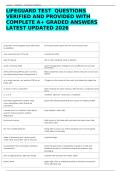
LIFEGUARD TEST QUESTIONS
VERIFIED AND PROVIDED WITH
COMPLETE A+ GRADED ANSWERS
LATEST UPDATED 2026


sunscreen can be applied most effectively 20 minutes before going into the sun and every hour
by applying


most important part of the job maintaining 10/20


sign of hypoxia fast or slow breathing, weak or labored


Guest In Distress (GID) active struggling w/ headback and insufficient arm and leg
movement

when performing CPR as part of a team, AED is attached, ready to analyze, directs rescuers to not touch
you should discontinue compressions if patient


as a single rescuer, you perform CPR on an 2 fingers on the center of the chest, just below the nipple line
infant with


an ease in entry is used when when entering the water nearby a GID that has a suspected spinal
injury

C. A. R. E confident, attentive, responsive, empathetic


providing supplement oxygen using guest with labored breathing and a pulse of reading of 89%
a non-rebreather mask should be
used when

crossed arms is a common hand signal stop dispatch (stop ride)
used to communicate to another
lifeguard to

Duck pluck rescue hold center of the tube with one hand and reach over tube
with other hand


the "10" is 10/20 stands for being able to scan your entire assigned zone and recognize
a GID within 10 seconds


stage of drowning that a guest would surprised stage
rarely need any further care if rescued


circumstance the a tourniquet should be when the guest has a catastrophic wound to a limb and
considered is bleeding cannot be controlled using direct pressure and
bandaging

prior to approaching a GID you should activate EAP and enter the water safely


broken bone apply rigid, soft, or anatomical splint to minimize movement
of the affected area

Document information

Uploaded on
September 5, 2026
Number of pages
3
Written in
2026/2027
Type
Exam (elaborations)
Contains
Questions & answers
$15.99

Wrong document? Swap it for free Within 14 days of purchase and before downloading, you can choose a different document. You can simply spend the amount again.
Written by students who passed
Immediately available after payment
Read online or as PDF

Seller avatar
Reputation scores are based on the amount of documents a seller has sold for a fee and the reviews they have received for those documents. There are three levels: Bronze, Silver and Gold. The better the reputation, the more your can rely on the quality of the sellers work.
LectDeniz
5.0
(1)
Sold
21
Followers
16
Items
5281
Last sold
10 months ago


Why students choose Stuvia

Created by fellow students, verified by reviews

Quality you can trust: written by students who passed their tests and reviewed by others who've used these notes.

Didn't get what you expected? Choose another document

No worries! You can instantly pick a different document that better fits what you're looking for.

Pay as you like, start learning right away

No subscription, no commitments. Pay the way you're used to via credit card and download your PDF document instantly.

Student with book image

“Bought, downloaded, and aced it. It really can be that simple.”

Alisha Student

Working on your references?

Create accurate citations in APA, MLA and Harvard with our free citation generator.

Working on your references?

Frequently asked questions

