
EDITION
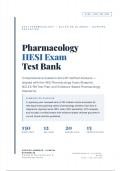
HESI PHARMACOLOGY | NCLEX-RN ALIGNED | NURSING
E D U C ATI O N
Pharmacology
HESI Exam
Test Bank
Comprehensive Question Set with Verified Answers —
aligned with the HESI Pharmacology Exam Blueprint,
NCLEX-RN Test Plan, and Evidence-Based Pharmacology
Standards.
E X A M I N AT I O N O V E R V I E W
A rigorously peer-reviewed bank of 150 multiple-choice and select-all-
that-apply items spanning twelve pharmacology domains. Each item is
mapped to cognitive levels (20% recall, 50% application, 30% analysis)
and includes a verified answer with evidence-based rationale grounded in
current clinical practice guidelines.
150
Q UES T I O N S
12
S ECT I O N S
20
DO S AG E CAL C
15
P R I O R I T I Z AT I O N
VE RIFIE D ANSWE RS · CLINICAL
R AT I O N A L E S CO MPREHEN SI V E · EV I DEN CE-
Prepared by Nu rsin g Edu cation & B A SED
Ph armacology F acu lty EDI TI O N
,Pharmacology HESI Exam Test Bank 2026/2027 Comprehensive Question Set
PHARMACOLOGY HESI EXAM TEST BANK
2026/2027
Comprehensive Question Set with Verified Answers — aligned with the HESI Pharmacology Exam Blueprint,
NCLEX-RN Test Plan, and Evidence-Based Pharmacology Standards (2026/2027 Edition).
150 12 20 15
Questions Sections Dosage Calc Prioritization
Instructions for Use. This test bank contains 150 multiple-choice and select-all-that-apply items distributed across
twelve pharmacology domains. Each item is mapped to HESI cognitive levels (approximately 20% recall, 50%
application, and 30% analysis) and is accompanied by a verified answer and an evidence-based rationale grounded
in current clinical practice guidelines. Recommended study approach: complete each section under timed
conditions, then review the rationale for both correct and incorrect options. Items flagged as prioritization, dosage
calculation, or patient teaching are designed to mirror the clinical reasoning emphasis of the HESI Pharmacology
specialty exam.
Section 1: General Pharmacology Principles · Q1-Q15
Pharmacokinetics, Pharmacodynamics, Drug Interactions, ADRs, Pharmacogenomics
Q1. A patient receives a drug that is highly protein-bound. Which statement by the nurse indicates
understanding of how this affects drug action?
A. Highly protein-bound drugs have a smaller volume of distribution.
B. Only the unbound fraction of the drug produces a pharmacologic effect. [CORRECT]
C. Protein binding increases the drug's free concentration in the blood.
D. Protein-bound drugs are excreted unchanged by the kidneys.
Correct Answer: B
Rationale: Only free (unbound) drug crosses membranes and produces a pharmacologic effect; the protein-bound fraction
acts as a circulating reservoir. Highly protein-bound drugs tend to remain in the vascular compartment and have a longer
duration of action. Displacement by another drug can transiently raise free-drug levels and precipitate toxicity, which is why
interaction monitoring matters in patients on warfarin, phenytoin, or methotrexate.
Tags: pharmacokinetics
Q2. An elderly patient taking warfarin 5 mg daily is prescribed sulfamethoxazole-trimethoprim for a
urinary tract infection. The nurse should prioritize which action?
A. Increase the warfarin dose to compensate for the antibiotic effect.
B. Monitor INR closely and notify the provider of an elevated INR. [CORRECT]
C. Administer the antibiotic 2 hours apart from warfarin.
D. Discontinue warfarin until the antibiotic course is complete.
Correct Answer: B
Verified Answers · Clinical Rationales Page 1 2026/2027 Edition
,Pharmacology HESI Exam Test Bank 2026/2027 Comprehensive Question Set
Rationale: Sulfonamides displace warfarin from protein-binding sites and inhibit CYP2C9-mediated metabolism,
dramatically elevating INR and bleeding risk within 3-7 days. The priority is close INR monitoring with provider
notification; dose adjustment is the prescriber's decision. Stopping warfarin abruptly risks thrombosis, and staggered
administration does not prevent a metabolic interaction.
Tags: prioritization; drug interaction
Q3. A drug has a half-life of 8 hours. The patient receives 500 mg every 8 hours. Approximately how long
will it take to reach steady state?
A. 8 hours
B. 16 hours
C. 40 hours [CORRECT]
D. 80 hours
Correct Answer: C
Rationale: Steady state is reached in approximately 4-5 half-lives regardless of dose or dosing interval. With a half-life of 8
hours, steady state is achieved in 32-40 hours. Increasing the dose raises the steady-state concentration but does not shorten
the time to reach steady state. Loading doses are used when rapid therapeutic levels are required (e.g., antiarrhythmics,
anti-epileptics).
Tags: dosage calculation
Q4. A nurse is preparing to administer naloxone to a patient with opioid-induced respiratory depression.
Naloxone acts as which type of receptor agent?
A. Partial agonist
B. Competitive antagonist [CORRECT]
C. Noncompetitive agonist
D. Positive allosteric modulator
Correct Answer: B
Rationale: Naloxone is a competitive antagonist at mu, kappa, and delta opioid receptors. It competes with opioids for
receptor binding without producing any intrinsic opioid effect, thereby reversing respiratory depression. Partial agonists
(e.g., buprenorphine) produce submaximal effects, while positive allosteric modulators enhance endogenous ligand activity
at a distinct site.
Tags: pharmacodynamics
Q5. A patient is prescribed oral tetracycline 500 mg every 6 hours. Which snack should the nurse
recommend avoiding when administering this medication?
A. Applesauce
B. Greek yogurt [CORRECT]
C. Plain crackers
D. Banana slices
Correct Answer: B
Rationale: Dairy products (Greek yogurt, milk, cheese) contain calcium that forms insoluble chelates with tetracycline,
reducing absorption by up to 50%. The nurse should administer tetracycline 1 hour before or 2 hours after dairy products,
calcium or iron supplements, or antacids. Applesauce, crackers, and bananas do not significantly interfere with tetracycline
absorption.
Tags: drug-food interaction; patient teaching
Verified Answers · Clinical Rationales Page 2 2026/2027 Edition
, Pharmacology HESI Exam Test Bank 2026/2027 Comprehensive Question Set
Q6. A patient receiving IV vancomycin develops sudden flushing, hypotension, and an erythematous rash
over the upper body during infusion. Which action should the nurse take first?
A. Administer diphenhydramine 50 mg IV.
B. Stop the infusion immediately. [CORRECT]
C. Slow the infusion rate to 60 minutes.
D. Notify the prescriber for an order change.
Correct Answer: B
Rationale: These manifestations describe Red Man Syndrome, a rate-related infusion reaction caused by histamine release
during rapid vancomycin administration. The first action is to STOP the infusion to halt further histamine release. After
stopping, the nurse can administer diphenhydramine as ordered and restart at a slower rate (no faster than 10 mg/min or over
60-90 minutes) once symptoms resolve. It is not a true IgE allergy, so rechallenge at the correct rate is acceptable.
Tags: prioritization; adverse effect
Q7. A patient of Asian descent is prescribed clopidogrel 75 mg daily after coronary stent placement. The
nurse understands that genetic testing for which enzyme may be warranted before therapy?
A. CYP2D6
B. CYP2C19 [CORRECT]
C. CYP3A4
D. TPMT
Correct Answer: B
Rationale: Clopidogrel is a prodrug activated by CYP2C19. Patients with loss-of-function CYP2C19 variants (more
common in Asian populations, ~30% prevalence) have reduced clopidogrel activation and increased thrombotic risk after
stenting. CPIC guidelines recommend alternative antiplatelet therapy (prasugrel, ticagrelor) for poor metabolizers. CYP2D6
affects codeine/tamoxifen metabolism; TPMT affects thiopurine dosing.
Tags: pharmacogenomics
Q8. Which medication class is included on the ISMP list of high-alert medications due to its potential for
catastrophic harm when used in error?
A. Proton pump inhibitors
B. Insulin (subcutaneous and IV) [CORRECT]
C. Selective serotonin reuptake inhibitors
D. HMG-CoA reductase inhibitors
Correct Answer: B
Rationale: Insulin (subcutaneous and IV) is classified as a high-alert medication by the Institute for Safe Medication
Practices (ISMP) because errors in dosing, concentration, or product selection can cause severe hypoglycemia, permanent
neurological injury, or death. While PPIs, SSRIs, and statins have risks, they do not carry the same catastrophic potential per
error and are not on the high-alert list.
Tags: medication safety
Q9. A patient taking levothyroxine 100 mcg daily is newly started on calcium carbonate 1,500 mg daily for
osteoporosis. The nurse should teach the patient to:
A. Take both medications together with breakfast.
B. Separate the medications by at least 4 hours. [CORRECT]
C. Increase the levothyroxine dose during calcium therapy.
D. Crush the calcium tablet before taking it with levothyroxine.
Verified Answers · Clinical Rationales Page 3 2026/2027 Edition
HESI PHARMACOLOGY | NCLEX-RN ALIGNED | NURSING
E D U C ATI O N
Pharmacology
HESI Exam
Test Bank
Comprehensive Question Set with Verified Answers —
aligned with the HESI Pharmacology Exam Blueprint,
NCLEX-RN Test Plan, and Evidence-Based Pharmacology
Standards.
E X A M I N AT I O N O V E R V I E W
A rigorously peer-reviewed bank of 150 multiple-choice and select-all-
that-apply items spanning twelve pharmacology domains. Each item is
mapped to cognitive levels (20% recall, 50% application, 30% analysis)
and includes a verified answer with evidence-based rationale grounded in
current clinical practice guidelines.
150
Q UES T I O N S
12
S ECT I O N S
20
DO S AG E CAL C
15
P R I O R I T I Z AT I O N
VE RIFIE D ANSWE RS · CLINICAL
R AT I O N A L E S CO MPREHEN SI V E · EV I DEN CE-
Prepared by Nu rsin g Edu cation & B A SED
Ph armacology F acu lty EDI TI O N
,Pharmacology HESI Exam Test Bank 2026/2027 Comprehensive Question Set
PHARMACOLOGY HESI EXAM TEST BANK
2026/2027
Comprehensive Question Set with Verified Answers — aligned with the HESI Pharmacology Exam Blueprint,
NCLEX-RN Test Plan, and Evidence-Based Pharmacology Standards (2026/2027 Edition).
150 12 20 15
Questions Sections Dosage Calc Prioritization
Instructions for Use. This test bank contains 150 multiple-choice and select-all-that-apply items distributed across
twelve pharmacology domains. Each item is mapped to HESI cognitive levels (approximately 20% recall, 50%
application, and 30% analysis) and is accompanied by a verified answer and an evidence-based rationale grounded
in current clinical practice guidelines. Recommended study approach: complete each section under timed
conditions, then review the rationale for both correct and incorrect options. Items flagged as prioritization, dosage
calculation, or patient teaching are designed to mirror the clinical reasoning emphasis of the HESI Pharmacology
specialty exam.
Section 1: General Pharmacology Principles · Q1-Q15
Pharmacokinetics, Pharmacodynamics, Drug Interactions, ADRs, Pharmacogenomics
Q1. A patient receives a drug that is highly protein-bound. Which statement by the nurse indicates
understanding of how this affects drug action?
A. Highly protein-bound drugs have a smaller volume of distribution.
B. Only the unbound fraction of the drug produces a pharmacologic effect. [CORRECT]
C. Protein binding increases the drug's free concentration in the blood.
D. Protein-bound drugs are excreted unchanged by the kidneys.
Correct Answer: B
Rationale: Only free (unbound) drug crosses membranes and produces a pharmacologic effect; the protein-bound fraction
acts as a circulating reservoir. Highly protein-bound drugs tend to remain in the vascular compartment and have a longer
duration of action. Displacement by another drug can transiently raise free-drug levels and precipitate toxicity, which is why
interaction monitoring matters in patients on warfarin, phenytoin, or methotrexate.
Tags: pharmacokinetics
Q2. An elderly patient taking warfarin 5 mg daily is prescribed sulfamethoxazole-trimethoprim for a
urinary tract infection. The nurse should prioritize which action?
A. Increase the warfarin dose to compensate for the antibiotic effect.
B. Monitor INR closely and notify the provider of an elevated INR. [CORRECT]
C. Administer the antibiotic 2 hours apart from warfarin.
D. Discontinue warfarin until the antibiotic course is complete.
Correct Answer: B
Verified Answers · Clinical Rationales Page 1 2026/2027 Edition
,Pharmacology HESI Exam Test Bank 2026/2027 Comprehensive Question Set
Rationale: Sulfonamides displace warfarin from protein-binding sites and inhibit CYP2C9-mediated metabolism,
dramatically elevating INR and bleeding risk within 3-7 days. The priority is close INR monitoring with provider
notification; dose adjustment is the prescriber's decision. Stopping warfarin abruptly risks thrombosis, and staggered
administration does not prevent a metabolic interaction.
Tags: prioritization; drug interaction
Q3. A drug has a half-life of 8 hours. The patient receives 500 mg every 8 hours. Approximately how long
will it take to reach steady state?
A. 8 hours
B. 16 hours
C. 40 hours [CORRECT]
D. 80 hours
Correct Answer: C
Rationale: Steady state is reached in approximately 4-5 half-lives regardless of dose or dosing interval. With a half-life of 8
hours, steady state is achieved in 32-40 hours. Increasing the dose raises the steady-state concentration but does not shorten
the time to reach steady state. Loading doses are used when rapid therapeutic levels are required (e.g., antiarrhythmics,
anti-epileptics).
Tags: dosage calculation
Q4. A nurse is preparing to administer naloxone to a patient with opioid-induced respiratory depression.
Naloxone acts as which type of receptor agent?
A. Partial agonist
B. Competitive antagonist [CORRECT]
C. Noncompetitive agonist
D. Positive allosteric modulator
Correct Answer: B
Rationale: Naloxone is a competitive antagonist at mu, kappa, and delta opioid receptors. It competes with opioids for
receptor binding without producing any intrinsic opioid effect, thereby reversing respiratory depression. Partial agonists
(e.g., buprenorphine) produce submaximal effects, while positive allosteric modulators enhance endogenous ligand activity
at a distinct site.
Tags: pharmacodynamics
Q5. A patient is prescribed oral tetracycline 500 mg every 6 hours. Which snack should the nurse
recommend avoiding when administering this medication?
A. Applesauce
B. Greek yogurt [CORRECT]
C. Plain crackers
D. Banana slices
Correct Answer: B
Rationale: Dairy products (Greek yogurt, milk, cheese) contain calcium that forms insoluble chelates with tetracycline,
reducing absorption by up to 50%. The nurse should administer tetracycline 1 hour before or 2 hours after dairy products,
calcium or iron supplements, or antacids. Applesauce, crackers, and bananas do not significantly interfere with tetracycline
absorption.
Tags: drug-food interaction; patient teaching
Verified Answers · Clinical Rationales Page 2 2026/2027 Edition
, Pharmacology HESI Exam Test Bank 2026/2027 Comprehensive Question Set
Q6. A patient receiving IV vancomycin develops sudden flushing, hypotension, and an erythematous rash
over the upper body during infusion. Which action should the nurse take first?
A. Administer diphenhydramine 50 mg IV.
B. Stop the infusion immediately. [CORRECT]
C. Slow the infusion rate to 60 minutes.
D. Notify the prescriber for an order change.
Correct Answer: B
Rationale: These manifestations describe Red Man Syndrome, a rate-related infusion reaction caused by histamine release
during rapid vancomycin administration. The first action is to STOP the infusion to halt further histamine release. After
stopping, the nurse can administer diphenhydramine as ordered and restart at a slower rate (no faster than 10 mg/min or over
60-90 minutes) once symptoms resolve. It is not a true IgE allergy, so rechallenge at the correct rate is acceptable.
Tags: prioritization; adverse effect
Q7. A patient of Asian descent is prescribed clopidogrel 75 mg daily after coronary stent placement. The
nurse understands that genetic testing for which enzyme may be warranted before therapy?
A. CYP2D6
B. CYP2C19 [CORRECT]
C. CYP3A4
D. TPMT
Correct Answer: B
Rationale: Clopidogrel is a prodrug activated by CYP2C19. Patients with loss-of-function CYP2C19 variants (more
common in Asian populations, ~30% prevalence) have reduced clopidogrel activation and increased thrombotic risk after
stenting. CPIC guidelines recommend alternative antiplatelet therapy (prasugrel, ticagrelor) for poor metabolizers. CYP2D6
affects codeine/tamoxifen metabolism; TPMT affects thiopurine dosing.
Tags: pharmacogenomics
Q8. Which medication class is included on the ISMP list of high-alert medications due to its potential for
catastrophic harm when used in error?
A. Proton pump inhibitors
B. Insulin (subcutaneous and IV) [CORRECT]
C. Selective serotonin reuptake inhibitors
D. HMG-CoA reductase inhibitors
Correct Answer: B
Rationale: Insulin (subcutaneous and IV) is classified as a high-alert medication by the Institute for Safe Medication
Practices (ISMP) because errors in dosing, concentration, or product selection can cause severe hypoglycemia, permanent
neurological injury, or death. While PPIs, SSRIs, and statins have risks, they do not carry the same catastrophic potential per
error and are not on the high-alert list.
Tags: medication safety
Q9. A patient taking levothyroxine 100 mcg daily is newly started on calcium carbonate 1,500 mg daily for
osteoporosis. The nurse should teach the patient to:
A. Take both medications together with breakfast.
B. Separate the medications by at least 4 hours. [CORRECT]
C. Increase the levothyroxine dose during calcium therapy.
D. Crush the calcium tablet before taking it with levothyroxine.
Verified Answers · Clinical Rationales Page 3 2026/2027 Edition


