
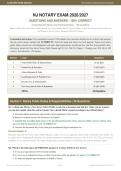
NJ NOTARY EXAM 2026/2027 100-Question Comprehensive Examination
NJ NOTARY EXAM 2026/2027
QUESTIONS AND ANSWERS - 100% CORRECT
Comprehensive State Licensing Examination - 100 Questions
Aligned with the New Jersey Notary Public Manual, New Jersey Statutes Title 52 (Notaries Public), and the New Jersey Division of Revenue
and Enterprise Services Notary Standards (2026/2027 Edition)
Examination Instructions: This examination consists of 100 multiple-choice questions divided into six sections. Each question
has one correct answer marked with *[CORRECT]*. Select the single best answer for each question. Topics cover notary
public duties, notarial acts, acknowledgments and oaths, legal requirements, records and fees, and New Jersey-specific rules.
References include the New Jersey Notary Public Manual and N.J.S.A. Title 52, Chapter 7. Passing score: 80% (80 of 100
correct). Time allowance: 120 minutes.
Section Topic Questions
1 Notary Public Duties & Responsibilities 20 (Q1-Q20)
2 Notarial Acts & Procedures 25 (Q21-Q45)
3 Acknowledgments & Oaths 20 (Q46-Q65)
4 Legal Requirements & Prohibited Acts 15 (Q66-Q80)
5 Records, Fees, & Administration 10 (Q81-Q90)
6 New Jersey-Specific Rules & Regulations 10 (Q91-Q100)
TOTAL 100 Questions
Section 1: Notary Public Duties & Responsibilities | 20 Questions
Q1: A client asks Maria, a New Jersey Notary Public, to notarize a document and tells her, 'Since you are a notary,
you can also explain what this contract means.' How should Maria respond according to her official duties?
A. Proceed with the notarization and provide a brief explanation of the contract
B. Refuse to notarize because the document is in English
C. Explain that providing legal advice is the unauthorized practice of law and not within a notary's duties, then
proceed with the notarial act only *[CORRECT]*
D. Notarize the document only if the client pays an additional legal-consultation fee
Correct Answer: C
Rationale: Under the New Jersey Notary Public Manual, a notary serves as an impartial witness to deter fraud and verify identity, not
as a legal advisor. Explaining the meaning of a contract constitutes the unauthorized practice of law (N.J.S.A. 2C:21-22) and is strictly
prohibited for non-attorney notaries. The notary should perform only the notarial act and decline the legal-interpretation request.
Q2: Which of the following is the PRIMARY purpose of a Notary Public in New Jersey?
A. To act as a legal advisor for low-income residents
B. To serve as an impartial witness to deter fraud and verify the identity of signers *[CORRECT]*
C. To draft and prepare legal documents on behalf of clients
New Jersey Notary Public Examination Page 1 Aligned with NJ Statutes Title 52, Ch. 7
,NJ NOTARY EXAM 2026/2027 100-Question Comprehensive Examination
D. To enforce court judgments and serve legal process
Correct Answer: B
Rationale: The New Jersey Notary Public Manual defines the notary's core purpose as serving as an impartial witness to deter fraud and
verify identity. Options A, C, and D describe functions reserved for attorneys, paralegals, or law enforcement, none of which fall within
notarial authority under N.J.S.A. 52:7-11 et seq.
Q3: James, age 16, is a New Jersey resident who wants to become a notary public. What is the BEST response to his
inquiry?
A. He may apply with parental consent
B. He must wait until age 18 because New Jersey requires notaries to be at least 18 years old *[CORRECT]*
C. He may apply if sponsored by a licensed attorney
D. Age is not a qualification; residency is the only requirement
Correct Answer: B
Rationale: Under N.J.S.A. 52:7-12 and the NJ Notary Public Manual, applicants must be at least 18 years of age. Parental consent,
attorney sponsorship, or residency alone cannot cure the minimum-age requirement. James must wait until his 18th birthday before
submitting an application.
Q4: An applicant for a New Jersey notary commission resides in Philadelphia, Pennsylvania, but works full-time in
Camden, New Jersey. She wishes to be commissioned as a New Jersey notary. What is the correct outcome?
A. She may be commissioned because she works in New Jersey
B. She may be commissioned if her employer signs an affidavit
C. She cannot be commissioned because New Jersey requires applicants to be residents of the state
*[CORRECT]*
D. She may be commissioned only for use within her county of employment
Correct Answer: C
Rationale: The NJ Notary Public Manual and N.J.S.A. 52:7-12 require applicants to be New Jersey residents. Employment within the
state does not substitute for residency. Out-of-state residents, even if employed in New Jersey, are ineligible for a New Jersey notary
commission.
Q5: Which of the following convictions would DISQUALIFY an applicant from receiving a New Jersey notary
commission?
A. A speeding violation paid five years ago
B. A misdemeanor shoplifting conviction from ten years ago
C. An indictable offense (felony) conviction involving fraud or dishonesty *[CORRECT]*
D. A municipal ordinance violation for a noisy party
Correct Answer: C
Rationale: The NJ Division of Revenue and Enterprise Services denies commissions to applicants convicted of crimes involving fraud,
dishonesty, or other indictable offenses (felonies). Minor traffic violations, ordinance infractions, and many non-violent misdemeanors
do not automatically disqualify. Speeding and noisy-party violations are not disqualifying under the notary standards.
Q6: A New Jersey notary commissioned on January 1, 2024, asks when her commission will expire. What is the
correct answer?
A. December 31, 2028 - commissions last 5 years
New Jersey Notary Public Examination Page 2 Aligned with NJ Statutes Title 52, Ch. 7
, NJ NOTARY EXAM 2026/2027 100-Question Comprehensive Examination
B. January 1, 2029 - commissions last 5 years from the date of issuance *[CORRECT]*
C. December 31, 2025 - commissions last 2 years
D. January 1, 2034 - commissions last 10 years
Correct Answer: B
Rationale: Under N.J.S.A. 52:7-12, a New Jersey notary commission is valid for five years from the date of issuance. A commission
issued January 1, 2024 expires January 1, 2029. The commission is not backdated to a calendar-year boundary, and ten-year
commissions are not authorized in New Jersey.
Q7: Which sequence correctly describes the New Jersey notary appointment process?
A. Submit application, take oath, pay fee, receive commission, obtain bond
B. Submit application with fee, undergo background check, obtain $5,000 bond, take oath of office, receive
commission certificate *[CORRECT]*
C. Obtain bond, take oath, submit application, undergo background check, receive commission
D. Take oath, pay fee, receive commission, obtain bond, undergo background check
Correct Answer: B
Rationale: The NJ Notary Public Manual prescribes the order: application submission with fee, background check, securing the $5,000
surety bond, oath of office, and finally issuance of the commission certificate. Other sequences place prerequisites (bond, oath) before
application, which is procedurally incorrect.
Q8: Which statement about the New Jersey notary background check is CORRECT?
A. It is optional and may be waived by employer request
B. It is conducted by the county sheriff only
C. It is required and reviews the applicant's criminal history for disqualifying offenses *[CORRECT]*
D. It is conducted by the FBI for every applicant regardless of offense
Correct Answer: C
Rationale: The NJ Division of Revenue and Enterprise Services requires a background review of each applicant's criminal history to
identify disqualifying offenses such as fraud, dishonesty, or other indictable crimes. The check is mandatory, conducted through state
resources, and cannot be waived by employer request.
Q9: Before assuming the duties of a notary public in New Jersey, an applicant MUST:
A. Publish a notice of appointment in a local newspaper
B. Take and subscribe the oath of office before an officer authorized to administer oaths *[CORRECT]*
C. Open a dedicated notary business bank account
D. Join the National Notary Association
Correct Answer: B
Rationale: N.J.S.A. 52:7-12 and the NJ Notary Public Manual require every newly commissioned notary to take and subscribe an oath
of office before a qualified officer before performing any notarial acts. Newspaper publication, business accounts, and association
membership are not statutory requirements.
Q10: What is the statutory bond amount required of every New Jersey notary public?
A. $1,000
B. $2,500
C. $5,000 *[CORRECT]*
New Jersey Notary Public Examination Page 3 Aligned with NJ Statutes Title 52, Ch. 7
NJ NOTARY EXAM 2026/2027
QUESTIONS AND ANSWERS - 100% CORRECT
Comprehensive State Licensing Examination - 100 Questions
Aligned with the New Jersey Notary Public Manual, New Jersey Statutes Title 52 (Notaries Public), and the New Jersey Division of Revenue
and Enterprise Services Notary Standards (2026/2027 Edition)
Examination Instructions: This examination consists of 100 multiple-choice questions divided into six sections. Each question
has one correct answer marked with *[CORRECT]*. Select the single best answer for each question. Topics cover notary
public duties, notarial acts, acknowledgments and oaths, legal requirements, records and fees, and New Jersey-specific rules.
References include the New Jersey Notary Public Manual and N.J.S.A. Title 52, Chapter 7. Passing score: 80% (80 of 100
correct). Time allowance: 120 minutes.
Section Topic Questions
1 Notary Public Duties & Responsibilities 20 (Q1-Q20)
2 Notarial Acts & Procedures 25 (Q21-Q45)
3 Acknowledgments & Oaths 20 (Q46-Q65)
4 Legal Requirements & Prohibited Acts 15 (Q66-Q80)
5 Records, Fees, & Administration 10 (Q81-Q90)
6 New Jersey-Specific Rules & Regulations 10 (Q91-Q100)
TOTAL 100 Questions
Section 1: Notary Public Duties & Responsibilities | 20 Questions
Q1: A client asks Maria, a New Jersey Notary Public, to notarize a document and tells her, 'Since you are a notary,
you can also explain what this contract means.' How should Maria respond according to her official duties?
A. Proceed with the notarization and provide a brief explanation of the contract
B. Refuse to notarize because the document is in English
C. Explain that providing legal advice is the unauthorized practice of law and not within a notary's duties, then
proceed with the notarial act only *[CORRECT]*
D. Notarize the document only if the client pays an additional legal-consultation fee
Correct Answer: C
Rationale: Under the New Jersey Notary Public Manual, a notary serves as an impartial witness to deter fraud and verify identity, not
as a legal advisor. Explaining the meaning of a contract constitutes the unauthorized practice of law (N.J.S.A. 2C:21-22) and is strictly
prohibited for non-attorney notaries. The notary should perform only the notarial act and decline the legal-interpretation request.
Q2: Which of the following is the PRIMARY purpose of a Notary Public in New Jersey?
A. To act as a legal advisor for low-income residents
B. To serve as an impartial witness to deter fraud and verify the identity of signers *[CORRECT]*
C. To draft and prepare legal documents on behalf of clients
New Jersey Notary Public Examination Page 1 Aligned with NJ Statutes Title 52, Ch. 7
,NJ NOTARY EXAM 2026/2027 100-Question Comprehensive Examination
D. To enforce court judgments and serve legal process
Correct Answer: B
Rationale: The New Jersey Notary Public Manual defines the notary's core purpose as serving as an impartial witness to deter fraud and
verify identity. Options A, C, and D describe functions reserved for attorneys, paralegals, or law enforcement, none of which fall within
notarial authority under N.J.S.A. 52:7-11 et seq.
Q3: James, age 16, is a New Jersey resident who wants to become a notary public. What is the BEST response to his
inquiry?
A. He may apply with parental consent
B. He must wait until age 18 because New Jersey requires notaries to be at least 18 years old *[CORRECT]*
C. He may apply if sponsored by a licensed attorney
D. Age is not a qualification; residency is the only requirement
Correct Answer: B
Rationale: Under N.J.S.A. 52:7-12 and the NJ Notary Public Manual, applicants must be at least 18 years of age. Parental consent,
attorney sponsorship, or residency alone cannot cure the minimum-age requirement. James must wait until his 18th birthday before
submitting an application.
Q4: An applicant for a New Jersey notary commission resides in Philadelphia, Pennsylvania, but works full-time in
Camden, New Jersey. She wishes to be commissioned as a New Jersey notary. What is the correct outcome?
A. She may be commissioned because she works in New Jersey
B. She may be commissioned if her employer signs an affidavit
C. She cannot be commissioned because New Jersey requires applicants to be residents of the state
*[CORRECT]*
D. She may be commissioned only for use within her county of employment
Correct Answer: C
Rationale: The NJ Notary Public Manual and N.J.S.A. 52:7-12 require applicants to be New Jersey residents. Employment within the
state does not substitute for residency. Out-of-state residents, even if employed in New Jersey, are ineligible for a New Jersey notary
commission.
Q5: Which of the following convictions would DISQUALIFY an applicant from receiving a New Jersey notary
commission?
A. A speeding violation paid five years ago
B. A misdemeanor shoplifting conviction from ten years ago
C. An indictable offense (felony) conviction involving fraud or dishonesty *[CORRECT]*
D. A municipal ordinance violation for a noisy party
Correct Answer: C
Rationale: The NJ Division of Revenue and Enterprise Services denies commissions to applicants convicted of crimes involving fraud,
dishonesty, or other indictable offenses (felonies). Minor traffic violations, ordinance infractions, and many non-violent misdemeanors
do not automatically disqualify. Speeding and noisy-party violations are not disqualifying under the notary standards.
Q6: A New Jersey notary commissioned on January 1, 2024, asks when her commission will expire. What is the
correct answer?
A. December 31, 2028 - commissions last 5 years
New Jersey Notary Public Examination Page 2 Aligned with NJ Statutes Title 52, Ch. 7
, NJ NOTARY EXAM 2026/2027 100-Question Comprehensive Examination
B. January 1, 2029 - commissions last 5 years from the date of issuance *[CORRECT]*
C. December 31, 2025 - commissions last 2 years
D. January 1, 2034 - commissions last 10 years
Correct Answer: B
Rationale: Under N.J.S.A. 52:7-12, a New Jersey notary commission is valid for five years from the date of issuance. A commission
issued January 1, 2024 expires January 1, 2029. The commission is not backdated to a calendar-year boundary, and ten-year
commissions are not authorized in New Jersey.
Q7: Which sequence correctly describes the New Jersey notary appointment process?
A. Submit application, take oath, pay fee, receive commission, obtain bond
B. Submit application with fee, undergo background check, obtain $5,000 bond, take oath of office, receive
commission certificate *[CORRECT]*
C. Obtain bond, take oath, submit application, undergo background check, receive commission
D. Take oath, pay fee, receive commission, obtain bond, undergo background check
Correct Answer: B
Rationale: The NJ Notary Public Manual prescribes the order: application submission with fee, background check, securing the $5,000
surety bond, oath of office, and finally issuance of the commission certificate. Other sequences place prerequisites (bond, oath) before
application, which is procedurally incorrect.
Q8: Which statement about the New Jersey notary background check is CORRECT?
A. It is optional and may be waived by employer request
B. It is conducted by the county sheriff only
C. It is required and reviews the applicant's criminal history for disqualifying offenses *[CORRECT]*
D. It is conducted by the FBI for every applicant regardless of offense
Correct Answer: C
Rationale: The NJ Division of Revenue and Enterprise Services requires a background review of each applicant's criminal history to
identify disqualifying offenses such as fraud, dishonesty, or other indictable crimes. The check is mandatory, conducted through state
resources, and cannot be waived by employer request.
Q9: Before assuming the duties of a notary public in New Jersey, an applicant MUST:
A. Publish a notice of appointment in a local newspaper
B. Take and subscribe the oath of office before an officer authorized to administer oaths *[CORRECT]*
C. Open a dedicated notary business bank account
D. Join the National Notary Association
Correct Answer: B
Rationale: N.J.S.A. 52:7-12 and the NJ Notary Public Manual require every newly commissioned notary to take and subscribe an oath
of office before a qualified officer before performing any notarial acts. Newspaper publication, business accounts, and association
membership are not statutory requirements.
Q10: What is the statutory bond amount required of every New Jersey notary public?
A. $1,000
B. $2,500
C. $5,000 *[CORRECT]*
New Jersey Notary Public Examination Page 3 Aligned with NJ Statutes Title 52, Ch. 7


