
NHA CCMA EXAMINATION PREPARATION Aligned with 2026-2027 Blueprint
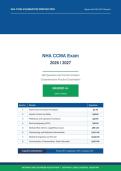
NHA CCMA Exam
180 Questions and Correct Answers
Comprehensive Practice Examination
GRADED A+
100% Verified
Section Domain Questions
1 Patient Care and Clinical Procedures Q1-45
2 Infection Control and Safety Q46-60
3 Phlebotomy and Laboratory Procedures Q61-80
4 Electrocardiography (ECG) Q81-95
5 Medical Office Admin & Legal/Ethical Issues Q96-120
6 Pharmacology and Medication Administration Q121-145
7 Medical Emergencies and First Aid Q146-160
8 Communication, Professionalism, Patient Education Q161-180
Cognitive Distribution Recall 25% | Application 55% | Analysis 20%
NATIONAL HEALTHCAREER ASSOCIATION | CERTIFIED CLINICAL MEDICAL ASSISTANT
,NHA CCMA Exam 2026/2027 | 180 Questions Graded A+ | 100% Verified
75% Scenario-Based | 25% Direct Recall / Procedure Identification
Aligned with 2026-2027 NHA CCMA Examination Blueprint Page 2
,NHA CCMA Exam 2026/2027 | 180 Questions Graded A+ | 100% Verified
About This Examination
This comprehensive 180-question practice examination is designed to align with the National Healthcareer
Association (NHA) Certified Clinical Medical Assistant (CCMA) examination blueprint for 2026-2027. It is
structured across eight clinical and administrative content domains that mirror the live exam's coverage of
patient care, infection control, phlebotomy, electrocardiography, medical office administration, pharmacology,
emergency response, and professional communication. Each question is constructed to reflect authentic clinical
scenarios encountered in modern ambulatory settings, including integrated EHR workflows, team-based care,
and current CDC/OSHA guidance.
Questions are written at three cognitive levels consistent with the NHA CCMA blueprint: approximately 25%
recall (factual knowledge and definitions), 55% application (applying knowledge to clinical scenarios), and
20% analysis (synthesizing data, prioritizing interventions, and evaluating clinical findings). Approximately 75%
of items are scenario-based to mirror real-world clinical reasoning, while 25% are direct recall or
procedure-identification items. Each question includes four answer choices with one best answer, followed by a
detailed rationale that explains why the correct option is right and why the distractors are incorrect.
Distractor design targets common NHA CCMA pitfalls: patient preparation errors, infection control
breakdowns, phlebotomy procedure errors (e.g., wrong order of draw), ECG lead placement errors, medication
calculation errors, and emergency response errors. Use this exam as a self-assessment tool: complete all 180
items under timed conditions (recommended 3-hour session, approximately 1 minute per question), then review
the rationales for any incorrect answers to identify knowledge gaps before scheduling the live NHA CCMA
examination. A score of 75% or higher across all eight sections indicates strong readiness for the certification
exam.
Examination Blueprint Summary
Question
Section Content Domain Count
Range
1 Patient Care and Clinical Procedures Q1 - Q45 45
2 Infection Control and Safety Q46 - Q60 15
3 Phlebotomy and Laboratory Procedures Q61 - Q80 20
4 Electrocardiography (ECG) Q81 - Q95 15
5 Medical Office Admin & Legal/Ethical Issues Q96 - Q120 25
6 Pharmacology and Medication Administration Q121 - Q145 25
7 Medical Emergencies and First Aid Q146 - Q160 15
8 Communication, Professionalism & Patient Education Q161 - Q180 20
TOTAL 180
Aligned with 2026-2027 NHA CCMA Examination Blueprint Page 3
, NHA CCMA Exam 2026/2027 | 180 Questions Graded A+ | 100% Verified
SECTION 1: Patient Care and Clinical Procedures (Q1-Q45)
Topics: Patient Preparation | Vital Signs | Medical History | Physical Exam Support | Patient Education
Q1: A medical assistant is preparing an exam room for a patient scheduled for a routine physical
examination. Which of the following actions should the MA take FIRST to ensure patient safety and
proper infection control?
A. Restock supplies and linens before cleaning surfaces
B. Wipe down all high-touch surfaces with EPA-registered disinfectant following the previous
patient [CORRECT]
C. Place a clean gown and drape on the exam table
D. Adjust the room temperature to 68°F
Correct Answer: B
Rationale:
Disinfecting high-touch surfaces with an EPA-registered hospital-grade disinfectant between patients is the first
critical step in preventing healthcare-associated infections and follows CDC guidelines for environmental infection
control. Restocking supplies, placing clean linens, and adjusting temperature are appropriate but secondary to
breaking the chain of infection. Cleaning must precede stocking to avoid contaminating newly placed items.
Q2: A 67-year-old Spanish-speaking patient arrives for a diabetic follow-up visit. The patient
speaks limited English. What is the MOST appropriate method for obtaining informed consent and
reviewing the treatment plan?
A. Ask a bilingual family member who accompanied the patient to translate
B. Use a trained medical interpreter, either in person or via phone/video service [CORRECT]
C. Use translation software on a smartphone to communicate instructions
D. Provide written materials in Spanish and have the patient sign without verbal explanation
Correct Answer: B
Rationale:
Federal law (Title VI of the Civil Rights Act) and ACA Section 1557 require healthcare facilities receiving federal
funding to provide qualified language services. Trained medical interpreters ensure accurate, impartial
communication and maintain patient confidentiality, unlike family members who may alter information or violate
privacy. Smartphone apps and unsigned explanations are insufficient for informed consent because they cannot
guarantee accuracy or verify understanding.
Aligned with 2026-2027 NHA CCMA Examination Blueprint Page 4
NHA CCMA Exam
180 Questions and Correct Answers
Comprehensive Practice Examination
GRADED A+
100% Verified
Section Domain Questions
1 Patient Care and Clinical Procedures Q1-45
2 Infection Control and Safety Q46-60
3 Phlebotomy and Laboratory Procedures Q61-80
4 Electrocardiography (ECG) Q81-95
5 Medical Office Admin & Legal/Ethical Issues Q96-120
6 Pharmacology and Medication Administration Q121-145
7 Medical Emergencies and First Aid Q146-160
8 Communication, Professionalism, Patient Education Q161-180
Cognitive Distribution Recall 25% | Application 55% | Analysis 20%
NATIONAL HEALTHCAREER ASSOCIATION | CERTIFIED CLINICAL MEDICAL ASSISTANT
,NHA CCMA Exam 2026/2027 | 180 Questions Graded A+ | 100% Verified
75% Scenario-Based | 25% Direct Recall / Procedure Identification
Aligned with 2026-2027 NHA CCMA Examination Blueprint Page 2
,NHA CCMA Exam 2026/2027 | 180 Questions Graded A+ | 100% Verified
About This Examination
This comprehensive 180-question practice examination is designed to align with the National Healthcareer
Association (NHA) Certified Clinical Medical Assistant (CCMA) examination blueprint for 2026-2027. It is
structured across eight clinical and administrative content domains that mirror the live exam's coverage of
patient care, infection control, phlebotomy, electrocardiography, medical office administration, pharmacology,
emergency response, and professional communication. Each question is constructed to reflect authentic clinical
scenarios encountered in modern ambulatory settings, including integrated EHR workflows, team-based care,
and current CDC/OSHA guidance.
Questions are written at three cognitive levels consistent with the NHA CCMA blueprint: approximately 25%
recall (factual knowledge and definitions), 55% application (applying knowledge to clinical scenarios), and
20% analysis (synthesizing data, prioritizing interventions, and evaluating clinical findings). Approximately 75%
of items are scenario-based to mirror real-world clinical reasoning, while 25% are direct recall or
procedure-identification items. Each question includes four answer choices with one best answer, followed by a
detailed rationale that explains why the correct option is right and why the distractors are incorrect.
Distractor design targets common NHA CCMA pitfalls: patient preparation errors, infection control
breakdowns, phlebotomy procedure errors (e.g., wrong order of draw), ECG lead placement errors, medication
calculation errors, and emergency response errors. Use this exam as a self-assessment tool: complete all 180
items under timed conditions (recommended 3-hour session, approximately 1 minute per question), then review
the rationales for any incorrect answers to identify knowledge gaps before scheduling the live NHA CCMA
examination. A score of 75% or higher across all eight sections indicates strong readiness for the certification
exam.
Examination Blueprint Summary
Question
Section Content Domain Count
Range
1 Patient Care and Clinical Procedures Q1 - Q45 45
2 Infection Control and Safety Q46 - Q60 15
3 Phlebotomy and Laboratory Procedures Q61 - Q80 20
4 Electrocardiography (ECG) Q81 - Q95 15
5 Medical Office Admin & Legal/Ethical Issues Q96 - Q120 25
6 Pharmacology and Medication Administration Q121 - Q145 25
7 Medical Emergencies and First Aid Q146 - Q160 15
8 Communication, Professionalism & Patient Education Q161 - Q180 20
TOTAL 180
Aligned with 2026-2027 NHA CCMA Examination Blueprint Page 3
, NHA CCMA Exam 2026/2027 | 180 Questions Graded A+ | 100% Verified
SECTION 1: Patient Care and Clinical Procedures (Q1-Q45)
Topics: Patient Preparation | Vital Signs | Medical History | Physical Exam Support | Patient Education
Q1: A medical assistant is preparing an exam room for a patient scheduled for a routine physical
examination. Which of the following actions should the MA take FIRST to ensure patient safety and
proper infection control?
A. Restock supplies and linens before cleaning surfaces
B. Wipe down all high-touch surfaces with EPA-registered disinfectant following the previous
patient [CORRECT]
C. Place a clean gown and drape on the exam table
D. Adjust the room temperature to 68°F
Correct Answer: B
Rationale:
Disinfecting high-touch surfaces with an EPA-registered hospital-grade disinfectant between patients is the first
critical step in preventing healthcare-associated infections and follows CDC guidelines for environmental infection
control. Restocking supplies, placing clean linens, and adjusting temperature are appropriate but secondary to
breaking the chain of infection. Cleaning must precede stocking to avoid contaminating newly placed items.
Q2: A 67-year-old Spanish-speaking patient arrives for a diabetic follow-up visit. The patient
speaks limited English. What is the MOST appropriate method for obtaining informed consent and
reviewing the treatment plan?
A. Ask a bilingual family member who accompanied the patient to translate
B. Use a trained medical interpreter, either in person or via phone/video service [CORRECT]
C. Use translation software on a smartphone to communicate instructions
D. Provide written materials in Spanish and have the patient sign without verbal explanation
Correct Answer: B
Rationale:
Federal law (Title VI of the Civil Rights Act) and ACA Section 1557 require healthcare facilities receiving federal
funding to provide qualified language services. Trained medical interpreters ensure accurate, impartial
communication and maintain patient confidentiality, unlike family members who may alter information or violate
privacy. Smartphone apps and unsigned explanations are insufficient for informed consent because they cannot
guarantee accuracy or verify understanding.
Aligned with 2026-2027 NHA CCMA Examination Blueprint Page 4


