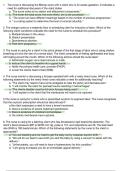
1. The nurse is discussing the Bishop score with a client who is 42 weeks gestation. It indicates a
need for additional discussion if the client states
a. "The score looks at my station and effacement components."
b. "The lower the total score, the more likely I am to be successful."
C. "The score can have different meanings based on the number of previous pregnancies."
d. " is a rating system to determine the level of cervical inducibly."
2. The charge nurse on a maternity floor is scheduling client for Induction of labor. Which of the
following client conditions indicates the need for the nurse to schedule this procedure?
a. Multiple fetuses in the uterus.
B. Breech presentation.
c. Spontaneous abortion.
d. Post-term pregnancy.
3. The nurse is caring for a client in the active phase of the first stage of labor who is using shallow
breathing at twice the rate of a normal adult. The client complaints of feeling lightheaded and dizzy
will tingling around the mouth. Which of the following actions should the nurse take?
a. Administer oxygen via a nasal cannula or mask.
b. Instruct the client to breathe into cupped hands
c. Notify the primary health care. provider (PHCP).
d. Lower the clients head of bad (HOB).
4. The nurse mentor is discussing a forceps-assisted birth with a newly hired nurse. Which of the
following statements by the newly hired nurse indicates a need for additionally teaching?
a. "The client may need to have some analgesia to relax the pelvic and decrease pain."
b. “I will monitor the client for perineal trauma resulting in hemorrhages"
c. “The clients bladder must be full prior forceps being used."
d. "I will explain to the client that the membranes will need to be ruptured
5.The nurse is caring for a client who is prescribed oxytocin to augment labor. The nurse recognizes
that the oxytocin prescription should be discontinued if
a.the client expresses a need to have a bowel movement.
b. there is evidence of severe maternal hypertension.
c. there is evidence of umbilical cord prolapse.
d. the clients membranes have ruptured.
6. The nurse is caring for a laboring client who has developed a rigid board-like abdomen. The
client's blood pressure (BP) is 90/50 mm Hg, pulse is 110, and respirations are 26. The fetal heart
rate (FHR) is 180 beats/minute. Which of the following statements by the nurse to the client is
appropriate?
a."You are bleeding and we need to get the baby out by cesarean section birth."
b. "We will do our best to save both you and the baby by using a vacuum to assist with the
delivery.*
c. "Unfortunately, you will need to have a hysterectomy for this condition."
d. "I am going to prepare you for an immediate vaginal delivery."
, 7. The nurse is caring for a client who has a placental abruption and suspects the client is going into
disseminated intravascular coagulation (DIC). After notifying the primary health care provider (PHCP),
which of the following interventions should the nurse perform first?
a. Monitor urinary output and ensure it is greater than 30 ml. per hour.
b. Provide emotional support to the family.
c. Perform a pelvic examination to determine it the client is ready for delivery.
d. Start an intravenous (IV) heparin drip.
a. Placenta previa.
b. Magnesium toxicity.
c. Severe preeclampsia
d. Abruptio placenta.
9. The nurse is caring for a client in labor who is receiving an oxytocin drip. The nurse notices uterine
tachysystole and a non-reassuring fetal heart rate (FHR). The nurse stops the oxytocin drip and
administers fluid per protocol. Which of the following actions should the nurse perform next?
a. Administer a tocolytic medication.
b. Administer oxygen at 4 L via face mask.
c. Notify the primary health care provider (PHCP)-
d. Tum the client onto the left side.
need for additional discussion if the client states
a. "The score looks at my station and effacement components."
b. "The lower the total score, the more likely I am to be successful."
C. "The score can have different meanings based on the number of previous pregnancies."
d. " is a rating system to determine the level of cervical inducibly."
2. The charge nurse on a maternity floor is scheduling client for Induction of labor. Which of the
following client conditions indicates the need for the nurse to schedule this procedure?
a. Multiple fetuses in the uterus.
B. Breech presentation.
c. Spontaneous abortion.
d. Post-term pregnancy.
3. The nurse is caring for a client in the active phase of the first stage of labor who is using shallow
breathing at twice the rate of a normal adult. The client complaints of feeling lightheaded and dizzy
will tingling around the mouth. Which of the following actions should the nurse take?
a. Administer oxygen via a nasal cannula or mask.
b. Instruct the client to breathe into cupped hands
c. Notify the primary health care. provider (PHCP).
d. Lower the clients head of bad (HOB).
4. The nurse mentor is discussing a forceps-assisted birth with a newly hired nurse. Which of the
following statements by the newly hired nurse indicates a need for additionally teaching?
a. "The client may need to have some analgesia to relax the pelvic and decrease pain."
b. “I will monitor the client for perineal trauma resulting in hemorrhages"
c. “The clients bladder must be full prior forceps being used."
d. "I will explain to the client that the membranes will need to be ruptured
5.The nurse is caring for a client who is prescribed oxytocin to augment labor. The nurse recognizes
that the oxytocin prescription should be discontinued if
a.the client expresses a need to have a bowel movement.
b. there is evidence of severe maternal hypertension.
c. there is evidence of umbilical cord prolapse.
d. the clients membranes have ruptured.
6. The nurse is caring for a laboring client who has developed a rigid board-like abdomen. The
client's blood pressure (BP) is 90/50 mm Hg, pulse is 110, and respirations are 26. The fetal heart
rate (FHR) is 180 beats/minute. Which of the following statements by the nurse to the client is
appropriate?
a."You are bleeding and we need to get the baby out by cesarean section birth."
b. "We will do our best to save both you and the baby by using a vacuum to assist with the
delivery.*
c. "Unfortunately, you will need to have a hysterectomy for this condition."
d. "I am going to prepare you for an immediate vaginal delivery."
, 7. The nurse is caring for a client who has a placental abruption and suspects the client is going into
disseminated intravascular coagulation (DIC). After notifying the primary health care provider (PHCP),
which of the following interventions should the nurse perform first?
a. Monitor urinary output and ensure it is greater than 30 ml. per hour.
b. Provide emotional support to the family.
c. Perform a pelvic examination to determine it the client is ready for delivery.
d. Start an intravenous (IV) heparin drip.
a. Placenta previa.
b. Magnesium toxicity.
c. Severe preeclampsia
d. Abruptio placenta.
9. The nurse is caring for a client in labor who is receiving an oxytocin drip. The nurse notices uterine
tachysystole and a non-reassuring fetal heart rate (FHR). The nurse stops the oxytocin drip and
administers fluid per protocol. Which of the following actions should the nurse perform next?
a. Administer a tocolytic medication.
b. Administer oxygen at 4 L via face mask.
c. Notify the primary health care provider (PHCP)-
d. Tum the client onto the left side.