
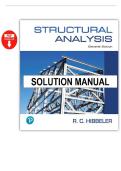
Structural Analysis 11th Edition Hibbeler Solution Manual & Answer Key | ISBN 9780138026110, 9780138026257 | Updated 2026
Solution Manual for Structural Analysis 11th Edition by Russell C. Hibbeler (All Chapters 1-17) Chapter 1 Types of Structures and Loads Chapter Objectives 1.1 Introduction Planning Analysis and Design Construction 1.2 Classification of Structures Structural Elements Tie Rods Beams Columns Types of Structures Trusses Cables and Arches Frames Surface Structures 1.3 Loads Dead Loads Live Loads Building Loads Highway Bridge Loads Railroad Bridge Loads Impact Loads Wind Loads Design Wind Pressure for Enclosed Buildings Design Wind Pressure for Signs Snow Loads Earthquake Loads Hydrostatic and Soil Pressure Other Natural Loads 1.4 Structural Design ASD LRFD Problems Chapter Review Chapter 2 Analysis of Statically Determinate Structures Chapter Objectives 2.1 Idealized Structural Supports and connections Idealized Structure Tributary Loadings One-Way System Two-Way System 2.2 Load Path 2.3 Principle of Superposition 2.4 Equations of Equilibrium 2.5 Determinacy and Stability Determinacy Stability Partial Constraints Improper Constraints 2.6 Application of the Equations of Equilibrium How Important Is the Free-Body Diagram? Fundamental Problems Problems Sec. 2.1 Sec. 2.2–2.5 Sec. 2.6 Project Problem Chapter Review Chapter 3 Analysis of Statically Determinate Trusses Chapter Objectives 3.1 Common Types of Trusses Roof Trusses Bridge Trusses Assumptions for Design 3.2 Classification of Coplanar Trusses Simple Truss Compound Truss Complex Truss Determinacy Stability External Stability Internal Stability Computer Analysis 3.3 The Method of Joints 3.4 Zero-Force Members 3.5 The Method of Sections 3.6 Selection of a Truss 3.7 Compound Trusses 3.8 Complex Trusses 3.9 Space Trusses Determinacy and Stability Assumptions for Design x, y, z, Force Components Zero-Force Members Preliminary Problems Fundamental Problems Problems Sec. 3.1–3.2 Sec. 3.3–3.4 Sec. 3.5–3.7 Sec. 3.8 Sec. 3.9 Project Problem Computer Problems* Chapter Review Chapter 4 Internal Loadings Developed in Structural Members Chapter Objectives 4.1 Internal Loadings at a Specified Point Sign Convention 4.2 Shear and Moment Functions 4.3 Shear and Moment Diagrams for a Beam Regions of Distributed Load Regions of Concentrated Force and Moment 4.4 Deflection Diagrams for Beams 4.5 Shear and Moment Diagrams for a Frame 4.6 Moment Diagrams Constructed by the Method of Superposition Preliminary Problems Fundamental Problems Problems Sec. 4.1 Sec. 4.2 Sec. 4.3–4.4 Sec. 4.5 Sec. 4.6 Project Problems Chapter Review Chapter 5 Cables and Arches Chapter Objectives 5.1 Cables 5.2 Cable Subjected to Concentrated Loads 5.3 Cable Subjected to a Uniform Distributed Load 5.4 Cable Subjected to its Own Weight 5.5 Arches 5.6 Three-Hinged Arch Problems Sec. 5.1–5.2 Sec. 5.3 Sec. 5.4 Sec. 5.5–5.6 Chapter Review Chapter 6 Influence Lines for Statically Determinate Structures Chapter Objectives 6.1 Influence Lines 6.2 Influence Lines for Beams Concentrated Force Uniform Load 6.3 Qualitative Influence Lines 6.4 Influence Lines for Floor Girders 6.5 Influence Lines for Trusses 6.6 Maximum Influence at a Point Due to a Series of Concentrated Loads Shear Moment 6.7 Absolute Maximum Shear and Moment Shear Moment Envelope of Maximum Values of Shear or Moment Fundamental Problems Problems Sec. 6.1–6.3 Sec. 6.4 Sec. 6.5 Sec. 6.6 Sec. 6.7 Project Problems Chapter Review Chapter 7 Deflections Chapter Objective 7.1 Deflection Diagram and Elastic Curve Deflection Diagram Examples of Beam Deflections Examples of Frame Deflections 7.2 Elastic-Beam Theory Tabulated Results 7.3 The Double Integration Method Sign Convention Boundary and Continuity Conditions 7.4 Moment-Area Theorems 7.5 Conjugate-Beam Method Conjugate-Beam Supports Preliminary Problems Fundamental Problems Problems Sec. 7.1–7.3 Sec. 7.4–7.5 Chapter Review Chapter 8 Deflections Using Energy Methods Chapter Objective 8.1 External Work and Strain Energy External Work—Force External Work—Moment Strain Energy—Axial Force Strain Energy—Bending 8.2 Principle of Work and Energy 8.3 Principle of Virtual Work 8.4 Method of Virtual Work: Trusses External Loading Temperature Fabrication Errors and Camber 8.5 Castigliano’s Theorem 8.6 Castigliano’s Theorem for Trusses 8.7 Method of Virtual Work: Beams and Frames Integration Using Tables 8.8 Virtual Strain Energy Caused by Axial Load, Shear, Torsion, and Temperature Axial Load Shear Torsion Temperature General Comments 8.9 Castigliano’s Theorem for Beams and Frames Fundamental Problems Problems Sec. 8.1–8.6 Sec. 8.7–8.9 Chapter Review Chapter 9 Analysis of Statically Indeterminate Structures by the Force Method Chapter Objectives 9.1 Statically Indeterminate Structures Advantages and Disadvantages Methods of Analysis Force Method Displacement Method 9.2 Force Method of Analysis: General Procedure 9.3 Maxwell’s Theorem of Reciprocal Displacements 9.4 Force Method of Analysis: Beams 9.5 Force Method of Analysis: Frames 9.6 Force Method of Analysis: Trusses 9.7 Composite Structures 9.8 Symmetric Structures 9.9 Influence Lines for Statically Indeterminate Beams Reaction at A Shear at E Moment at E 9.10 Qualitative Influence Lines for Frames Preliminary Problems Fundamental Problems Problems Sec. 9.1–9.4 Sec. 9.5 Sec. 9.6 Sec. 9.7 Sec. 9.9–9.10 Computer Problems* Chapter Review Chapter 10 Displacement Method of Analysis: Slope-Deflection Equations Chapter Objective 10.1 Displacement Method of Analysis: General Procedures Degrees of Freedom 10.2 Slope-Deflection Equations General Case Angular Displacement at A, θA Angular Displacement at B, θB Relative Linear Displacement, Δ Fixed-End Moments Slope-Deflection Equation Pin-Supported End Span 10.3 Analysis of Beams 10.4 Analysis of Frames: No Sidesway 10.5 Analysis of Frames: Sidesway Problems Sec. 10.1–10.3 Sec. 10.4 Sec. 10.5 Project Problem Chapter Review Chapter 11 Displacement Method of Analysis: Moment Distribution Chapter Objective 11.1 General Principles and Definitions Sign Convention Fixed-End Moments (FEMs) Member Stiffness Factor Joint Stiffness Factor Distribution Factor (DF) Member Relative-Stiffness Factor Carry-Over Factor 11.2 Moment Distribution for Beams 11.3 Stiffness-Factor Modifications Member Pin Supported at Far End Symmetric Beam and Loading Symmetric Beam with Antisymmetric Loading 11.4 Moment Distribution for Frames: No Sidesway 11.5 Moment Distribution for Frames: Sidesway Multistory Frames Problems Sec. 11.1–11.3 Sec. 11.4 Sec. 11.5 Chapter Review Chapter 12 Approximate Analysis of Statically Indeterminate Structures Chapter Objective 12.1 Use of Approximate Methods 12.2 Trusses 12.3 Vertical Loads on Building Frames Assumptions for an Approximate Analysis 12.4 Portal Frames and Trusses Frames Pin Supported Fixed Supported Partial Fixity Trusses 12.5 Lateral Loads on Building Frames: Portal Method 12.6 Lateral Loads on Building Frames: Cantilever Method Problems Sec. 12.1–12.2 Sec. 12.3 Sec. 12.4 Sec. 12.5–12.6 Chapter Review Chapter 13 Beams and Frames Having Nonprismatic Members Chapter Objective 13.1 Introduction 13.2 Loading Properties of Nonprismatic Members Fixed-End Moments (FEM) Stiffness Factor (K) Carry-Over Factor (COF) 13.3 Moment Distribution for Structures Having Nonprismatic Members Beam Pin Supported at Far End Symmetric Beam and Loading Symmetric Beam with Antisymmetric Loading Relative Joint Translation of Beam 13.4 Slope-Deflection Equations for Nonprismatic Members Loads Relative Joint Translation Rotation at A Rotation at B Problems Chapter Review Chapter 14 Truss Analysis Using the Stiffness Method Chapter Objective 14.1 Fundamentals of the Stiffness Method Member and Node Identification Global and Member Coordinates Kinematic Indeterminacy 14.2 Member Stiffness Matrix 14.3 Displacement and Force Transformation Matrices Displacement Transformation Matrix Force Transformation Matrix 14.4 Member Global Stiffness Matrix 14.5 Truss Stiffness Matrix 14.6 Application of the Stiffness Method for Truss Analysis 14.7 Nodal Coordinates 14.8 Trusses Having Thermal Changes and Fabrication Errors Thermal Effects Fabrication Errors Matrix Analysis 14.9 Space-Truss Analysis Problems Chapter Review Chapter 15 Beam Analysis Using the Stiffness Method Chapter Objective 15.1 Preliminary Remarks Member and Node Identification Global and Member Coordinates Code Numbers 15.2 Beam-Member Stiffness Matrix y′ Displacements z′ Rotations 15.3 Beam-Structure Stiffness Matrix 15.4 Application of the Stiffness Method for Beam Analysis Intermediate Loadings Problems Chapter 16 Plane Frame Analysis Using the Stiffness Method Chapter Objective 16.1 Frame-Member Stiffness Matrix 16.2 Displacement and Force Transformation Matrices Displacement Transformation Matrix Force Transformation Matrix 16.3 Frame-Member Global Stiffness Matrix 16.4 Application of the Stiffness Method for Frame Analysis Problems Chapter 17 Structural Modeling and Computer Analysis Chapter Objectives 17.1 General Structural Modeling 17.2 Modeling Structural Members Tie Rods Beams and Girders Columns 17.3 Modeling a Structure Floor, Roof, and Wall Loadings Lateral Loads Cross Bracing Shear Walls 17.4 Materials 17.5 General Application of a Structural Analysis Computer Program Preliminary Steps Global Coordinates Local Coordinates Program Operation General Structure Information Node Data Member Data Support Data Load Data Results Additional Remarks Problem Project Problems
Document information
- Uploaded on
- September 5, 2026
- Number of pages
- 562
- Written in
- 2026/2027
- Type
- Exam (elaborations)
- Contains
- Questions & answers


