

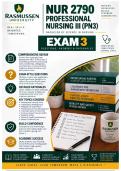
,NUR 2790 Exam 3 | Professional Nursing III (2026) Actual
Q&A PDF | Rasmussen College
1. Which of the following best describes the pathophysiologic mechanism underlying
all forms of shock?
A) Excessive vasodilation leading to hypotension
B) Reduction in oxygenation and tissue perfusion leading to cellular damage
C) Primary cardiac pump failure reducing stroke volume
D) Massive fluid loss from the vascular compartment
Correct Answer: Reduction in oxygenation and tissue perfusion leading to cellular
damage
Rationale: All forms of shock result in decreased oxygen delivery to tissues, causing
cellular hypoxia, metabolic acidosis, and eventual organ dysfunction. While
hypovolemic, cardiogenic, and distributive shocks have different initiating events, the
common final pathway is inadequate tissue perfusion and oxygen delivery. This
cellular damage is the unifying feature, making B the correct overarching description.
2. According to the Surviving Sepsis Campaign, which hemodynamic parameter is the
primary target for initial resuscitation in a patient with septic shock?
A) Central venous pressure of 8–12 mmHg
B) Mean arterial pressure of at least 65 mmHg
C) Cardiac index of 2.5 L/min/m²
D) Pulmonary artery wedge pressure of 12–15 mmHg
Correct Answer: Mean arterial pressure of at least 65 mmHg
,Rationale: The Surviving Sepsis Campaign guidelines recommend a MAP of ≥65
mmHg as the initial resuscitation target to ensure adequate organ perfusion. While
CVP and ScvO₂ are also monitored, MAP is the most direct measure of perfusion
pressure. Achieving this target reduces mortality and prevents progression to multi-
organ failure.
3. A nurse is assessing a patient who is in the compensatory stage of hypovolemic
shock. Which vital sign pattern is most consistent with this stage?
A) Heart rate 120, blood pressure 90/60, respirations 22
B) Heart rate 98, blood pressure 110/70, respirations 16
C) Heart rate 135, blood pressure 85/50, respirations 28
D) Heart rate 110, blood pressure 100/65, respirations 20
Correct Answer: Heart rate 120, blood pressure 90/60, respirations 22
Rationale: In the compensatory stage, sympathetic activation causes tachycardia and
increased respiratory rate to maintain cardiac output. Blood pressure may remain
near normal or slightly low due to vasoconstriction. Option A shows tachycardia with
a mildly low BP, which fits the compensatory response before decompensation
occurs. Options with normal HR/BP do not reflect the sympathetic surge.
4. What is the most likely outcome if a patient in the progressive (decompensated)
stage of shock does not receive timely intervention?
A) Spontaneous recovery due to hormonal compensation
B) Transition to the refractory stage with irreversible cellular death
C) Development of acute kidney injury that fully resolves
D) Chronic hypertension due to renin-angiotensin overactivation
Correct Answer: Transition to the refractory stage with irreversible cellular death
, Rationale: Without intervention, progressive shock leads to worsening tissue
hypoxia, lactic acidosis, and capillary leak, culminating in the refractory stage. In this
final stage, cellular death is irreversible and organ systems fail despite maximal
support. Recovery is no longer possible, making B the correct prognosis. The other
options incorrectly suggest positive or reversible outcomes.
5. Which class of hypovolemic shock corresponds to a blood loss of 15–30% (750–
1500 mL) with tachycardia and a slight drop in blood pressure?
A) Class I
B) Class II
C) Class III
D) Class IV
Correct Answer: Class II
Rationale: Class II hypovolemic shock involves 15–30% blood loss, presenting with
tachycardia (100–120 bpm), mild hypotension, and a narrow pulse pressure. Urine
output remains >20 mL/hr. Class I is <15% loss with no vital sign changes. Class III is
30–40% loss with marked hypotension, and Class IV is >40% with profound
hypotension and anuria.
6. A researcher is studying the inflammatory cascade in sepsis. Which pro-
inflammatory cytokine is considered the primary mediator of the systemic
inflammatory response syndrome (SIRS)?
A) Interleukin-4
B) Tumor necrosis factor-alpha
C) Interleukin-10
D) Transforming growth factor-beta
Q&A PDF | Rasmussen College
1. Which of the following best describes the pathophysiologic mechanism underlying
all forms of shock?
A) Excessive vasodilation leading to hypotension
B) Reduction in oxygenation and tissue perfusion leading to cellular damage
C) Primary cardiac pump failure reducing stroke volume
D) Massive fluid loss from the vascular compartment
Correct Answer: Reduction in oxygenation and tissue perfusion leading to cellular
damage
Rationale: All forms of shock result in decreased oxygen delivery to tissues, causing
cellular hypoxia, metabolic acidosis, and eventual organ dysfunction. While
hypovolemic, cardiogenic, and distributive shocks have different initiating events, the
common final pathway is inadequate tissue perfusion and oxygen delivery. This
cellular damage is the unifying feature, making B the correct overarching description.
2. According to the Surviving Sepsis Campaign, which hemodynamic parameter is the
primary target for initial resuscitation in a patient with septic shock?
A) Central venous pressure of 8–12 mmHg
B) Mean arterial pressure of at least 65 mmHg
C) Cardiac index of 2.5 L/min/m²
D) Pulmonary artery wedge pressure of 12–15 mmHg
Correct Answer: Mean arterial pressure of at least 65 mmHg
,Rationale: The Surviving Sepsis Campaign guidelines recommend a MAP of ≥65
mmHg as the initial resuscitation target to ensure adequate organ perfusion. While
CVP and ScvO₂ are also monitored, MAP is the most direct measure of perfusion
pressure. Achieving this target reduces mortality and prevents progression to multi-
organ failure.
3. A nurse is assessing a patient who is in the compensatory stage of hypovolemic
shock. Which vital sign pattern is most consistent with this stage?
A) Heart rate 120, blood pressure 90/60, respirations 22
B) Heart rate 98, blood pressure 110/70, respirations 16
C) Heart rate 135, blood pressure 85/50, respirations 28
D) Heart rate 110, blood pressure 100/65, respirations 20
Correct Answer: Heart rate 120, blood pressure 90/60, respirations 22
Rationale: In the compensatory stage, sympathetic activation causes tachycardia and
increased respiratory rate to maintain cardiac output. Blood pressure may remain
near normal or slightly low due to vasoconstriction. Option A shows tachycardia with
a mildly low BP, which fits the compensatory response before decompensation
occurs. Options with normal HR/BP do not reflect the sympathetic surge.
4. What is the most likely outcome if a patient in the progressive (decompensated)
stage of shock does not receive timely intervention?
A) Spontaneous recovery due to hormonal compensation
B) Transition to the refractory stage with irreversible cellular death
C) Development of acute kidney injury that fully resolves
D) Chronic hypertension due to renin-angiotensin overactivation
Correct Answer: Transition to the refractory stage with irreversible cellular death
, Rationale: Without intervention, progressive shock leads to worsening tissue
hypoxia, lactic acidosis, and capillary leak, culminating in the refractory stage. In this
final stage, cellular death is irreversible and organ systems fail despite maximal
support. Recovery is no longer possible, making B the correct prognosis. The other
options incorrectly suggest positive or reversible outcomes.
5. Which class of hypovolemic shock corresponds to a blood loss of 15–30% (750–
1500 mL) with tachycardia and a slight drop in blood pressure?
A) Class I
B) Class II
C) Class III
D) Class IV
Correct Answer: Class II
Rationale: Class II hypovolemic shock involves 15–30% blood loss, presenting with
tachycardia (100–120 bpm), mild hypotension, and a narrow pulse pressure. Urine
output remains >20 mL/hr. Class I is <15% loss with no vital sign changes. Class III is
30–40% loss with marked hypotension, and Class IV is >40% with profound
hypotension and anuria.
6. A researcher is studying the inflammatory cascade in sepsis. Which pro-
inflammatory cytokine is considered the primary mediator of the systemic
inflammatory response syndrome (SIRS)?
A) Interleukin-4
B) Tumor necrosis factor-alpha
C) Interleukin-10
D) Transforming growth factor-beta


