
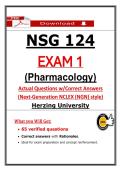
NSG 124
EXAM 1
(Pharmacology)
Actual Questions w/Correct Answers
(Next-Generation NCLEX (NGN) style)
Herzing University
What you Will Get:
• 65 verified questions
• Correct answers with Rationales.
• Ideal for exam preparation and concept reinforcement.
,Question 1. A patient is prescribed a medication that has a high first-pass effect.
The nurse understands that this means:
A. The medication will be rapidly excreted by the kidneys.
B. The medication will have a prolonged half-life.
C. A significant amount of the medication will be inactivated by the liver before reaching
systemic circulation when given orally.
D. The medication is more likely to cause allergic reactions.
Correct Answer: C
Rationale:
A high first-pass effect means a substantial portion of an orally administered drug is
metabolized by the liver before it reaches systemic circulation, reducing its
bioavailability.
Why the other options are incorrect:
Option A: Renal excretion is unrelated to the hepatic first-pass effect.
Option B: Half-life refers to how long it takes the drug concentration to decrease by 50%.
Option D: Allergic reactions are immune-mediated and are not caused by first-pass
metabolism.
Question 2. A drug that binds to a receptor and blocks the action of an
endogenous substance or another drug is known as a(n):
A. Agonist
B. Antagonist
C. Partial agonist
D. Prodrug
Correct Answer: B
Rationale:
An antagonist binds to a receptor but does not activate it. Instead, it blocks or inhibits
the effects of an agonist or endogenous substance.
Why the other options are incorrect:
Option A: An agonist activates a receptor and produces a response.
Option C: A partial agonist activates a receptor but produces a weaker response than a
,full agonist.
Option D: A prodrug is converted into its active form after administration.
Question 3. The nurse is administering a medication with a narrow therapeutic
index. Which action is the priority?
A. Administer the medication with a full glass of water.
B. Monitor the patient closely for signs of drug toxicity.
C. Inform the patient that this medication has minimal side effects.
D. Obtain vital signs only once during the shift.
Correct Answer: B
Rationale:
Drugs with a narrow therapeutic index have a small difference between therapeutic and
toxic concentrations. Close monitoring for adverse effects and toxicity is therefore
essential.
Why the other options are incorrect:
Option A: Water intake does not address the major safety concern.
Option C: Narrow-therapeutic-index medications can produce significant toxicity.
Option D: Monitoring may need to occur more frequently depending on the medication.
Question 4. A patient asks why the physician prescribed the generic form of a
medication instead of the brand-name form. What is the nurse’s best response?
A. “Generic drugs are less effective but are much cheaper.”
B. “Brand-name drugs are usually reserved for more severe illnesses.”
C. “Generic drugs have the same active ingredient as the brand-name drug and are
usually more cost-effective.”
D. “Your insurance probably does not cover the brand-name medication.”
Correct Answer: C
Rationale:
Generic drugs contain the same active ingredient and must meet regulatory standards
for therapeutic equivalence while generally costing less.
Why the other options are incorrect:
Option A: Generic medications are not inherently less effective.
Option B: Disease severity does not determine whether a generic medication may be
used.
, Option D: Insurance coverage may influence cost but is not the fundamental
explanation.
Question 5. Which pharmacokinetic process is most affected by impaired renal
function?
A. Absorption
B. Distribution
C. Metabolism
D. Excretion
Correct Answer: D
Rationale:
The kidneys eliminate many medications and metabolites. Reduced renal function can
decrease drug clearance and increase the risk of accumulation and toxicity.
Why the other options are incorrect:
Option A: Absorption primarily occurs through the gastrointestinal tract or other
administration sites.
Option B: Distribution primarily depends on blood flow, tissue permeability, and protein
binding.
Option C: Most drug metabolism occurs in the liver.
Question 6. A patient experiences an unexpected and uncommon response to a
newly prescribed medication that is likely related to a genetic predisposition.
What type of reaction is this?
A. Allergic reaction
B. Side effect
C. Idiosyncratic reaction
D. Toxic effect
Correct Answer: C
Rationale:
An idiosyncratic reaction is an unusual, unpredictable drug response that can be related
to genetic differences.
Why the other options are incorrect:
Option A: An allergic reaction results from an immune response.
EXAM 1
(Pharmacology)
Actual Questions w/Correct Answers
(Next-Generation NCLEX (NGN) style)
Herzing University
What you Will Get:
• 65 verified questions
• Correct answers with Rationales.
• Ideal for exam preparation and concept reinforcement.
,Question 1. A patient is prescribed a medication that has a high first-pass effect.
The nurse understands that this means:
A. The medication will be rapidly excreted by the kidneys.
B. The medication will have a prolonged half-life.
C. A significant amount of the medication will be inactivated by the liver before reaching
systemic circulation when given orally.
D. The medication is more likely to cause allergic reactions.
Correct Answer: C
Rationale:
A high first-pass effect means a substantial portion of an orally administered drug is
metabolized by the liver before it reaches systemic circulation, reducing its
bioavailability.
Why the other options are incorrect:
Option A: Renal excretion is unrelated to the hepatic first-pass effect.
Option B: Half-life refers to how long it takes the drug concentration to decrease by 50%.
Option D: Allergic reactions are immune-mediated and are not caused by first-pass
metabolism.
Question 2. A drug that binds to a receptor and blocks the action of an
endogenous substance or another drug is known as a(n):
A. Agonist
B. Antagonist
C. Partial agonist
D. Prodrug
Correct Answer: B
Rationale:
An antagonist binds to a receptor but does not activate it. Instead, it blocks or inhibits
the effects of an agonist or endogenous substance.
Why the other options are incorrect:
Option A: An agonist activates a receptor and produces a response.
Option C: A partial agonist activates a receptor but produces a weaker response than a
,full agonist.
Option D: A prodrug is converted into its active form after administration.
Question 3. The nurse is administering a medication with a narrow therapeutic
index. Which action is the priority?
A. Administer the medication with a full glass of water.
B. Monitor the patient closely for signs of drug toxicity.
C. Inform the patient that this medication has minimal side effects.
D. Obtain vital signs only once during the shift.
Correct Answer: B
Rationale:
Drugs with a narrow therapeutic index have a small difference between therapeutic and
toxic concentrations. Close monitoring for adverse effects and toxicity is therefore
essential.
Why the other options are incorrect:
Option A: Water intake does not address the major safety concern.
Option C: Narrow-therapeutic-index medications can produce significant toxicity.
Option D: Monitoring may need to occur more frequently depending on the medication.
Question 4. A patient asks why the physician prescribed the generic form of a
medication instead of the brand-name form. What is the nurse’s best response?
A. “Generic drugs are less effective but are much cheaper.”
B. “Brand-name drugs are usually reserved for more severe illnesses.”
C. “Generic drugs have the same active ingredient as the brand-name drug and are
usually more cost-effective.”
D. “Your insurance probably does not cover the brand-name medication.”
Correct Answer: C
Rationale:
Generic drugs contain the same active ingredient and must meet regulatory standards
for therapeutic equivalence while generally costing less.
Why the other options are incorrect:
Option A: Generic medications are not inherently less effective.
Option B: Disease severity does not determine whether a generic medication may be
used.
, Option D: Insurance coverage may influence cost but is not the fundamental
explanation.
Question 5. Which pharmacokinetic process is most affected by impaired renal
function?
A. Absorption
B. Distribution
C. Metabolism
D. Excretion
Correct Answer: D
Rationale:
The kidneys eliminate many medications and metabolites. Reduced renal function can
decrease drug clearance and increase the risk of accumulation and toxicity.
Why the other options are incorrect:
Option A: Absorption primarily occurs through the gastrointestinal tract or other
administration sites.
Option B: Distribution primarily depends on blood flow, tissue permeability, and protein
binding.
Option C: Most drug metabolism occurs in the liver.
Question 6. A patient experiences an unexpected and uncommon response to a
newly prescribed medication that is likely related to a genetic predisposition.
What type of reaction is this?
A. Allergic reaction
B. Side effect
C. Idiosyncratic reaction
D. Toxic effect
Correct Answer: C
Rationale:
An idiosyncratic reaction is an unusual, unpredictable drug response that can be related
to genetic differences.
Why the other options are incorrect:
Option A: An allergic reaction results from an immune response.


