

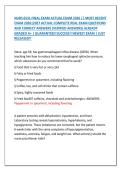
NURS 6531 FINAL EXAM ACTUAL EXAM 2026 || MOST RECENT
EXAM 2026|2027 ACTUAL COMPLETE REAL EXAM QUESTIONS
AND CORRECT ANSWERS (VERIFIED ANSWERS) ALREADY
GRADED A+ | GUARANTEED SUCCESS!! NEWEST EXAM | JUST
RELEASED!!
Steve, age 69, has gastroesophageal reflux disease (GERD). When
teaching him how to reduce his lower esophageal sphincter pressure,
which substances do you recommend that he avoid?
§ Food that is very hot or very cold
§ Fatty or fried foods
§ Peppermint or spearmint, including flavoring
§ Coffee, tea, and soft drinks that contain caffeine
§ Spicy, highly seasoned foods
§ Fried foodDT caffeine, chocolate and anticholinergics -ANSWERS-
Peppermint or spearmint, including flavoring
A patient presents with dehydration, hypotension, and fever.
Laboratory testing reveals hyponatremia, hyperkalemia, and
hypoglycemia. These imbalances are corrected, but the patient returns
6 weeks later with the same symptoms of hyperpigmentation,
weakness, anorexia, fatigue, and weight loss. What action(s) should the
nurse practitioner take?
,.A Obtain a thorough history and physical, and check serum cortisol and
ACTH levels.
B. Perform a diet history and check CBC and FBS.
C. Provide nutritional guidance and have the patient return in one
month.
D. Consult home health for intravenous administration -ANSWERS-A.
Obtain a thorough history and physical, and serum cortisol and ACTH
levels
Which of the following is a potential acquired cause of thrombophilia?
A. Homocysteinuria
B. Protein C deficiency
C. Factor V Leiden
D. Antiphospholipid antibodies -ANSWERS-D. Antiphospholipid
antibodies
, A 75-year-old female is diagnosed with primary hyperparathyroidism
and asks the nurse practitioner what the treatment for this disorder is.
The nurse practitioner explains:
Primary hyperparathyroidism is treated with Vitamin D restriction
Primary hyperparathyroidism is treated with parathyroidectomy
Primary hyperparathyroidism is treated with daily magnesium
Primary hyperparathyroidism is treated with parenteral parathyroid
hormone (PTH) -ANSWERS-Primary hyperparathyroidism is treated with
parathyroidectomy
A 25 year old overweight patient presents with a complaint of dull
achiness in his groin and history of a palpable lump in his scrotum that
"comes and goes". On physical examination, the nurse practitioner
does not detect a scrotal mass. There is no tenderness, edema, or
erythema of the scrotum, the scrotum does not transilluminate. What
is the most likely diagnosis?
A. Testicular torsion
B. Epididymitis
C. Inguinal hernia
EXAM 2026|2027 ACTUAL COMPLETE REAL EXAM QUESTIONS
AND CORRECT ANSWERS (VERIFIED ANSWERS) ALREADY
GRADED A+ | GUARANTEED SUCCESS!! NEWEST EXAM | JUST
RELEASED!!
Steve, age 69, has gastroesophageal reflux disease (GERD). When
teaching him how to reduce his lower esophageal sphincter pressure,
which substances do you recommend that he avoid?
§ Food that is very hot or very cold
§ Fatty or fried foods
§ Peppermint or spearmint, including flavoring
§ Coffee, tea, and soft drinks that contain caffeine
§ Spicy, highly seasoned foods
§ Fried foodDT caffeine, chocolate and anticholinergics -ANSWERS-
Peppermint or spearmint, including flavoring
A patient presents with dehydration, hypotension, and fever.
Laboratory testing reveals hyponatremia, hyperkalemia, and
hypoglycemia. These imbalances are corrected, but the patient returns
6 weeks later with the same symptoms of hyperpigmentation,
weakness, anorexia, fatigue, and weight loss. What action(s) should the
nurse practitioner take?
,.A Obtain a thorough history and physical, and check serum cortisol and
ACTH levels.
B. Perform a diet history and check CBC and FBS.
C. Provide nutritional guidance and have the patient return in one
month.
D. Consult home health for intravenous administration -ANSWERS-A.
Obtain a thorough history and physical, and serum cortisol and ACTH
levels
Which of the following is a potential acquired cause of thrombophilia?
A. Homocysteinuria
B. Protein C deficiency
C. Factor V Leiden
D. Antiphospholipid antibodies -ANSWERS-D. Antiphospholipid
antibodies
, A 75-year-old female is diagnosed with primary hyperparathyroidism
and asks the nurse practitioner what the treatment for this disorder is.
The nurse practitioner explains:
Primary hyperparathyroidism is treated with Vitamin D restriction
Primary hyperparathyroidism is treated with parathyroidectomy
Primary hyperparathyroidism is treated with daily magnesium
Primary hyperparathyroidism is treated with parenteral parathyroid
hormone (PTH) -ANSWERS-Primary hyperparathyroidism is treated with
parathyroidectomy
A 25 year old overweight patient presents with a complaint of dull
achiness in his groin and history of a palpable lump in his scrotum that
"comes and goes". On physical examination, the nurse practitioner
does not detect a scrotal mass. There is no tenderness, edema, or
erythema of the scrotum, the scrotum does not transilluminate. What
is the most likely diagnosis?
A. Testicular torsion
B. Epididymitis
C. Inguinal hernia


