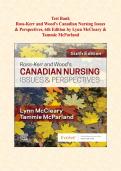
Prepare for your nursing exams with the ultimate study companion! This comprehensive test bank is specifically designed to accompany Ross-Kerr and Wood's Canadian Nursing Issues & Perspectives, 6th Edition. Written by experts Lynn McCleary and Tammie McParland, this resource is an invaluable tool for nursing students across Canada.
Test Bank for Ross-Kerr and Wood's Canadian Nursing Issues & Perspectives, 6th Edition by Lynn McCleary & Tammie McParland |A Comprehensive Review of Over 700 Multiple-Choice Questions and Correct Verified Answers with Rationales
TABLE OF CONTENTS
Part Chapter Title Question Numbers
Part I: The Profession in Canada 1 The Canadian Health Care System 1-28
2 Nursing in Canada, 1600s to the Present: A Brief Account 29-56
3 Professionalization in Canadian Nursing 57-84
4 The Professional Image: Impact and Strategies for Change 85-112
5 Gender in Nursing 113-140
Part II: Nursing Knowledge 6 Theoretical Issues in Nursing in the Twenty-First Century 141-168
7 Thinking Philosophically in Nursing 169-196
8 Nursing Research in Canada 197-224
9 Knowledge Translation and Evidence-Informed Practice 225-252
10 Nursing Informatics and Digital Health 253-280
Part III: Nursing Care Delivery 11 Primary Health Care: Challenges and Opportunities 281-308
12 Quality of Care: From Quality Assurance to Cultures of Patient Safety 309-336
13 The Practicing Nurse and the Law 337-364
14 Decolonizing and Anti-Oppressive Nursing Practice 365-392
15 Ethical Issues and Dilemmas in Nursing Practice 393-420
16 Collaboration in Nursing Practice 421-448
17 Shortage or Oversupply? The Nursing Workforce Pendulum 449-476
18 Political Influence in Nursing 477-504
19 Nursing Unions as a Social Force in Canada 505-532
Part IV: Educating Nurses for the Future 20 The Origins and Development of Nursing Education in Canada 533-560
21 Licensure, Credentialing, and Entry to Practice in Nursing 561-588
22 The Growth of Graduate Education in Nursing in Canada 589-616
23 Career Development in Nursing 617-644
24 Monitoring Standards in Nursing Education 645-672
Part V: Canadian and International Nursing 25 Global Health Nursing: Emerging Issues and Events 673-700
26 Internationalization in Canadian Nursing 701-728
PART I: THE PROFESSION IN CANADA
CHAPTER 1: THE CANADIAN HEALTH CARE SYSTEM
________________________________________
1. Which of the following is a fundamental principle of the Canada Health Act (1984)?
• A. Profit-driven healthcare delivery
• B. Private insurance for all services
• C. Universality
• D. User fees for all medical services
Answer: C
Rationale: The Canada Health Act (1984) establishes five fundamental principles: public administration, comprehensiveness, universality, portability, and accessibility. Universality ensures that all insured residents have equal access to health services on uniform terms and conditions, without discrimination based on income, age, or health status. Options A, B, and D contradict the principles of the Act, which prohibits user fees and extra-billing while promoting publicly administered, non-profit healthcare delivery.
DIF: Knowledge REF: Chapter 1 OBJ: 1 KEY: Canada Health Act MSC: Health Policy
________________________________________
2. Which level of government in Canada is primarily responsible for the delivery of healthcare services?
• A. Federal government
• B. Provincial and territorial governments
• C. Municipal governments
• D. Regional health authorities only
Answer: B
Rationale: Under the Canadian Constitution, provincial and territorial governments bear primary responsibility for the administration and delivery of healthcare services. They are responsible for planning, financing, and evaluating healthcare services, as well as managing hospitals, physician services, and other health programs. The federal government provides funding through the Canada Health Transfer and sets national standards under the Canada Health Act but does not directly deliver healthcare services.
DIF: Comprehension REF: Chapter 1 OBJ: 2 KEY: Government responsibility MSC: Health Policy
________________________________________
3. The Canada Health Act (1984) prohibits which of the following practices?
• A. Public health promotion
• B. Extra-billing and user fees
• C. Preventive healthcare services
• D. Interprofessional collaboration
Answer: B
Rationale: The Canada Health Act specifically prohibits extra-billing (charging patients amounts beyond what is covered by provincial health insurance) and user fees for insured health services. These prohibitions are designed to maintain equity and accessibility in the Canadian healthcare system. The Act does not prohibit public health promotion, preventive services, or interprofessional collaboration, which are encouraged components of the healthcare system.
DIF: Knowledge REF: Chapter 1 OBJ: 1 KEY: Canada Health Act MSC: Health Policy
________________________________________
4. Which of the following is a major challenge currently facing the Canadian health care system?
• A. Declining life expectancy
• B. An aging population
• C. Decreasing healthcare costs
• D. Oversupply of healthcare providers
Answer: B
Rationale: Canada faces multiple interrelated challenges that directly impact nursing practice and patient safety, including an aging population with increased life expectancy leading to higher prevalence of chronic illness, multimorbidity, and polypharmacy. Other challenges include concerns about patient safety, service delivery, fiscal constraints, and the high cost of new technology and drugs. Declining life expectancy and decreasing costs are not current realities; rather, costs are increasing and life expectancy continues to rise.
DIF: Comprehension REF: Chapter 1 OBJ: 3 KEY: Health system challenges MSC: Healthcare Delivery
________________________________________
5. The Canadian health care system is best described as which type of system?
• A. A fully privatized system
• B. A publicly funded, privately delivered system
• C. A fully socialized system
• D. An insurance-based American-style system
Answer: B
Rationale: Canada's healthcare system is publicly funded through taxation but privately delivered. The government acts as the single payer (public funding) for medically necessary hospital and physician services, but healthcare providers are generally not government employees (private delivery). This distinguishes Canada's system from fully socialized systems (where government both funds and delivers care) and fully privatized systems (where both funding and delivery are private).
Content preview
Test Bank
Ross-Kerr and Wood's Canadian Nursing Issues
& Perspectives, 6th Edition by Lynn McCleary &
Tammie McParland
,Test Bank for Ross-Kerr and Wood's Canadian
Nursing Issues & Perspectives, 6th Edition by Lynn
McCleary & Tammie McParland |A Comprehensive
Review of Over 700 Multiple-Choice Questions and
Correct Verified Answers with Rationales
TABLE OF CONTENTS
Question
Part Chapter Title
Numbers
Part I: The
The Canadian Health Care
Profession in 1 1-28
System
Canada
Nursing in Canada, 1600s
2 to the Present: A Brief 29-56
Account
Professionalization in
3 57-84
Canadian Nursing
The Professional Image:
4 Impact and Strategies for 85-112
Change
5 Gender in Nursing 113-140
Theoretical Issues in
Part II: Nursing
6 Nursing in the Twenty-First 141-168
Knowledge
Century
Thinking Philosophically in
7 169-196
Nursing
, Question
Part Chapter Title
Numbers
Nursing Research in
8 197-224
Canada
Knowledge Translation and
9 Evidence-Informed 225-252
Practice
Nursing Informatics and
10 253-280
Digital Health
Primary Health Care:
Part III: Nursing
11 Challenges and 281-308
Care Delivery
Opportunities
Quality of Care: From
12 Quality Assurance to 309-336
Cultures of Patient Safety
The Practicing Nurse and
13 337-364
the Law
Decolonizing and Anti-
14 Oppressive Nursing 365-392
Practice
Ethical Issues and
15 Dilemmas in Nursing 393-420
Practice
Collaboration in Nursing
16 421-448
Practice
Shortage or Oversupply?
17 The Nursing Workforce 449-476
Pendulum
, Question
Part Chapter Title
Numbers
Political Influence in
18 477-504
Nursing
Nursing Unions as a Social
19 505-532
Force in Canada
Part IV: The Origins and
Educating Nurses 20 Development of Nursing 533-560
for the Future Education in Canada
Licensure, Credentialing,
21 and Entry to Practice in 561-588
Nursing
The Growth of Graduate
22 Education in Nursing in 589-616
Canada
Career Development in
23 617-644
Nursing
Monitoring Standards in
24 645-672
Nursing Education
Part V: Canadian Global Health Nursing:
and International 25 Emerging Issues and 673-700
Nursing Events
Internationalization in
26 701-728
Canadian Nursing