

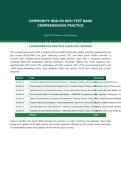
COMMUNITY HEALTH HESI TEST BANK
COMPREHENSIVE PRACTICE
2026/2027 Edition • 620 Questions
COMMUNITY HEALTH HESI TEST BANK
COMPREHENSIVE PRACTICE (2026/2027 EDITION)
This comprehensive test bank is aligned with the HESI Community Health specialty assessment and
the current NCLEX-RN® test plan, reflecting current CDC and WHO public health priorities. It
contains 620 multiple-choice questions across eight sections, each with a complete rationale,
including NGN-style integrated scenario questions. Coverage reflects the exam cognitive mix:
approximately 30% recall, 50% application, and 20% analysis, with ≈75% scenario-based items and
≈25% direct-knowledge items. Each question offers four options (A–D) with exactly one correct
response.
Section Topic Questions
Section 1 Community Health Nursing Theory & Practice – Population Health, Community75
Assessment, CHN Process
Section 2 Epidemiology & Communicable Disease Control – Epidemiological Triangle, Attack
85 Rate, Levels of Prevention,
Section 3 Health Promotion & Disease Prevention – Primary/Secondary/Tertiary Prevention,
80 Health Behavior Models, Scr
Section 4 Environmental Health & Vulnerable Populations – I PREPARE, Occupational Health,
75 Homeless, Immigrants, Env
Section 5 Disaster Preparedness & Emergency Management – Disaster Phases, Triage, Public
70 Health Response, Mitigatio
Section 6 Program Planning & Evaluation – Needs Assessment, Outcome vs. Process Evaluation,
70 Evidence-Based Practic
Section 7 Case Management & Client Advocacy – Referrals, Confidentiality, HIPAA, Client
65Rights, Home Health, Interdisc
Section 8 Integrated Scenario-Based Questions – NGN-Style Bow-Tie, Matrix, Cloze, and 100
Complex Community Health Sce
TOTAL 620
How to use this test bank: Work through the sections in order, marking your answers. Each item
shows four options (A–D) with exactly one correct response, followed by the answer and a rationale.
A consolidated answer key appears at the end for quick scoring.
,COMMUNITY HEALTH HESI TEST BANK — COMPREHENSIVE PRACTICE 2026/2027 Edition
Section 1: Community Health Nursing Theory & Practice – Population Health,
Community Assessment, CHN Process
Q1: Community-ORIENTED nursing focuses primarily on:
A. health promotion and disease prevention for entire populations [CORRECT]
B. illness care for individuals in clinics
C. acute hospital care
D. reimbursement and billing
Correct Answer: A
Rationale: Community-oriented nursing aims to improve the health of whole populations.
Q2: Community-BASED nursing focuses primarily on:
A. providing direct illness care to individuals and families in community settings [CORRECT]
B. population-wide prevention
C. policy development only
D. hospital staffing
Correct Answer: A
Rationale: Community-based nursing delivers illness care to individuals/families where they live.
Q3: Population health focuses on:
A. the health outcomes of a group of individuals [CORRECT]
B. a single patient's diagnosis
C. hospital revenue
D. individual insurance claims
Correct Answer: A
Rationale: Population health examines outcomes and distribution within a defined group.
Q4: The Community Health Nursing (CHN) process follows which sequence?
A. Assessment, diagnosis, planning, implementation, evaluation [CORRECT]
B. Diagnosis, assessment, evaluation, planning, implementation
C. Planning, implementation, assessment, diagnosis, evaluation
D. Evaluation, assessment, diagnosis, planning, implementation
Correct Answer: A
Rationale: The CHN process mirrors the nursing process (ADPIE) applied to communities.
Q5: A windshield survey is BEST described as:
A. observing community characteristics while driving or walking through the area [CORRECT]
B. a survey of car windshields
C. an individual patient interview
D. a laboratory test
Correct Answer: A
Rationale: The windshield survey is observational community assessment.
Q6: Community health diagnosis differs from an individual nursing diagnosis because it:
A. identifies community health problems and their influencing factors [CORRECT]
B. names a single patient's disease
C. is made by physicians
D. requires laboratory confirmation
Correct Answer: A
Rationale: Community diagnoses address population-level problems and their determinants.
Page 2 of 109
,COMMUNITY HEALTH HESI TEST BANK — COMPREHENSIVE PRACTICE 2026/2027 Edition
Q7: Which is a key principle of community health nursing?
A. Equitable distribution of resources [CORRECT]
B. Care for only the insured
C. Hospital-based care only
D. Individual-only focus
Correct Answer: A
Rationale: Equity, partnerships, and population focus are core CHN principles.
Q8: Community partnerships in public health are important because they:
A. engage stakeholders and share resources to address community needs [CORRECT]
B. increase hospital profits
C. reduce community involvement
D. replace evidence-based practice
Correct Answer: A
Rationale: Partnerships mobilize resources and community ownership.
Q9: Evidence-based practice in community health integrates:
A. best evidence, clinical expertise, and client values and preferences [CORRECT]
B. tradition only
C. provider preference only
D. cost alone
Correct Answer: A
Rationale: EBP combines evidence, expertise, and patient/community values.
Q10: The 'community as client' concept means the nurse:
A. treats the community itself as the focus of assessment and intervention [CORRECT]
B. only treats individual clients
C. avoids community data
D. works only in hospitals
Correct Answer: A
Rationale: The community is the unit of care in community health nursing.
Q11: Which is an example of a community demographic characteristic?
A. Age distribution of residents [CORRECT]
B. A single patient's blood pressure
C. One family's income
D. A nurse's schedule
Correct Answer: A
Rationale: Demographics describe population characteristics such as age, sex, and race.
Q12: Social determinants of health include:
A. income, education, housing, and access to care [CORRECT]
B. genetics only
C. hospital bed count only
D. laboratory values
Correct Answer: A
Rationale: Social determinants are the conditions where people live, learn, work, and play.
Page 3 of 109
, COMMUNITY HEALTH HESI TEST BANK — COMPREHENSIVE PRACTICE 2026/2027 Edition
Q13: The primary goal of a community health needs assessment is to:
A. identify the health needs and priorities of the community [CORRECT]
B. increase hospital admissions
C. reduce nursing documentation
D. bill insurance
Correct Answer: A
Rationale: Needs assessment identifies gaps and priorities for planning.
Q14: Primary data for a community assessment is:
A. collected directly by the nurse (e.g., interviews, observations) [CORRECT]
B. published statistics
C. census data only
D. vital records only
Correct Answer: A
Rationale: Primary data are gathered firsthand; secondary data come from existing sources.
Q15: Secondary data for community assessment includes:
A. census data and vital statistics [CORRECT]
B. the nurse's own observations
C. interviews the nurse conducts
D. a windshield survey
Correct Answer: A
Rationale: Secondary data are existing records such as census and vital statistics.
Q16: Vital statistics include data on:
A. births, deaths, marriages, and divorces [CORRECT]
B. hospital profits
C. insurance premiums
D. nurse staffing ratios
Correct Answer: A
Rationale: Vital statistics record life events (births, deaths, marriages).
Q17: A community health nurse uses the Omaha System to:
A. classify client problems, interventions, and outcomes in community settings [CORRECT]
B. prescribe medications
C. calculate insurance premiums
D. schedule surgeries
Correct Answer: A
Rationale: The Omaha System is a standardized community/public health classification tool.
Q18: The Health Belief Model predicts that a person will take action if they:
A. perceive susceptibility, severity, benefits, and few barriers [CORRECT]
B. have no perceived risk
C. ignore all cues
D. avoid self-efficacy
Correct Answer: A
Rationale: Perceived susceptibility, severity, benefits, and low barriers drive action.
Page 4 of 109
COMPREHENSIVE PRACTICE
2026/2027 Edition • 620 Questions
COMMUNITY HEALTH HESI TEST BANK
COMPREHENSIVE PRACTICE (2026/2027 EDITION)
This comprehensive test bank is aligned with the HESI Community Health specialty assessment and
the current NCLEX-RN® test plan, reflecting current CDC and WHO public health priorities. It
contains 620 multiple-choice questions across eight sections, each with a complete rationale,
including NGN-style integrated scenario questions. Coverage reflects the exam cognitive mix:
approximately 30% recall, 50% application, and 20% analysis, with ≈75% scenario-based items and
≈25% direct-knowledge items. Each question offers four options (A–D) with exactly one correct
response.
Section Topic Questions
Section 1 Community Health Nursing Theory & Practice – Population Health, Community75
Assessment, CHN Process
Section 2 Epidemiology & Communicable Disease Control – Epidemiological Triangle, Attack
85 Rate, Levels of Prevention,
Section 3 Health Promotion & Disease Prevention – Primary/Secondary/Tertiary Prevention,
80 Health Behavior Models, Scr
Section 4 Environmental Health & Vulnerable Populations – I PREPARE, Occupational Health,
75 Homeless, Immigrants, Env
Section 5 Disaster Preparedness & Emergency Management – Disaster Phases, Triage, Public
70 Health Response, Mitigatio
Section 6 Program Planning & Evaluation – Needs Assessment, Outcome vs. Process Evaluation,
70 Evidence-Based Practic
Section 7 Case Management & Client Advocacy – Referrals, Confidentiality, HIPAA, Client
65Rights, Home Health, Interdisc
Section 8 Integrated Scenario-Based Questions – NGN-Style Bow-Tie, Matrix, Cloze, and 100
Complex Community Health Sce
TOTAL 620
How to use this test bank: Work through the sections in order, marking your answers. Each item
shows four options (A–D) with exactly one correct response, followed by the answer and a rationale.
A consolidated answer key appears at the end for quick scoring.
,COMMUNITY HEALTH HESI TEST BANK — COMPREHENSIVE PRACTICE 2026/2027 Edition
Section 1: Community Health Nursing Theory & Practice – Population Health,
Community Assessment, CHN Process
Q1: Community-ORIENTED nursing focuses primarily on:
A. health promotion and disease prevention for entire populations [CORRECT]
B. illness care for individuals in clinics
C. acute hospital care
D. reimbursement and billing
Correct Answer: A
Rationale: Community-oriented nursing aims to improve the health of whole populations.
Q2: Community-BASED nursing focuses primarily on:
A. providing direct illness care to individuals and families in community settings [CORRECT]
B. population-wide prevention
C. policy development only
D. hospital staffing
Correct Answer: A
Rationale: Community-based nursing delivers illness care to individuals/families where they live.
Q3: Population health focuses on:
A. the health outcomes of a group of individuals [CORRECT]
B. a single patient's diagnosis
C. hospital revenue
D. individual insurance claims
Correct Answer: A
Rationale: Population health examines outcomes and distribution within a defined group.
Q4: The Community Health Nursing (CHN) process follows which sequence?
A. Assessment, diagnosis, planning, implementation, evaluation [CORRECT]
B. Diagnosis, assessment, evaluation, planning, implementation
C. Planning, implementation, assessment, diagnosis, evaluation
D. Evaluation, assessment, diagnosis, planning, implementation
Correct Answer: A
Rationale: The CHN process mirrors the nursing process (ADPIE) applied to communities.
Q5: A windshield survey is BEST described as:
A. observing community characteristics while driving or walking through the area [CORRECT]
B. a survey of car windshields
C. an individual patient interview
D. a laboratory test
Correct Answer: A
Rationale: The windshield survey is observational community assessment.
Q6: Community health diagnosis differs from an individual nursing diagnosis because it:
A. identifies community health problems and their influencing factors [CORRECT]
B. names a single patient's disease
C. is made by physicians
D. requires laboratory confirmation
Correct Answer: A
Rationale: Community diagnoses address population-level problems and their determinants.
Page 2 of 109
,COMMUNITY HEALTH HESI TEST BANK — COMPREHENSIVE PRACTICE 2026/2027 Edition
Q7: Which is a key principle of community health nursing?
A. Equitable distribution of resources [CORRECT]
B. Care for only the insured
C. Hospital-based care only
D. Individual-only focus
Correct Answer: A
Rationale: Equity, partnerships, and population focus are core CHN principles.
Q8: Community partnerships in public health are important because they:
A. engage stakeholders and share resources to address community needs [CORRECT]
B. increase hospital profits
C. reduce community involvement
D. replace evidence-based practice
Correct Answer: A
Rationale: Partnerships mobilize resources and community ownership.
Q9: Evidence-based practice in community health integrates:
A. best evidence, clinical expertise, and client values and preferences [CORRECT]
B. tradition only
C. provider preference only
D. cost alone
Correct Answer: A
Rationale: EBP combines evidence, expertise, and patient/community values.
Q10: The 'community as client' concept means the nurse:
A. treats the community itself as the focus of assessment and intervention [CORRECT]
B. only treats individual clients
C. avoids community data
D. works only in hospitals
Correct Answer: A
Rationale: The community is the unit of care in community health nursing.
Q11: Which is an example of a community demographic characteristic?
A. Age distribution of residents [CORRECT]
B. A single patient's blood pressure
C. One family's income
D. A nurse's schedule
Correct Answer: A
Rationale: Demographics describe population characteristics such as age, sex, and race.
Q12: Social determinants of health include:
A. income, education, housing, and access to care [CORRECT]
B. genetics only
C. hospital bed count only
D. laboratory values
Correct Answer: A
Rationale: Social determinants are the conditions where people live, learn, work, and play.
Page 3 of 109
, COMMUNITY HEALTH HESI TEST BANK — COMPREHENSIVE PRACTICE 2026/2027 Edition
Q13: The primary goal of a community health needs assessment is to:
A. identify the health needs and priorities of the community [CORRECT]
B. increase hospital admissions
C. reduce nursing documentation
D. bill insurance
Correct Answer: A
Rationale: Needs assessment identifies gaps and priorities for planning.
Q14: Primary data for a community assessment is:
A. collected directly by the nurse (e.g., interviews, observations) [CORRECT]
B. published statistics
C. census data only
D. vital records only
Correct Answer: A
Rationale: Primary data are gathered firsthand; secondary data come from existing sources.
Q15: Secondary data for community assessment includes:
A. census data and vital statistics [CORRECT]
B. the nurse's own observations
C. interviews the nurse conducts
D. a windshield survey
Correct Answer: A
Rationale: Secondary data are existing records such as census and vital statistics.
Q16: Vital statistics include data on:
A. births, deaths, marriages, and divorces [CORRECT]
B. hospital profits
C. insurance premiums
D. nurse staffing ratios
Correct Answer: A
Rationale: Vital statistics record life events (births, deaths, marriages).
Q17: A community health nurse uses the Omaha System to:
A. classify client problems, interventions, and outcomes in community settings [CORRECT]
B. prescribe medications
C. calculate insurance premiums
D. schedule surgeries
Correct Answer: A
Rationale: The Omaha System is a standardized community/public health classification tool.
Q18: The Health Belief Model predicts that a person will take action if they:
A. perceive susceptibility, severity, benefits, and few barriers [CORRECT]
B. have no perceived risk
C. ignore all cues
D. avoid self-efficacy
Correct Answer: A
Rationale: Perceived susceptibility, severity, benefits, and low barriers drive action.
Page 4 of 109


