

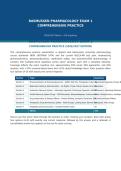
RASMUSSEN PHARMACOLOGY EXAM 1
COMPREHENSIVE PRACTICE
2026/2027 Edition • 150 Questions
RASMUSSEN PHARMACOLOGY EXAM 1
COMPREHENSIVE PRACTICE (2026/2027 EDITION)
This comprehensive practice examination is aligned with Rasmussen University pharmacology
course standards (NUR 2407/NUR 2474) and the current NCLEX-RN test plan, emphasizing
pharmacokinetics, pharmacodynamics, medication safety, and autonomic/CNS pharmacology. It
contains 150 multiple-choice questions across seven sections, each with a complete rationale.
Coverage reflects the exam cognitive mix: approximately 30% recall, 50% application, and 20%
analysis, with ≈75% scenario-based items and ≈25% direct-knowledge items. Each question offers
four options (A–D) with exactly one correct response.
Section Topic Questions
Section 1 Pharmacokinetics & Pharmacodynamics – ADME, Half-Life, Therapeutic Index,30
Agonists/Antagonists, Protein B
Section 2 Medication Safety & Administration – Six Rights, Three Checks, Routes, Error Prevention
20
Section 3 Autonomic Nervous System – Adrenergic Agonists, Cholinergic Agonists, Anticholinergics,
30 Adrenergic Blockers
Section 4 Central Nervous System Drugs – CNS Stimulants, Benzodiazepines, Anticonvulsants,
25 Antipsychotics, Antidepre
Section 5 Drug Interactions & Adverse Effects – Protein Binding, Serotonin Syndrome, EPS,
20 Anticholinergic Effects
Section 6 Therapeutic Drug Monitoring & Safety – Peak/Trough, Loading Dose, Narrow Therapeutic
15 Index Drugs
Section 7 Integrated Clinical Scenarios – Complex Patient Cases 10
TOTAL 150
How to use this exam: Work through the sections in order, marking your answers. Each item shows
four options (A–D) with exactly one correct response, followed by the answer and a rationale. A
consolidated answer key appears at the end for quick scoring.
,RASMUSSEN PHARMACOLOGY EXAM 1 — COMPREHENSIVE PRACTICE 2026/2027 Edition
Section 1: Pharmacokinetics & Pharmacodynamics – ADME, Half-Life, Therapeutic
Index, Agonists/Antagonists, Protein Binding
Q1: Pharmacokinetics is BEST defined as the study of:
A. how the body processes a drug (absorption, distribution, metabolism, excretion) [CORRECT]
B. how a drug affects the body
C. the study of poisons
D. the study of drug names
Correct Answer: A
Rationale: Pharmacokinetics describes what the body does to a drug: ADME.
Q2: The four processes of pharmacokinetics are:
A. absorption, distribution, metabolism, and excretion [CORRECT]
B. absorption, distribution, metabolism, and elimination only
C. absorption, digestion, metabolism, excretion
D. agonism, distribution, metabolism, excretion
Correct Answer: A
Rationale: ADME - absorption, distribution, metabolism, excretion - are the four pharmacokinetic processes.
Q3: Distribution is BEST defined as:
A. movement of a drug from the bloodstream to tissues [CORRECT]
B. movement of a drug from the GI tract to blood
C. breakdown of a drug in the liver
D. removal of a drug by the kidneys
Correct Answer: A
Rationale: Distribution is the transport of drug from blood into tissues and target sites.
Q4: The PRIMARY site of drug metabolism is the:
A. liver [CORRECT]
B. kidney
C. lungs
D. stomach
Correct Answer: A
Rationale: The liver is the main site of metabolism, largely via cytochrome P450 enzymes.
Q5: Cytochrome P450 (CYP450) enzymes are primarily responsible for:
A. drug metabolism in the liver [CORRECT]
B. drug absorption
C. renal excretion
D. protein binding
Correct Answer: A
Rationale: CYP450 enzymes metabolize many drugs in the liver.
Q6: The PRIMARY organ for excretion of most drugs is the:
A. kidneys [CORRECT]
B. liver
C. lungs
D. skin
Correct Answer: A
Rationale: Most drugs and their metabolites are excreted by the kidneys.
Page 2 of 29
, RASMUSSEN PHARMACOLOGY EXAM 1 — COMPREHENSIVE PRACTICE 2026/2027 Edition
Q7: The first-pass effect refers to:
A. hepatic metabolism of an oral drug before it reaches systemic circulation [CORRECT]
B. the first dose of a drug
C. the first drug given in an emergency
D. rapid renal clearance
Correct Answer: A
Rationale: Oral drugs pass through the liver first, reducing the amount reaching circulation.
Q8: Bioavailability is BEST defined as:
A. the percentage of an administered dose that reaches systemic circulation [CORRECT]
B. the speed of drug absorption
C. the degree of protein binding
D. the duration of drug action
Correct Answer: A
Rationale: Bioavailability is the fraction of the dose reaching systemic circulation unchanged.
Q9: Which route provides 100% bioavailability?
A. Intravenous (IV) [CORRECT]
B. Oral (PO)
C. Subcutaneous
D. Intramuscular
Correct Answer: A
Rationale: IV drugs bypass absorption and first-pass metabolism, giving 100% bioavailability.
Q10: The half-life of a drug is the time required for:
A. the drug concentration to decrease by 50% [CORRECT]
B. the drug to reach peak effect
C. the drug to be completely eliminated
D. the drug to bind to receptors
Correct Answer: A
Rationale: Half-life is the time for plasma concentration to fall by half.
Q11: A drug has a half-life of 4 hours. After 12 hours, what fraction of the drug remains?
A. 12.5% (three half-lives) [CORRECT]
B. 50%
C. 25%
D. 0%
Correct Answer: A
Rationale: 12 hours = 3 half-lives: 100% to 50% to 25% to 12.5%.
Q12: The therapeutic index is BEST defined as:
A. the margin of safety between the therapeutic dose and the toxic dose [CORRECT]
B. the ratio of drug to receptor
C. the number of doses needed for cure
D. the time to peak effect
Correct Answer: A
Rationale: The therapeutic index compares effective and toxic doses; a narrow index needs close monitoring.
Page 3 of 29
COMPREHENSIVE PRACTICE
2026/2027 Edition • 150 Questions
RASMUSSEN PHARMACOLOGY EXAM 1
COMPREHENSIVE PRACTICE (2026/2027 EDITION)
This comprehensive practice examination is aligned with Rasmussen University pharmacology
course standards (NUR 2407/NUR 2474) and the current NCLEX-RN test plan, emphasizing
pharmacokinetics, pharmacodynamics, medication safety, and autonomic/CNS pharmacology. It
contains 150 multiple-choice questions across seven sections, each with a complete rationale.
Coverage reflects the exam cognitive mix: approximately 30% recall, 50% application, and 20%
analysis, with ≈75% scenario-based items and ≈25% direct-knowledge items. Each question offers
four options (A–D) with exactly one correct response.
Section Topic Questions
Section 1 Pharmacokinetics & Pharmacodynamics – ADME, Half-Life, Therapeutic Index,30
Agonists/Antagonists, Protein B
Section 2 Medication Safety & Administration – Six Rights, Three Checks, Routes, Error Prevention
20
Section 3 Autonomic Nervous System – Adrenergic Agonists, Cholinergic Agonists, Anticholinergics,
30 Adrenergic Blockers
Section 4 Central Nervous System Drugs – CNS Stimulants, Benzodiazepines, Anticonvulsants,
25 Antipsychotics, Antidepre
Section 5 Drug Interactions & Adverse Effects – Protein Binding, Serotonin Syndrome, EPS,
20 Anticholinergic Effects
Section 6 Therapeutic Drug Monitoring & Safety – Peak/Trough, Loading Dose, Narrow Therapeutic
15 Index Drugs
Section 7 Integrated Clinical Scenarios – Complex Patient Cases 10
TOTAL 150
How to use this exam: Work through the sections in order, marking your answers. Each item shows
four options (A–D) with exactly one correct response, followed by the answer and a rationale. A
consolidated answer key appears at the end for quick scoring.
,RASMUSSEN PHARMACOLOGY EXAM 1 — COMPREHENSIVE PRACTICE 2026/2027 Edition
Section 1: Pharmacokinetics & Pharmacodynamics – ADME, Half-Life, Therapeutic
Index, Agonists/Antagonists, Protein Binding
Q1: Pharmacokinetics is BEST defined as the study of:
A. how the body processes a drug (absorption, distribution, metabolism, excretion) [CORRECT]
B. how a drug affects the body
C. the study of poisons
D. the study of drug names
Correct Answer: A
Rationale: Pharmacokinetics describes what the body does to a drug: ADME.
Q2: The four processes of pharmacokinetics are:
A. absorption, distribution, metabolism, and excretion [CORRECT]
B. absorption, distribution, metabolism, and elimination only
C. absorption, digestion, metabolism, excretion
D. agonism, distribution, metabolism, excretion
Correct Answer: A
Rationale: ADME - absorption, distribution, metabolism, excretion - are the four pharmacokinetic processes.
Q3: Distribution is BEST defined as:
A. movement of a drug from the bloodstream to tissues [CORRECT]
B. movement of a drug from the GI tract to blood
C. breakdown of a drug in the liver
D. removal of a drug by the kidneys
Correct Answer: A
Rationale: Distribution is the transport of drug from blood into tissues and target sites.
Q4: The PRIMARY site of drug metabolism is the:
A. liver [CORRECT]
B. kidney
C. lungs
D. stomach
Correct Answer: A
Rationale: The liver is the main site of metabolism, largely via cytochrome P450 enzymes.
Q5: Cytochrome P450 (CYP450) enzymes are primarily responsible for:
A. drug metabolism in the liver [CORRECT]
B. drug absorption
C. renal excretion
D. protein binding
Correct Answer: A
Rationale: CYP450 enzymes metabolize many drugs in the liver.
Q6: The PRIMARY organ for excretion of most drugs is the:
A. kidneys [CORRECT]
B. liver
C. lungs
D. skin
Correct Answer: A
Rationale: Most drugs and their metabolites are excreted by the kidneys.
Page 2 of 29
, RASMUSSEN PHARMACOLOGY EXAM 1 — COMPREHENSIVE PRACTICE 2026/2027 Edition
Q7: The first-pass effect refers to:
A. hepatic metabolism of an oral drug before it reaches systemic circulation [CORRECT]
B. the first dose of a drug
C. the first drug given in an emergency
D. rapid renal clearance
Correct Answer: A
Rationale: Oral drugs pass through the liver first, reducing the amount reaching circulation.
Q8: Bioavailability is BEST defined as:
A. the percentage of an administered dose that reaches systemic circulation [CORRECT]
B. the speed of drug absorption
C. the degree of protein binding
D. the duration of drug action
Correct Answer: A
Rationale: Bioavailability is the fraction of the dose reaching systemic circulation unchanged.
Q9: Which route provides 100% bioavailability?
A. Intravenous (IV) [CORRECT]
B. Oral (PO)
C. Subcutaneous
D. Intramuscular
Correct Answer: A
Rationale: IV drugs bypass absorption and first-pass metabolism, giving 100% bioavailability.
Q10: The half-life of a drug is the time required for:
A. the drug concentration to decrease by 50% [CORRECT]
B. the drug to reach peak effect
C. the drug to be completely eliminated
D. the drug to bind to receptors
Correct Answer: A
Rationale: Half-life is the time for plasma concentration to fall by half.
Q11: A drug has a half-life of 4 hours. After 12 hours, what fraction of the drug remains?
A. 12.5% (three half-lives) [CORRECT]
B. 50%
C. 25%
D. 0%
Correct Answer: A
Rationale: 12 hours = 3 half-lives: 100% to 50% to 25% to 12.5%.
Q12: The therapeutic index is BEST defined as:
A. the margin of safety between the therapeutic dose and the toxic dose [CORRECT]
B. the ratio of drug to receptor
C. the number of doses needed for cure
D. the time to peak effect
Correct Answer: A
Rationale: The therapeutic index compares effective and toxic doses; a narrow index needs close monitoring.
Page 3 of 29


