

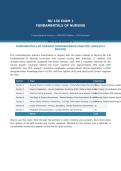
NU 136 EXAM 1
FUNDAMENTALS OF NURSING
Comprehensive Practice • 2026/2027 Edition • 150 Questions
NU 136 EXAM 1
FUNDAMENTALS OF NURSING COMPREHENSIVE PRACTICE (2026/2027
EDITION)
This comprehensive practice examination is aligned with the Galen College of Nursing NU 136
Fundamentals of Nursing curriculum and current nursing best practices. It contains 150
multiple-choice questions organized into seven sections, each with a complete rationale for the
correct answer. Coverage reflects the exam cognitive mix: approximately 30% recall, 50%
application, and 20% analysis. Questions emphasize scenario-based clinical application (≈75%)
alongside direct knowledge items (≈25%), with four options (A–D) and exactly one correct response
per item.
Section Topic Questions
Section 1 Nursing Process & Health and Illness Concepts – Primary/Secondary/Terminal 30
Illness, Stages of Illness, Health/
Section 2 Stress & Adaptation – General Adaptation Syndrome (GAS), Defense Mechanisms,
25 Coping, Stress-Related Diso
Section 3 Infection Control & Asepsis – Chain of Infection, Medical/Surgical Asepsis, Standard
30 Precautions, PPE, Hand Hy
Section 4 Vital Signs & Physical Assessment – Normal Ranges, Pulse Auscultation, Breath
25Sounds, Bowel Sounds, Apical
Section 5 Patient Safety, Mobility & Positioning – Fall Risk, Safe Patient Handling, Crutch20
Walking, Patient Positioning, Re
Section 6 Levels of Prevention – Primary, Secondary, Tertiary Prevention Interventions 10
Section 7 Integrated Clinical Scenarios – Complex Patient Care Scenarios 10
TOTAL 150
How to use this exam: Work through the sections in order, marking your answers. Each item shows
four options (A–D) with exactly one correct response, followed by the answer and a rationale. A
consolidated answer key appears at the end for quick scoring.
,NU 136 EXAM 1 — FUNDAMENTALS OF NURSING Comprehensive Practice (2026/2027)
Section 1: Nursing Process & Health and Illness Concepts –
Primary/Secondary/Terminal Illness, Stages of Illness, Health/Illness Behavior,
Maslow's Hierarchy
Q1: A primary illness is best defined as an illness that:
A. develops without being caused by another health problem [CORRECT]
B. results from or is caused by another illness
C. is always terminal
D. only occurs in childhood
Correct Answer: A
Rationale: Primary illness arises independently; secondary illness results from a primary illness.
Q2: A secondary illness is best defined as an illness that:
A. results from or is caused by a primary illness [CORRECT]
B. develops on its own
C. cannot be treated
D. is contagious
Correct Answer: A
Rationale: Secondary illnesses are complications or consequences of a primary illness.
Q3: A terminal illness is one that:
A. is expected to result in death [CORRECT]
B. resolves completely
C. is always preventable
D. only affects older adults
Correct Answer: A
Rationale: Terminal illness is progressive and expected to end in death.
Q4: During the Transition stage of illness, a patient typically:
A. may deny feeling ill but recognizes symptoms [CORRECT]
B. acknowledges illness and seeks treatment
C. is fully recovered
D. has no symptoms at all
Correct Answer: A
Rationale: Transition is the earliest stage, where symptoms are recognized but illness may be denied.
Q5: During the Acceptance stage of illness, a patient:
A. acknowledges the illness and takes measures to become well [CORRECT]
B. denies any symptoms
C. is recovering and regaining health
D. has no awareness of illness
Correct Answer: A
Rationale: Acceptance involves acknowledging illness and taking action toward wellness.
Q6: During the Convalescence stage of illness, a patient is:
A. recovering after illness and regaining health [CORRECT]
B. denying symptoms
C. first noticing symptoms
D. critically ill
Correct Answer: A
Rationale: Convalescence is the recovery phase following illness.
Page 2 of 29
, NU 136 EXAM 1 — FUNDAMENTALS OF NURSING Comprehensive Practice (2026/2027)
Q7: Health behavior is defined as any action that:
A. promotes good health, prevents disease, or detects disease in early asymptomatic stages [CORRECT]
B. monitors and interprets symptoms
C. uses the healthcare system after becoming ill
D. treats an existing illness
Correct Answer: A
Rationale: Health behaviors (nutrition, exercise, immunizations, checkups) promote and protect health.
Q8: Illness behavior describes the ways people:
A. monitor their bodies, define and interpret symptoms, take remedial action, and use the healthcare
system [CORRECT]
B. prevent disease
C. promote wellness
D. avoid all healthcare
Correct Answer: A
Rationale: Illness behavior involves recognizing and responding to symptoms.
Q9: Watching nutrition, exercising, obtaining immunizations, and getting regular checkups are
examples of:
A. health behavior [CORRECT]
B. illness behavior
C. tertiary prevention only
D. terminal illness
Correct Answer: A
Rationale: These actions promote health and detect disease early (health behaviors).
Q10: Health literacy is defined as:
A. having the knowledge and skills to make health decisions [CORRECT]
B. the ability to read prescriptions only
C. knowing medical terminology
D. having health insurance
Correct Answer: A
Rationale: Health literacy is the capacity to obtain, understand, and use health information to make decisions.
Q11: The holistic approach to nursing considers which needs?
A. Biologic, psychological, sociologic, and spiritual needs [CORRECT]
B. Biologic needs only
C. Spiritual needs only
D. Financial needs only
Correct Answer: A
Rationale: Holistic care addresses the whole person across biologic, psychologic, sociologic, and spiritual
domains.
Q12: Which of the following is NOT one of Maslow's five levels of need?
A. Financial success [CORRECT]
B. Physiologic
C. Safety and security
D. Self-actualization
Correct Answer: A
Rationale: Maslow's hierarchy is physiologic, safety, love/belonging, self-esteem, and self-actualization;
financial success is not a level.
Page 3 of 29
FUNDAMENTALS OF NURSING
Comprehensive Practice • 2026/2027 Edition • 150 Questions
NU 136 EXAM 1
FUNDAMENTALS OF NURSING COMPREHENSIVE PRACTICE (2026/2027
EDITION)
This comprehensive practice examination is aligned with the Galen College of Nursing NU 136
Fundamentals of Nursing curriculum and current nursing best practices. It contains 150
multiple-choice questions organized into seven sections, each with a complete rationale for the
correct answer. Coverage reflects the exam cognitive mix: approximately 30% recall, 50%
application, and 20% analysis. Questions emphasize scenario-based clinical application (≈75%)
alongside direct knowledge items (≈25%), with four options (A–D) and exactly one correct response
per item.
Section Topic Questions
Section 1 Nursing Process & Health and Illness Concepts – Primary/Secondary/Terminal 30
Illness, Stages of Illness, Health/
Section 2 Stress & Adaptation – General Adaptation Syndrome (GAS), Defense Mechanisms,
25 Coping, Stress-Related Diso
Section 3 Infection Control & Asepsis – Chain of Infection, Medical/Surgical Asepsis, Standard
30 Precautions, PPE, Hand Hy
Section 4 Vital Signs & Physical Assessment – Normal Ranges, Pulse Auscultation, Breath
25Sounds, Bowel Sounds, Apical
Section 5 Patient Safety, Mobility & Positioning – Fall Risk, Safe Patient Handling, Crutch20
Walking, Patient Positioning, Re
Section 6 Levels of Prevention – Primary, Secondary, Tertiary Prevention Interventions 10
Section 7 Integrated Clinical Scenarios – Complex Patient Care Scenarios 10
TOTAL 150
How to use this exam: Work through the sections in order, marking your answers. Each item shows
four options (A–D) with exactly one correct response, followed by the answer and a rationale. A
consolidated answer key appears at the end for quick scoring.
,NU 136 EXAM 1 — FUNDAMENTALS OF NURSING Comprehensive Practice (2026/2027)
Section 1: Nursing Process & Health and Illness Concepts –
Primary/Secondary/Terminal Illness, Stages of Illness, Health/Illness Behavior,
Maslow's Hierarchy
Q1: A primary illness is best defined as an illness that:
A. develops without being caused by another health problem [CORRECT]
B. results from or is caused by another illness
C. is always terminal
D. only occurs in childhood
Correct Answer: A
Rationale: Primary illness arises independently; secondary illness results from a primary illness.
Q2: A secondary illness is best defined as an illness that:
A. results from or is caused by a primary illness [CORRECT]
B. develops on its own
C. cannot be treated
D. is contagious
Correct Answer: A
Rationale: Secondary illnesses are complications or consequences of a primary illness.
Q3: A terminal illness is one that:
A. is expected to result in death [CORRECT]
B. resolves completely
C. is always preventable
D. only affects older adults
Correct Answer: A
Rationale: Terminal illness is progressive and expected to end in death.
Q4: During the Transition stage of illness, a patient typically:
A. may deny feeling ill but recognizes symptoms [CORRECT]
B. acknowledges illness and seeks treatment
C. is fully recovered
D. has no symptoms at all
Correct Answer: A
Rationale: Transition is the earliest stage, where symptoms are recognized but illness may be denied.
Q5: During the Acceptance stage of illness, a patient:
A. acknowledges the illness and takes measures to become well [CORRECT]
B. denies any symptoms
C. is recovering and regaining health
D. has no awareness of illness
Correct Answer: A
Rationale: Acceptance involves acknowledging illness and taking action toward wellness.
Q6: During the Convalescence stage of illness, a patient is:
A. recovering after illness and regaining health [CORRECT]
B. denying symptoms
C. first noticing symptoms
D. critically ill
Correct Answer: A
Rationale: Convalescence is the recovery phase following illness.
Page 2 of 29
, NU 136 EXAM 1 — FUNDAMENTALS OF NURSING Comprehensive Practice (2026/2027)
Q7: Health behavior is defined as any action that:
A. promotes good health, prevents disease, or detects disease in early asymptomatic stages [CORRECT]
B. monitors and interprets symptoms
C. uses the healthcare system after becoming ill
D. treats an existing illness
Correct Answer: A
Rationale: Health behaviors (nutrition, exercise, immunizations, checkups) promote and protect health.
Q8: Illness behavior describes the ways people:
A. monitor their bodies, define and interpret symptoms, take remedial action, and use the healthcare
system [CORRECT]
B. prevent disease
C. promote wellness
D. avoid all healthcare
Correct Answer: A
Rationale: Illness behavior involves recognizing and responding to symptoms.
Q9: Watching nutrition, exercising, obtaining immunizations, and getting regular checkups are
examples of:
A. health behavior [CORRECT]
B. illness behavior
C. tertiary prevention only
D. terminal illness
Correct Answer: A
Rationale: These actions promote health and detect disease early (health behaviors).
Q10: Health literacy is defined as:
A. having the knowledge and skills to make health decisions [CORRECT]
B. the ability to read prescriptions only
C. knowing medical terminology
D. having health insurance
Correct Answer: A
Rationale: Health literacy is the capacity to obtain, understand, and use health information to make decisions.
Q11: The holistic approach to nursing considers which needs?
A. Biologic, psychological, sociologic, and spiritual needs [CORRECT]
B. Biologic needs only
C. Spiritual needs only
D. Financial needs only
Correct Answer: A
Rationale: Holistic care addresses the whole person across biologic, psychologic, sociologic, and spiritual
domains.
Q12: Which of the following is NOT one of Maslow's five levels of need?
A. Financial success [CORRECT]
B. Physiologic
C. Safety and security
D. Self-actualization
Correct Answer: A
Rationale: Maslow's hierarchy is physiologic, safety, love/belonging, self-esteem, and self-actualization;
financial success is not a level.
Page 3 of 29


