

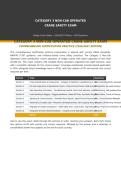
CATEGORY 3 NON-CAB OPERATED
CRANE SAFETY EXAM
Bridge Crane Safety • 2026/2027 Edition • 200 Questions
CATEGORY 3 NON-CAB OPERATED CRANE SAFETY EXAM
COMPREHENSIVE CERTIFICATION PRACTICE (2026/2027 EDITION)
This comprehensive certification practice examination is aligned with current OSHA standards,
NAVFAC P-307 guidance, and evidence-based crane safety practices. The Category 3 Non-Cab
Operated Crane certification covers operators of bridge cranes with rated capacities of less than
20,000 lbs. This exam contains 200 multiple-choice questions organized into eight sections, each
with a complete rationale for the correct answer. Coverage emphasizes scenario-based application
(≈75%) alongside direct knowledge items (≈25%), with four options (A–D) and exactly one correct
response per item.
Section Topic Questions
Section 1 Crane Classification & Components – Category 3 Definition, Load-Bearing vs. Load-Controlling
30 Parts, General/O
Section 2 Pre-Use Inspections & Operational Checks – Daily Pre-Use Checks, Walk-Around
30Inspection, No-Load Testing, L
Section 3 Safe Operating Procedures – Two-Blocking Hazards, Hoist Limit Switches, Load25
Positioning, Side Loading Preve
Section 4 Load Handling & Rigging – Rigging Hardware, Grade 80 Chain, Synthetic Sling30
Restrictions, Center of Gravity,
Section 5 Signaling & Communication – Standard Hand Signals, Signal Person Requirements,
20 Communication Methods
Section 6 Personnel & Complex Lifts – Personnel Lift Requirements, 50% Capacity Rule, 20
Complex Lift Planning, Pre-Job B
Section 7 Regulatory & Safety Compliance – OSHA 1926.1417, Load Charts, Tag-Out/Lock-Out,
25 Power Line Clearance, St
Section 8 Integrated Scenario-Based Questions – Complex Crane Operation and Safety Scenarios
20
TOTAL 200
How to use this exam: Work through the sections in order, marking your answers. Each item shows
four options (A–D) with exactly one correct response, followed by the answer and a rationale. A
consolidated answer key appears at the end for quick scoring.
,CATEGORY 3 NON-CAB OPERATED CRANE SAFETY EXAM Comprehensive Certification Practice (2026/2027)
Section 1: Crane Classification & Components – Category 3 Definition, Load-Bearing
vs. Load-Controlling Parts, General/Operational Safety Devices
Q1: A Category 3 crane is best defined as a bridge crane with a rated capacity of:
A. less than 20,000 lbs [CORRECT]
B. 20,000 lbs or greater
C. exactly 100,000 lbs
D. more than 200,000 lbs
Correct Answer: A
Rationale: Category 3 cranes are bridge cranes with rated capacities under 20,000 lbs; Category 2 are 20,000
lbs or greater.
Q2: A bridge crane with a rated capacity of 20,000 lbs or greater is classified as:
A. Category 2 [CORRECT]
B. Category 3
C. Category 1
D. Category 4
Correct Answer: A
Rationale: Bridge cranes rated at 20,000 lbs or greater fall under Category 2.
Q3: Components that control, restrain, or position the load, and upon failure would cause dropping,
shifting, or uncontrolled movement of the load, are classified as:
A. load controlling parts [CORRECT]
B. load-bearing parts
C. general safety devices
D. non-critical parts
Correct Answer: A
Rationale: Load controlling parts manage the load's movement; their failure causes uncontrolled load
movement.
Q4: Components that support the load are classified as:
A. load-bearing parts [CORRECT]
B. load controlling parts
C. operational safety devices
D. general safety devices
Correct Answer: A
Rationale: Load-bearing parts (such as hooks) physically support the load.
Q5: A hook is an example of a:
A. load-bearing part [CORRECT]
B. load controlling part
C. general safety device
D. travel alarm
Correct Answer: A
Rationale: Hooks support the load, making them load-bearing components.
Page 2 of 37
,CATEGORY 3 NON-CAB OPERATED CRANE SAFETY EXAM Comprehensive Certification Practice (2026/2027)
Q6: Safety devices that protect personnel and equipment are classified as:
A. general safety devices [CORRECT]
B. load-bearing parts
C. load controlling parts
D. rigging hardware
Correct Answer: A
Rationale: General safety devices protect personnel and equipment from hazards.
Q7: Safety devices that affect safe load lifting and handling capabilities are classified as:
A. operational safety devices [CORRECT]
B. general safety devices
C. load-bearing parts
D. structural members
Correct Answer: A
Rationale: Operational safety devices directly affect safe lifting and load handling capability.
Q8: A travel alarm is classified as a:
A. general safety device [CORRECT]
B. load-bearing part
C. load controlling part
D. rigging component
Correct Answer: A
Rationale: Travel alarms warn personnel of crane movement, protecting people and equipment (general safety
device).
Q9: The bridge of a bridge crane is:
A. the structural beam that spans the runway and carries the trolley [CORRECT]
B. the hook assembly
C. the pendant control
D. the wire rope
Correct Answer: A
Rationale: The bridge is the main horizontal structure spanning the runway, supporting the trolley.
Q10: The trolley on a bridge crane:
A. carries the hoist and travels along the bridge [CORRECT]
B. supports the runway
C. is the pendant station
D. is the load hook
Correct Answer: A
Rationale: The trolley carries the hoisting mechanism and moves along the bridge.
Q11: The hoist is the component that:
A. raises and lowers the load [CORRECT]
B. moves the bridge along the runway
C. moves the trolley along the bridge
D. sounds the travel alarm
Correct Answer: A
Rationale: The hoist raises and lowers the load via the drum and wire rope.
Page 3 of 37
, CATEGORY 3 NON-CAB OPERATED CRANE SAFETY EXAM Comprehensive Certification Practice (2026/2027)
Q12: The runway of a bridge crane is:
A. the tracks/beams on which the bridge travels [CORRECT]
B. the hook block
C. the operator's pendant
D. the wire rope drum
Correct Answer: A
Rationale: Runways are the longitudinal rails supporting and guiding the bridge.
Q13: The pendant (push-button) control station is used to:
A. operate the crane's motions from the floor (non-cab operated) [CORRECT]
B. lift the crane for maintenance
C. rig the load
D. lock out the power
Correct Answer: A
Rationale: Non-cab operated (Category 3) cranes are controlled from a pendant or remote station.
Q14: A Category 3 crane is 'non-cab operated' because it:
A. is operated from a pendant or remote control rather than an enclosed operator's cab [CORRECT]
B. has no operator at all
C. is always automated
D. is operated only by maintenance staff
Correct Answer: A
Rationale: Category 3 cranes are controlled remotely or by pendant, not from an onboard cab.
Q15: Wire rope used for hoisting is generally classified as:
A. a load controlling part [CORRECT]
B. a general safety device
C. a runway component
D. a load-bearing part
Correct Answer: A
Rationale: Wire rope controls load movement (raising/lowering); its failure causes uncontrolled load movement.
Q16: The drum on a hoist is:
A. the cylinder on which the wire rope is wound [CORRECT]
B. the hook assembly
C. the pendant control
D. the travel alarm
Correct Answer: A
Rationale: The drum stores and winds the hoisting wire rope.
Q17: A component whose failure would only affect personnel/equipment protection (not load control) is
a:
A. general safety device [CORRECT]
B. load-bearing part
C. load controlling part
D. hook
Correct Answer: A
Rationale: General safety devices protect personnel/equipment; they do not control the load.
Page 4 of 37
CRANE SAFETY EXAM
Bridge Crane Safety • 2026/2027 Edition • 200 Questions
CATEGORY 3 NON-CAB OPERATED CRANE SAFETY EXAM
COMPREHENSIVE CERTIFICATION PRACTICE (2026/2027 EDITION)
This comprehensive certification practice examination is aligned with current OSHA standards,
NAVFAC P-307 guidance, and evidence-based crane safety practices. The Category 3 Non-Cab
Operated Crane certification covers operators of bridge cranes with rated capacities of less than
20,000 lbs. This exam contains 200 multiple-choice questions organized into eight sections, each
with a complete rationale for the correct answer. Coverage emphasizes scenario-based application
(≈75%) alongside direct knowledge items (≈25%), with four options (A–D) and exactly one correct
response per item.
Section Topic Questions
Section 1 Crane Classification & Components – Category 3 Definition, Load-Bearing vs. Load-Controlling
30 Parts, General/O
Section 2 Pre-Use Inspections & Operational Checks – Daily Pre-Use Checks, Walk-Around
30Inspection, No-Load Testing, L
Section 3 Safe Operating Procedures – Two-Blocking Hazards, Hoist Limit Switches, Load25
Positioning, Side Loading Preve
Section 4 Load Handling & Rigging – Rigging Hardware, Grade 80 Chain, Synthetic Sling30
Restrictions, Center of Gravity,
Section 5 Signaling & Communication – Standard Hand Signals, Signal Person Requirements,
20 Communication Methods
Section 6 Personnel & Complex Lifts – Personnel Lift Requirements, 50% Capacity Rule, 20
Complex Lift Planning, Pre-Job B
Section 7 Regulatory & Safety Compliance – OSHA 1926.1417, Load Charts, Tag-Out/Lock-Out,
25 Power Line Clearance, St
Section 8 Integrated Scenario-Based Questions – Complex Crane Operation and Safety Scenarios
20
TOTAL 200
How to use this exam: Work through the sections in order, marking your answers. Each item shows
four options (A–D) with exactly one correct response, followed by the answer and a rationale. A
consolidated answer key appears at the end for quick scoring.
,CATEGORY 3 NON-CAB OPERATED CRANE SAFETY EXAM Comprehensive Certification Practice (2026/2027)
Section 1: Crane Classification & Components – Category 3 Definition, Load-Bearing
vs. Load-Controlling Parts, General/Operational Safety Devices
Q1: A Category 3 crane is best defined as a bridge crane with a rated capacity of:
A. less than 20,000 lbs [CORRECT]
B. 20,000 lbs or greater
C. exactly 100,000 lbs
D. more than 200,000 lbs
Correct Answer: A
Rationale: Category 3 cranes are bridge cranes with rated capacities under 20,000 lbs; Category 2 are 20,000
lbs or greater.
Q2: A bridge crane with a rated capacity of 20,000 lbs or greater is classified as:
A. Category 2 [CORRECT]
B. Category 3
C. Category 1
D. Category 4
Correct Answer: A
Rationale: Bridge cranes rated at 20,000 lbs or greater fall under Category 2.
Q3: Components that control, restrain, or position the load, and upon failure would cause dropping,
shifting, or uncontrolled movement of the load, are classified as:
A. load controlling parts [CORRECT]
B. load-bearing parts
C. general safety devices
D. non-critical parts
Correct Answer: A
Rationale: Load controlling parts manage the load's movement; their failure causes uncontrolled load
movement.
Q4: Components that support the load are classified as:
A. load-bearing parts [CORRECT]
B. load controlling parts
C. operational safety devices
D. general safety devices
Correct Answer: A
Rationale: Load-bearing parts (such as hooks) physically support the load.
Q5: A hook is an example of a:
A. load-bearing part [CORRECT]
B. load controlling part
C. general safety device
D. travel alarm
Correct Answer: A
Rationale: Hooks support the load, making them load-bearing components.
Page 2 of 37
,CATEGORY 3 NON-CAB OPERATED CRANE SAFETY EXAM Comprehensive Certification Practice (2026/2027)
Q6: Safety devices that protect personnel and equipment are classified as:
A. general safety devices [CORRECT]
B. load-bearing parts
C. load controlling parts
D. rigging hardware
Correct Answer: A
Rationale: General safety devices protect personnel and equipment from hazards.
Q7: Safety devices that affect safe load lifting and handling capabilities are classified as:
A. operational safety devices [CORRECT]
B. general safety devices
C. load-bearing parts
D. structural members
Correct Answer: A
Rationale: Operational safety devices directly affect safe lifting and load handling capability.
Q8: A travel alarm is classified as a:
A. general safety device [CORRECT]
B. load-bearing part
C. load controlling part
D. rigging component
Correct Answer: A
Rationale: Travel alarms warn personnel of crane movement, protecting people and equipment (general safety
device).
Q9: The bridge of a bridge crane is:
A. the structural beam that spans the runway and carries the trolley [CORRECT]
B. the hook assembly
C. the pendant control
D. the wire rope
Correct Answer: A
Rationale: The bridge is the main horizontal structure spanning the runway, supporting the trolley.
Q10: The trolley on a bridge crane:
A. carries the hoist and travels along the bridge [CORRECT]
B. supports the runway
C. is the pendant station
D. is the load hook
Correct Answer: A
Rationale: The trolley carries the hoisting mechanism and moves along the bridge.
Q11: The hoist is the component that:
A. raises and lowers the load [CORRECT]
B. moves the bridge along the runway
C. moves the trolley along the bridge
D. sounds the travel alarm
Correct Answer: A
Rationale: The hoist raises and lowers the load via the drum and wire rope.
Page 3 of 37
, CATEGORY 3 NON-CAB OPERATED CRANE SAFETY EXAM Comprehensive Certification Practice (2026/2027)
Q12: The runway of a bridge crane is:
A. the tracks/beams on which the bridge travels [CORRECT]
B. the hook block
C. the operator's pendant
D. the wire rope drum
Correct Answer: A
Rationale: Runways are the longitudinal rails supporting and guiding the bridge.
Q13: The pendant (push-button) control station is used to:
A. operate the crane's motions from the floor (non-cab operated) [CORRECT]
B. lift the crane for maintenance
C. rig the load
D. lock out the power
Correct Answer: A
Rationale: Non-cab operated (Category 3) cranes are controlled from a pendant or remote station.
Q14: A Category 3 crane is 'non-cab operated' because it:
A. is operated from a pendant or remote control rather than an enclosed operator's cab [CORRECT]
B. has no operator at all
C. is always automated
D. is operated only by maintenance staff
Correct Answer: A
Rationale: Category 3 cranes are controlled remotely or by pendant, not from an onboard cab.
Q15: Wire rope used for hoisting is generally classified as:
A. a load controlling part [CORRECT]
B. a general safety device
C. a runway component
D. a load-bearing part
Correct Answer: A
Rationale: Wire rope controls load movement (raising/lowering); its failure causes uncontrolled load movement.
Q16: The drum on a hoist is:
A. the cylinder on which the wire rope is wound [CORRECT]
B. the hook assembly
C. the pendant control
D. the travel alarm
Correct Answer: A
Rationale: The drum stores and winds the hoisting wire rope.
Q17: A component whose failure would only affect personnel/equipment protection (not load control) is
a:
A. general safety device [CORRECT]
B. load-bearing part
C. load controlling part
D. hook
Correct Answer: A
Rationale: General safety devices protect personnel/equipment; they do not control the load.
Page 4 of 37


