

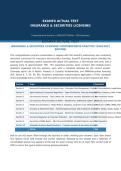
EXAMFX ACTUAL TEST
INSURANCE & SECURITIES LICENSING
Comprehensive Practice • 2026/2027 Edition • 200 Questions
EXAMFX ACTUAL TEST
INSURANCE & SECURITIES LICENSING COMPREHENSIVE PRACTICE (2026/2027
EDITION)
This comprehensive practice examination is aligned with the ExamFX prelicensing and continuing
education curriculum for insurance and securities licensing. ExamFX licensing exams simulate the
state-specific regulatory exams, typically with about 150 questions, a 150-minute time limit, and a
passing score of approximately 70%. This expanded practice exam contains 200 multiple-choice
questions organized into ten sections, each with a complete rationale for the correct answer.
Coverage spans Life & Health, Property & Casualty fundamentals, and FINRA/securities licensing
(SIE, Series 6, 7, 63, 65, 66). Questions emphasize scenario-based application (≈75%) alongside
direct knowledge items (≈25%), with four options (A–D) and exactly one correct response per item.
Section Topic Questions
Section 1 Insurance Fundamentals & Contract Law – Principles, Risk Management, Contract
30 Characteristics, Legal Eleme
Section 2 Agent Authority & Insurance Regulation – Types of Authority, Fiduciary Responsibility,
25 Licensing, Unfair Trade
Section 3 Life Insurance Policies – Term, Whole Life, Universal, Variable, Adjustable Life,30
Non-Forfeiture Values
Section 4 Life Insurance Policy Provisions & Riders – Beneficiaries, Settlement Options, Dividends,
25 Guaranteed Insurabili
Section 5 Health Insurance Basics – Major Medical, Disability, Long-Term Care, Medicare,
20Medicaid, COBRA, HIPAA, Pre-E
Section 6 Annuities & Retirement Plans – Fixed/Variable Annuities, IRA (Traditional, Roth,
20SEP), 401(k), 403(b), Keogh, T
Section 7 Social Security & Government Programs – Retirement, Disability, Survivor Benefits,
15 Medicare Parts A-D, Medic
Section 8 Insurance Regulation & Consumer Protection – Fair Credit Reporting Act, Medical
15 Information Bureau, HIPAA P
Section 9 Securities & FINRA Basics – SIE, Series 6/7/63/65/66, Variable Products, Securities
10 Regulation
Section 10 Integrated Scenario-Based Questions – Complex Insurance & Securities Scenarios
10
TOTAL 200
How to use this exam: Work through the sections in order, marking your answers. Each item shows
four options (A–D) with exactly one correct response, followed by the answer and a rationale. A
consolidated answer key appears at the end for quick scoring. Aim for at least 70% correct (140 of
200) to mirror the typical state licensing passing standard.
,EXAMFX ACTUAL TEST — INSURANCE & SECURITIES LICENSING Comprehensive Practice (2026/2027)
Section 1: Insurance Fundamentals & Contract Law – Principles, Risk Management,
Contract Characteristics, Legal Elements, Hazards
Q1: Insurance is best defined as a contract whereby one party agrees to:
A. indemnify another against specified losses [CORRECT]
B. guarantee a profit
C. eliminate all risk
D. lend money at interest
Correct Answer: A
Rationale: Insurance is a contract of indemnification in which the insurer compensates the insured for covered
losses.
Q2: An aleatory contract is one in which:
A. the exchange of value is unequal (e.g., a $100 premium for a $10,000 death benefit) [CORRECT]
B. both parties exchange equal value
C. only one party makes a promise
D. the terms are negotiated equally
Correct Answer: A
Rationale: Aleatory contracts involve unequal values exchanged, depending on an uncertain event.
Q3: A unilateral contract means that:
A. only the insurer makes an enforceable promise [CORRECT]
B. both parties make enforceable promises
C. neither party makes a promise
D. the insured must make a promise to pay claims
Correct Answer: A
Rationale: In a unilateral contract, only the insurer promises to pay; the insured is not obligated to pay
premiums beyond the first.
Q4: A contract of adhesion means that:
A. the insured accepts the contract as written, with no negotiation [CORRECT]
B. both parties negotiate all terms
C. the contract is void
D. the insurer must renegotiate annually
Correct Answer: A
Rationale: Adhesion contracts are drafted by one party (the insurer); the insured 'adheres' to the terms as
written.
Q5: A conditional contract means the insurer's promise to pay is:
A. conditioned on the insured meeting certain requirements (such as paying premiums) [CORRECT]
B. unconditional
C. based on the insurer's mood
D. valid without any conditions
Correct Answer: A
Rationale: The insurer's duty to pay arises only when the insured satisfies policy conditions.
Page 2 of 37
,EXAMFX ACTUAL TEST — INSURANCE & SECURITIES LICENSING Comprehensive Practice (2026/2027)
Q6: In an insurance contract, the consideration provided by the insured is:
A. the premium payment [CORRECT]
B. the insurer's promise to pay
C. the application only
D. nothing
Correct Answer: A
Rationale: The insured's consideration is the premium; the insurer's consideration is its promise to pay claims.
Q7: The four elements of a legal insurance contract are:
A. offer and acceptance, consideration, competent parties, and legal purpose [CORRECT]
B. premium, deductible, coinsurance, and limit
C. application, policy, rider, and endorsement
D. agent, insurer, insured, and beneficiary
Correct Answer: A
Rationale: A valid contract requires offer/acceptance, consideration, competent parties, and a legal purpose.
Q8: A moral hazard is best described as:
A. a tendency toward dishonesty or an intent to defraud [CORRECT]
B. indifference to loss (such as leaving doors unlocked)
C. a physical condition that increases loss
D. an unavoidable natural risk
Correct Answer: A
Rationale: Moral hazard involves dishonest intent, such as arson or faking a claim.
Q9: A morale hazard is best described as:
A. an indifferent or careless attitude toward loss (such as not locking doors) [CORRECT]
B. dishonest intent to defraud
C. a physical condition that increases loss
D. a speculative risk
Correct Answer: A
Rationale: Morale hazard is carelessness or indifference that increases the chance of loss.
Q10: A physical hazard is best described as:
A. a physical condition that increases the chance of loss [CORRECT]
B. dishonest intent
C. careless attitude
D. a legal defect in the contract
Correct Answer: A
Rationale: Physical hazards are tangible conditions (icy sidewalks, faulty wiring) that increase loss potential.
Q11: Risk management that shifts the financial consequence of loss to an insurer is called:
A. transfer [CORRECT]
B. avoidance
C. retention
D. reduction
Correct Answer: A
Rationale: Insurance transfers the financial burden of risk to the insurer.
Page 3 of 37
, EXAMFX ACTUAL TEST — INSURANCE & SECURITIES LICENSING Comprehensive Practice (2026/2027)
Q12: A pure risk is one that involves only:
A. the possibility of loss or no loss [CORRECT]
B. the possibility of gain
C. guaranteed profit
D. speculative investment
Correct Answer: A
Rationale: Pure risks involve loss or no loss; only pure risks are insurable.
Q13: The law of large numbers allows insurers to:
A. predict losses more accurately as the number of insureds grows [CORRECT]
B. eliminate all losses
C. charge everyone the same premium
D. guarantee no claims
Correct Answer: A
Rationale: Large numbers make aggregate losses more predictable, enabling accurate pricing.
Q14: The principle of indemnity means insurance is designed to:
A. restore the insured to their pre-loss financial position (no profit) [CORRECT]
B. provide a profit to the insured
C. cover speculative losses
D. pay more than the loss
Correct Answer: A
Rationale: Indemnity restores financial position without allowing the insured to profit from a loss.
Q15: Utmost good faith requires that:
A. both parties disclose all material facts relevant to the contract [CORRECT]
B. only the insurer be honest
C. the insured may conceal material facts
D. no disclosure is needed
Correct Answer: A
Rationale: Insurance contracts demand utmost good faith, with full disclosure of material facts.
Q16: Insurable interest in a life insurance contract must exist:
A. at the time of application [CORRECT]
B. at the time of death
C. only after the claim
D. never
Correct Answer: A
Rationale: Life insurance requires insurable interest at application (not necessarily at death).
Q17: A statement made by the applicant that is true to the best of their knowledge is a:
A. representation [CORRECT]
B. warranty
C. guarantee
D. promissory note
Correct Answer: A
Rationale: Representations are statements believed true to the best of the applicant's knowledge.
Page 4 of 37
INSURANCE & SECURITIES LICENSING
Comprehensive Practice • 2026/2027 Edition • 200 Questions
EXAMFX ACTUAL TEST
INSURANCE & SECURITIES LICENSING COMPREHENSIVE PRACTICE (2026/2027
EDITION)
This comprehensive practice examination is aligned with the ExamFX prelicensing and continuing
education curriculum for insurance and securities licensing. ExamFX licensing exams simulate the
state-specific regulatory exams, typically with about 150 questions, a 150-minute time limit, and a
passing score of approximately 70%. This expanded practice exam contains 200 multiple-choice
questions organized into ten sections, each with a complete rationale for the correct answer.
Coverage spans Life & Health, Property & Casualty fundamentals, and FINRA/securities licensing
(SIE, Series 6, 7, 63, 65, 66). Questions emphasize scenario-based application (≈75%) alongside
direct knowledge items (≈25%), with four options (A–D) and exactly one correct response per item.
Section Topic Questions
Section 1 Insurance Fundamentals & Contract Law – Principles, Risk Management, Contract
30 Characteristics, Legal Eleme
Section 2 Agent Authority & Insurance Regulation – Types of Authority, Fiduciary Responsibility,
25 Licensing, Unfair Trade
Section 3 Life Insurance Policies – Term, Whole Life, Universal, Variable, Adjustable Life,30
Non-Forfeiture Values
Section 4 Life Insurance Policy Provisions & Riders – Beneficiaries, Settlement Options, Dividends,
25 Guaranteed Insurabili
Section 5 Health Insurance Basics – Major Medical, Disability, Long-Term Care, Medicare,
20Medicaid, COBRA, HIPAA, Pre-E
Section 6 Annuities & Retirement Plans – Fixed/Variable Annuities, IRA (Traditional, Roth,
20SEP), 401(k), 403(b), Keogh, T
Section 7 Social Security & Government Programs – Retirement, Disability, Survivor Benefits,
15 Medicare Parts A-D, Medic
Section 8 Insurance Regulation & Consumer Protection – Fair Credit Reporting Act, Medical
15 Information Bureau, HIPAA P
Section 9 Securities & FINRA Basics – SIE, Series 6/7/63/65/66, Variable Products, Securities
10 Regulation
Section 10 Integrated Scenario-Based Questions – Complex Insurance & Securities Scenarios
10
TOTAL 200
How to use this exam: Work through the sections in order, marking your answers. Each item shows
four options (A–D) with exactly one correct response, followed by the answer and a rationale. A
consolidated answer key appears at the end for quick scoring. Aim for at least 70% correct (140 of
200) to mirror the typical state licensing passing standard.
,EXAMFX ACTUAL TEST — INSURANCE & SECURITIES LICENSING Comprehensive Practice (2026/2027)
Section 1: Insurance Fundamentals & Contract Law – Principles, Risk Management,
Contract Characteristics, Legal Elements, Hazards
Q1: Insurance is best defined as a contract whereby one party agrees to:
A. indemnify another against specified losses [CORRECT]
B. guarantee a profit
C. eliminate all risk
D. lend money at interest
Correct Answer: A
Rationale: Insurance is a contract of indemnification in which the insurer compensates the insured for covered
losses.
Q2: An aleatory contract is one in which:
A. the exchange of value is unequal (e.g., a $100 premium for a $10,000 death benefit) [CORRECT]
B. both parties exchange equal value
C. only one party makes a promise
D. the terms are negotiated equally
Correct Answer: A
Rationale: Aleatory contracts involve unequal values exchanged, depending on an uncertain event.
Q3: A unilateral contract means that:
A. only the insurer makes an enforceable promise [CORRECT]
B. both parties make enforceable promises
C. neither party makes a promise
D. the insured must make a promise to pay claims
Correct Answer: A
Rationale: In a unilateral contract, only the insurer promises to pay; the insured is not obligated to pay
premiums beyond the first.
Q4: A contract of adhesion means that:
A. the insured accepts the contract as written, with no negotiation [CORRECT]
B. both parties negotiate all terms
C. the contract is void
D. the insurer must renegotiate annually
Correct Answer: A
Rationale: Adhesion contracts are drafted by one party (the insurer); the insured 'adheres' to the terms as
written.
Q5: A conditional contract means the insurer's promise to pay is:
A. conditioned on the insured meeting certain requirements (such as paying premiums) [CORRECT]
B. unconditional
C. based on the insurer's mood
D. valid without any conditions
Correct Answer: A
Rationale: The insurer's duty to pay arises only when the insured satisfies policy conditions.
Page 2 of 37
,EXAMFX ACTUAL TEST — INSURANCE & SECURITIES LICENSING Comprehensive Practice (2026/2027)
Q6: In an insurance contract, the consideration provided by the insured is:
A. the premium payment [CORRECT]
B. the insurer's promise to pay
C. the application only
D. nothing
Correct Answer: A
Rationale: The insured's consideration is the premium; the insurer's consideration is its promise to pay claims.
Q7: The four elements of a legal insurance contract are:
A. offer and acceptance, consideration, competent parties, and legal purpose [CORRECT]
B. premium, deductible, coinsurance, and limit
C. application, policy, rider, and endorsement
D. agent, insurer, insured, and beneficiary
Correct Answer: A
Rationale: A valid contract requires offer/acceptance, consideration, competent parties, and a legal purpose.
Q8: A moral hazard is best described as:
A. a tendency toward dishonesty or an intent to defraud [CORRECT]
B. indifference to loss (such as leaving doors unlocked)
C. a physical condition that increases loss
D. an unavoidable natural risk
Correct Answer: A
Rationale: Moral hazard involves dishonest intent, such as arson or faking a claim.
Q9: A morale hazard is best described as:
A. an indifferent or careless attitude toward loss (such as not locking doors) [CORRECT]
B. dishonest intent to defraud
C. a physical condition that increases loss
D. a speculative risk
Correct Answer: A
Rationale: Morale hazard is carelessness or indifference that increases the chance of loss.
Q10: A physical hazard is best described as:
A. a physical condition that increases the chance of loss [CORRECT]
B. dishonest intent
C. careless attitude
D. a legal defect in the contract
Correct Answer: A
Rationale: Physical hazards are tangible conditions (icy sidewalks, faulty wiring) that increase loss potential.
Q11: Risk management that shifts the financial consequence of loss to an insurer is called:
A. transfer [CORRECT]
B. avoidance
C. retention
D. reduction
Correct Answer: A
Rationale: Insurance transfers the financial burden of risk to the insurer.
Page 3 of 37
, EXAMFX ACTUAL TEST — INSURANCE & SECURITIES LICENSING Comprehensive Practice (2026/2027)
Q12: A pure risk is one that involves only:
A. the possibility of loss or no loss [CORRECT]
B. the possibility of gain
C. guaranteed profit
D. speculative investment
Correct Answer: A
Rationale: Pure risks involve loss or no loss; only pure risks are insurable.
Q13: The law of large numbers allows insurers to:
A. predict losses more accurately as the number of insureds grows [CORRECT]
B. eliminate all losses
C. charge everyone the same premium
D. guarantee no claims
Correct Answer: A
Rationale: Large numbers make aggregate losses more predictable, enabling accurate pricing.
Q14: The principle of indemnity means insurance is designed to:
A. restore the insured to their pre-loss financial position (no profit) [CORRECT]
B. provide a profit to the insured
C. cover speculative losses
D. pay more than the loss
Correct Answer: A
Rationale: Indemnity restores financial position without allowing the insured to profit from a loss.
Q15: Utmost good faith requires that:
A. both parties disclose all material facts relevant to the contract [CORRECT]
B. only the insurer be honest
C. the insured may conceal material facts
D. no disclosure is needed
Correct Answer: A
Rationale: Insurance contracts demand utmost good faith, with full disclosure of material facts.
Q16: Insurable interest in a life insurance contract must exist:
A. at the time of application [CORRECT]
B. at the time of death
C. only after the claim
D. never
Correct Answer: A
Rationale: Life insurance requires insurable interest at application (not necessarily at death).
Q17: A statement made by the applicant that is true to the best of their knowledge is a:
A. representation [CORRECT]
B. warranty
C. guarantee
D. promissory note
Correct Answer: A
Rationale: Representations are statements believed true to the best of the applicant's knowledge.
Page 4 of 37


