

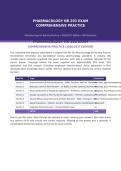
PHARMACOLOGY NR 293 EXAM
COMPREHENSIVE PRACTICE
Pharmacology for Nursing Practice • 2026/2027 Edition • 180 Questions
PHARMACOLOGY NR 293 EXAM
COMPREHENSIVE PRACTICE (2026/2027 EDITION)
This comprehensive practice examination is aligned with NR 293 Pharmacology for Nursing Practice
(Chamberlain University) and foundational nursing pharmacology standards. It contains 180
multiple-choice questions organized into seven sections, each with a complete rationale for the
correct answer. Coverage reflects the exam cognitive mix: approximately 30% recall, 50%
application, and 20% analysis. Questions emphasize scenario-based clinical application (≈75%)
alongside direct knowledge items (≈25%), with four options (A–D) and exactly one correct response
per item.
Section Topic Questions
Section 1 Pharmacokinetics & Pharmacodynamics – ADME, First-Pass, Half-Life, Therapeutic
40 Index, Agonists/Antagonists
Section 2 Medication Safety & Administration – Six Rights, Tall Man Lettering, Black Box40
Warnings, Error Prevention, Saf
Section 3 Drug Classifications & Therapeutic Applications – Antibiotics, Cardiovascular, Analgesics,
35 Psychotropics, Endoc
Section 4 Dosage Calculations & Pharmacokinetic Applications – Half-Life, Loading Dose,25
Renal/Hepatic Adjustment, Ste
Section 5 Adverse Effects, Drug Interactions & Patient Education – ADRs, Teratogenic Effects,
20 Food-Drug Interactions, Te
Section 6 Special Populations – Pediatric, Geriatric, Pregnancy/Lactation, Renal/Hepatic 10
Impairment
Section 7 Integrated Clinical Scenarios – Complex Patient Cases 10
TOTAL 180
How to use this exam: Work through the sections in order, marking your answers. Each item shows
four options (A–D) with exactly one correct response, followed by the answer and a rationale. A
consolidated answer key appears at the end for quick scoring.
,PHARMACOLOGY NR 293 EXAM Comprehensive Practice (2026/2027)
Section 1: Pharmacokinetics & Pharmacodynamics – ADME, First-Pass, Half-Life,
Therapeutic Index, Agonists/Antagonists, CYP450
Q1: Pharmacokinetics is the study of:
A. what the body does to a drug (absorption, distribution, metabolism, excretion) [CORRECT]
B. what the drug does to the body
C. genetic factors influencing drug response
D. the adverse effects of drugs
Correct Answer: A
Rationale: Pharmacokinetics describes the body's handling of a drug (ADME); pharmacodynamics is what the
drug does to the body.
Q2: Absorption is best defined as:
A. movement of a drug from its administration site into the bloodstream [CORRECT]
B. transport of a drug to its site of action
C. chemical alteration of a drug by the liver
D. removal of a drug from the body
Correct Answer: A
Rationale: Absorption is movement of the drug into the bloodstream from the administration site.
Q3: Distribution is best defined as:
A. transport of the drug via the bloodstream to its site of action [CORRECT]
B. movement into the bloodstream
C. chemical alteration of the drug
D. elimination of the drug
Correct Answer: A
Rationale: Distribution carries the absorbed drug through the bloodstream to target tissues.
Q4: The primary site of drug metabolism is the:
A. liver [CORRECT]
B. kidney
C. lungs
D. small intestine
Correct Answer: A
Rationale: The liver, via the CYP450 system, is the primary site of drug metabolism.
Q5: The primary organ of drug excretion is the:
A. kidney [CORRECT]
B. liver
C. lungs
D. skin
Correct Answer: A
Rationale: The kidney is the primary organ of drug excretion through urine.
Q6: The first-pass effect refers to:
A. drug metabolism by the liver before the drug reaches systemic circulation [CORRECT]
B. drug excretion by the kidney
C. drug absorption in the stomach
D. drug distribution to the brain
Correct Answer: A
Rationale: First-pass effect is hepatic metabolism that reduces drug available to the systemic circulation after
oral administration.
Page 2 of 34
,PHARMACOLOGY NR 293 EXAM Comprehensive Practice (2026/2027)
Q7: Bioavailability is defined as:
A. the fraction of an administered dose of unchanged drug that reaches systemic circulation [CORRECT]
B. the rate of drug excretion
C. the time to peak effect
D. the drug's protein binding capacity
Correct Answer: A
Rationale: Bioavailability is the fraction of unchanged drug that reaches the systemic circulation.
Q8: Which route of administration has 100% bioavailability?
A. Intravenous (IV) [CORRECT]
B. Oral
C. Subcutaneous
D. Intramuscular
Correct Answer: A
Rationale: IV administration bypasses absorption and first-pass metabolism, giving 100% bioavailability.
Q9: The half-life of a drug is the time required for:
A. the plasma concentration to decrease by 50% [CORRECT]
B. the drug to be completely excreted
C. the drug to reach peak effect
D. the drug to reach steady state
Correct Answer: A
Rationale: Half-life is the time for plasma concentration to fall by 50%.
Q10: It generally takes how many half-lives for a drug to reach steady state?
A. 4-5 half-lives [CORRECT]
B. 1 half-life
C. 10 half-lives
D. 2 half-lives
Correct Answer: A
Rationale: Steady state is reached after approximately 4-5 half-lives.
Q11: The therapeutic index is the ratio between:
A. the toxic dose and the therapeutic dose [CORRECT]
B. the loading dose and the maintenance dose
C. the oral dose and the IV dose
D. the onset and the duration
Correct Answer: A
Rationale: Therapeutic index is the ratio of toxic to therapeutic dose; it reflects the safety margin.
Q12: A drug with a narrow therapeutic index has:
A. a small margin of safety [CORRECT]
B. a large margin of safety
C. no toxic effects
D. no therapeutic effect
Correct Answer: A
Rationale: A narrow therapeutic index means the toxic and therapeutic doses are close, so monitoring is
required.
Page 3 of 34
, PHARMACOLOGY NR 293 EXAM Comprehensive Practice (2026/2027)
Q13: Which drug has a NARROW therapeutic index requiring serum monitoring?
A. Digoxin [CORRECT]
B. Acetaminophen
C. Ibuprofen
D. Metformin
Correct Answer: A
Rationale: Digoxin (and lithium) have narrow therapeutic indices requiring careful monitoring.
Q14: An agonist is a drug that:
A. activates a receptor to produce a biological response [CORRECT]
B. blocks receptor activation
C. inactivates enzymes
D. binds plasma proteins
Correct Answer: A
Rationale: Agonists bind and activate receptors, producing a response.
Q15: An antagonist is a drug that:
A. blocks receptor activation [CORRECT]
B. activates a receptor
C. increases receptor sensitivity
D. enhances enzyme activity
Correct Answer: A
Rationale: Antagonists bind receptors and block activation, preventing a response.
Q16: The most important serum protein for binding drug molecules is:
A. albumin [CORRECT]
B. globulin
C. hemoglobin
D. fibrinogen
Correct Answer: A
Rationale: Albumin is the primary plasma protein that binds many drugs.
Q17: The CYP450 enzyme system is located primarily in the:
A. liver [CORRECT]
B. kidney
C. heart
D. brain
Correct Answer: A
Rationale: CYP450 enzymes that metabolize drugs are found mainly in the liver.
Q18: Grapefruit juice inhibits CYP3A4. When taken with a CYP3A4 substrate drug, the nurse should
expect:
A. increased drug levels and potential toxicity [CORRECT]
B. decreased drug levels
C. no effect
D. faster drug elimination
Correct Answer: A
Rationale: CYP3A4 inhibition reduces metabolism of substrate drugs, raising their levels and toxicity risk.
Page 4 of 34
COMPREHENSIVE PRACTICE
Pharmacology for Nursing Practice • 2026/2027 Edition • 180 Questions
PHARMACOLOGY NR 293 EXAM
COMPREHENSIVE PRACTICE (2026/2027 EDITION)
This comprehensive practice examination is aligned with NR 293 Pharmacology for Nursing Practice
(Chamberlain University) and foundational nursing pharmacology standards. It contains 180
multiple-choice questions organized into seven sections, each with a complete rationale for the
correct answer. Coverage reflects the exam cognitive mix: approximately 30% recall, 50%
application, and 20% analysis. Questions emphasize scenario-based clinical application (≈75%)
alongside direct knowledge items (≈25%), with four options (A–D) and exactly one correct response
per item.
Section Topic Questions
Section 1 Pharmacokinetics & Pharmacodynamics – ADME, First-Pass, Half-Life, Therapeutic
40 Index, Agonists/Antagonists
Section 2 Medication Safety & Administration – Six Rights, Tall Man Lettering, Black Box40
Warnings, Error Prevention, Saf
Section 3 Drug Classifications & Therapeutic Applications – Antibiotics, Cardiovascular, Analgesics,
35 Psychotropics, Endoc
Section 4 Dosage Calculations & Pharmacokinetic Applications – Half-Life, Loading Dose,25
Renal/Hepatic Adjustment, Ste
Section 5 Adverse Effects, Drug Interactions & Patient Education – ADRs, Teratogenic Effects,
20 Food-Drug Interactions, Te
Section 6 Special Populations – Pediatric, Geriatric, Pregnancy/Lactation, Renal/Hepatic 10
Impairment
Section 7 Integrated Clinical Scenarios – Complex Patient Cases 10
TOTAL 180
How to use this exam: Work through the sections in order, marking your answers. Each item shows
four options (A–D) with exactly one correct response, followed by the answer and a rationale. A
consolidated answer key appears at the end for quick scoring.
,PHARMACOLOGY NR 293 EXAM Comprehensive Practice (2026/2027)
Section 1: Pharmacokinetics & Pharmacodynamics – ADME, First-Pass, Half-Life,
Therapeutic Index, Agonists/Antagonists, CYP450
Q1: Pharmacokinetics is the study of:
A. what the body does to a drug (absorption, distribution, metabolism, excretion) [CORRECT]
B. what the drug does to the body
C. genetic factors influencing drug response
D. the adverse effects of drugs
Correct Answer: A
Rationale: Pharmacokinetics describes the body's handling of a drug (ADME); pharmacodynamics is what the
drug does to the body.
Q2: Absorption is best defined as:
A. movement of a drug from its administration site into the bloodstream [CORRECT]
B. transport of a drug to its site of action
C. chemical alteration of a drug by the liver
D. removal of a drug from the body
Correct Answer: A
Rationale: Absorption is movement of the drug into the bloodstream from the administration site.
Q3: Distribution is best defined as:
A. transport of the drug via the bloodstream to its site of action [CORRECT]
B. movement into the bloodstream
C. chemical alteration of the drug
D. elimination of the drug
Correct Answer: A
Rationale: Distribution carries the absorbed drug through the bloodstream to target tissues.
Q4: The primary site of drug metabolism is the:
A. liver [CORRECT]
B. kidney
C. lungs
D. small intestine
Correct Answer: A
Rationale: The liver, via the CYP450 system, is the primary site of drug metabolism.
Q5: The primary organ of drug excretion is the:
A. kidney [CORRECT]
B. liver
C. lungs
D. skin
Correct Answer: A
Rationale: The kidney is the primary organ of drug excretion through urine.
Q6: The first-pass effect refers to:
A. drug metabolism by the liver before the drug reaches systemic circulation [CORRECT]
B. drug excretion by the kidney
C. drug absorption in the stomach
D. drug distribution to the brain
Correct Answer: A
Rationale: First-pass effect is hepatic metabolism that reduces drug available to the systemic circulation after
oral administration.
Page 2 of 34
,PHARMACOLOGY NR 293 EXAM Comprehensive Practice (2026/2027)
Q7: Bioavailability is defined as:
A. the fraction of an administered dose of unchanged drug that reaches systemic circulation [CORRECT]
B. the rate of drug excretion
C. the time to peak effect
D. the drug's protein binding capacity
Correct Answer: A
Rationale: Bioavailability is the fraction of unchanged drug that reaches the systemic circulation.
Q8: Which route of administration has 100% bioavailability?
A. Intravenous (IV) [CORRECT]
B. Oral
C. Subcutaneous
D. Intramuscular
Correct Answer: A
Rationale: IV administration bypasses absorption and first-pass metabolism, giving 100% bioavailability.
Q9: The half-life of a drug is the time required for:
A. the plasma concentration to decrease by 50% [CORRECT]
B. the drug to be completely excreted
C. the drug to reach peak effect
D. the drug to reach steady state
Correct Answer: A
Rationale: Half-life is the time for plasma concentration to fall by 50%.
Q10: It generally takes how many half-lives for a drug to reach steady state?
A. 4-5 half-lives [CORRECT]
B. 1 half-life
C. 10 half-lives
D. 2 half-lives
Correct Answer: A
Rationale: Steady state is reached after approximately 4-5 half-lives.
Q11: The therapeutic index is the ratio between:
A. the toxic dose and the therapeutic dose [CORRECT]
B. the loading dose and the maintenance dose
C. the oral dose and the IV dose
D. the onset and the duration
Correct Answer: A
Rationale: Therapeutic index is the ratio of toxic to therapeutic dose; it reflects the safety margin.
Q12: A drug with a narrow therapeutic index has:
A. a small margin of safety [CORRECT]
B. a large margin of safety
C. no toxic effects
D. no therapeutic effect
Correct Answer: A
Rationale: A narrow therapeutic index means the toxic and therapeutic doses are close, so monitoring is
required.
Page 3 of 34
, PHARMACOLOGY NR 293 EXAM Comprehensive Practice (2026/2027)
Q13: Which drug has a NARROW therapeutic index requiring serum monitoring?
A. Digoxin [CORRECT]
B. Acetaminophen
C. Ibuprofen
D. Metformin
Correct Answer: A
Rationale: Digoxin (and lithium) have narrow therapeutic indices requiring careful monitoring.
Q14: An agonist is a drug that:
A. activates a receptor to produce a biological response [CORRECT]
B. blocks receptor activation
C. inactivates enzymes
D. binds plasma proteins
Correct Answer: A
Rationale: Agonists bind and activate receptors, producing a response.
Q15: An antagonist is a drug that:
A. blocks receptor activation [CORRECT]
B. activates a receptor
C. increases receptor sensitivity
D. enhances enzyme activity
Correct Answer: A
Rationale: Antagonists bind receptors and block activation, preventing a response.
Q16: The most important serum protein for binding drug molecules is:
A. albumin [CORRECT]
B. globulin
C. hemoglobin
D. fibrinogen
Correct Answer: A
Rationale: Albumin is the primary plasma protein that binds many drugs.
Q17: The CYP450 enzyme system is located primarily in the:
A. liver [CORRECT]
B. kidney
C. heart
D. brain
Correct Answer: A
Rationale: CYP450 enzymes that metabolize drugs are found mainly in the liver.
Q18: Grapefruit juice inhibits CYP3A4. When taken with a CYP3A4 substrate drug, the nurse should
expect:
A. increased drug levels and potential toxicity [CORRECT]
B. decreased drug levels
C. no effect
D. faster drug elimination
Correct Answer: A
Rationale: CYP3A4 inhibition reduces metabolism of substrate drugs, raising their levels and toxicity risk.
Page 4 of 34


