
COLLEGE ADMISSIONS • ACT, INC.
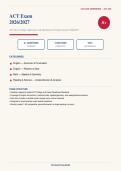
ACT Exam
2026/2027 A+
ACT, Inc. | College Admissions with Questions & Verified Answers 2026/2027
A+ QUESTIONS 4 SECTIONS 100%
VERIFIED COMPLETE RATIONALES
CATEGORIES
English — Grammar & Punctuation
English — Rhetoric & Style
Math — Algebra & Geometry
Reading & Science — Comprehension & Analysis
EXAM STRUCTURE
• Questions aligned to public ACT College and Career Readiness Standards
• Coverage of English conventions, rhetorical skills, algebra/geometry, and reading/science analysis
• Each item includes a verified correct answer and a concise rationale
• Designed for timed practice under realistic conditions
• Scoring: scaled 1–36 (competitive, percentile-based; no single passing cut score)
STUVIAACTUALEXAM
, SECTION 1: English — Grammar & Punctuation
Q1.
During a student council meeting, the secretary recorded the following sentence: "The proposal for a longer lunch period, which
was supported by a majority of the junior class was tabled until next month." To correct the punctuation error, a writer should
A. remove the comma after "period" because the clause is essential
B. add a semicolon after "class" to separate two independent clauses
C. place a comma after "class" to close the nonrestrictive clause
D. change "was tabled" to "were tabled" for subject-verb agreement
Correct Answer: C
Rationale: The clause "which was supported by a majority of the junior class" is nonrestrictive and must be set off by commas on both sides.
Adding the missing comma after "class" properly closes the clause.
Q2.
A draft of a science report contains the sentence: "Neither the control group nor the experimental groups was given the placebo
during the second trial." The most effective revision for agreement is to
A. change "groups" to "group" so that both subjects are singular
B. change "was" to "were" because the nearer subject "groups" is plural
C. leave the verb unchanged because "neither...nor" always takes a singular verb
D. rewrite the sentence to begin with "The experimental groups and the control group"
Correct Answer: B
Rationale: With "neither...nor," the verb agrees with the nearer subject. "Groups" is plural, so the verb must be "were."
Q3.
In an application essay a student wrote: "Having studied abroad for a semester the new perspectives I gained reshaped my career
goals." The underlined portion is best revised by
A. changing "Having studied" to "I studied" to create a compound sentence
B. moving "Having studied abroad for a semester" to the end of the sentence
C. replacing "the new perspectives" with "my new perspectives" for clarity
D. adding a comma after "semester" to separate the introductory participial phrase
Correct Answer: D
Rationale: An introductory participial phrase must be followed by a comma. The missing comma after "semester" creates a fused construction that
confuses the logical subject of the phrase.
Q4.
A history paper includes this sentence: "The treaty was signed in 1919, however, its long-term effects were not fully understood
for decades." The punctuation problem is best corrected by
A. replacing the comma after "1919" with a semicolon
B. removing the comma after "however"
C. changing "however" to "but" and keeping the existing commas
D. placing a period after "1919" and capitalizing "however"
Correct Answer: A
Rationale: "However" is a conjunctive adverb joining two independent clauses. A semicolon (or period) is required before it; a comma alone
produces a comma splice.
Q5.
The sentence "Each of the finalists have prepared a three-minute speech for the assembly" contains an error in
A. pronoun-antecedent agreement; "finalists" is plural
B. subject-verb agreement; "each" is singular and requires "has"
C. tense consistency; the present perfect is required
D. modifier placement; "three-minute" should follow "speech"
Correct Answer: B
Rationale: "Each" is singular and remains the true subject even when followed by a plural prepositional phrase. The verb must therefore be "has."
ACT Exam
2026/2027 A+
ACT, Inc. | College Admissions with Questions & Verified Answers 2026/2027
A+ QUESTIONS 4 SECTIONS 100%
VERIFIED COMPLETE RATIONALES
CATEGORIES
English — Grammar & Punctuation
English — Rhetoric & Style
Math — Algebra & Geometry
Reading & Science — Comprehension & Analysis
EXAM STRUCTURE
• Questions aligned to public ACT College and Career Readiness Standards
• Coverage of English conventions, rhetorical skills, algebra/geometry, and reading/science analysis
• Each item includes a verified correct answer and a concise rationale
• Designed for timed practice under realistic conditions
• Scoring: scaled 1–36 (competitive, percentile-based; no single passing cut score)
STUVIAACTUALEXAM
, SECTION 1: English — Grammar & Punctuation
Q1.
During a student council meeting, the secretary recorded the following sentence: "The proposal for a longer lunch period, which
was supported by a majority of the junior class was tabled until next month." To correct the punctuation error, a writer should
A. remove the comma after "period" because the clause is essential
B. add a semicolon after "class" to separate two independent clauses
C. place a comma after "class" to close the nonrestrictive clause
D. change "was tabled" to "were tabled" for subject-verb agreement
Correct Answer: C
Rationale: The clause "which was supported by a majority of the junior class" is nonrestrictive and must be set off by commas on both sides.
Adding the missing comma after "class" properly closes the clause.
Q2.
A draft of a science report contains the sentence: "Neither the control group nor the experimental groups was given the placebo
during the second trial." The most effective revision for agreement is to
A. change "groups" to "group" so that both subjects are singular
B. change "was" to "were" because the nearer subject "groups" is plural
C. leave the verb unchanged because "neither...nor" always takes a singular verb
D. rewrite the sentence to begin with "The experimental groups and the control group"
Correct Answer: B
Rationale: With "neither...nor," the verb agrees with the nearer subject. "Groups" is plural, so the verb must be "were."
Q3.
In an application essay a student wrote: "Having studied abroad for a semester the new perspectives I gained reshaped my career
goals." The underlined portion is best revised by
A. changing "Having studied" to "I studied" to create a compound sentence
B. moving "Having studied abroad for a semester" to the end of the sentence
C. replacing "the new perspectives" with "my new perspectives" for clarity
D. adding a comma after "semester" to separate the introductory participial phrase
Correct Answer: D
Rationale: An introductory participial phrase must be followed by a comma. The missing comma after "semester" creates a fused construction that
confuses the logical subject of the phrase.
Q4.
A history paper includes this sentence: "The treaty was signed in 1919, however, its long-term effects were not fully understood
for decades." The punctuation problem is best corrected by
A. replacing the comma after "1919" with a semicolon
B. removing the comma after "however"
C. changing "however" to "but" and keeping the existing commas
D. placing a period after "1919" and capitalizing "however"
Correct Answer: A
Rationale: "However" is a conjunctive adverb joining two independent clauses. A semicolon (or period) is required before it; a comma alone
produces a comma splice.
Q5.
The sentence "Each of the finalists have prepared a three-minute speech for the assembly" contains an error in
A. pronoun-antecedent agreement; "finalists" is plural
B. subject-verb agreement; "each" is singular and requires "has"
C. tense consistency; the present perfect is required
D. modifier placement; "three-minute" should follow "speech"
Correct Answer: B
Rationale: "Each" is singular and remains the true subject even when followed by a plural prepositional phrase. The verb must therefore be "has."


