
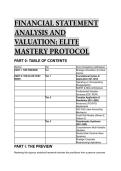
FINANCIAL STATEMENT
ANALYSIS AND
VALUATION: ELITE
MASTERY PROTOCOL
PART 0: TABLE OF CONTENTS
Section Tier Core Competency Addressed
PART I: THE PREVIEW N/A Strategic Orientation & Critical
Axioms
PART II: THE ELITE TEST Tier 1 Foundational Syntax &
BANK Application (Q1–Q10)
Operating vs. Nonoperating
Disaggregation
NOPAT & NOA Architecture
Fundamental Valuation
Syntaxes (DCF, ROPI)
Tier 2 Complex Application &
Simulation (Q11–Q20)
Advanced LIFO/FIFO
Adjustments
ASC 842 Lease Accounting
Mechanics
Credit Risk Models (Altman Z,
Ohlson O)
Tier 3 Grandmaster Synthesis
(Q21–Q30)
Comprehensive Multi-Variable
Valuation
Steady-State Terminal Value
Dynamics
Strategic Corporate
Restructuring Implications
PART I: THE PREVIEW
Mastering this rigorous analytical framework elevates the practitioner from a passive consumer
,of reported financial data into a precise architect of corporate valuation, allowing the seamless
extraction of accounting distortions to reveal the true economic engine of any enterprise. By
commanding these exact methodologies, academic mastery translates directly into elite
professional intuition, enabling the accurate pricing of risk, projection of abnormal growth, and
execution of high-stakes capital allocation decisions globally.
The "Critical Axioms" Cheat Sheet
Axiom Mathematical Formulation / Application Context
Strategic Rule
The Operating Dichotomy ROE = RNOA + [FLEV × Isolating core operational
Spread] profitability (RNOA) from
returns generated via financial
leverage.
The NOPAT Tax Shield NOPAT = Net Income + NNE Valuing operations as if strictly
(after-tax) equity-financed by stripping the
tax benefits of debt.
Valuation Equivalency DCF Intrinsic Value = ROPI Accrual accounting dictates
Intrinsic Value timing, not total value. If clean
surplus holds, models align
perfectly.
The ASC 842 Imperative Operating Leases = ROU Asset Capitalizing previously
+ Lease Liability off-balance-sheet
commitments, fundamentally
altering historical ROA and
leverage trends.
The LIFO Adjustment Law FIFO Inventory = LIFO Standardizing NOA across
Inventory + LIFO Reserve peers requires adding the
reserve to assets, tax-effecting
the DTL, and adjusting equity.
PART II: THE ELITE TEST BANK
Tier 1: Foundational Syntax & Application
Q1: A multinational industrial firm reports an aggregate Return on Equity (ROE) of 22.0%. An
analyst disaggregates this return and determines that the firm's Return on Net Operating Assets
(RNOA) is 14.0%. The firm possesses a positive financial leverage (FLEV) ratio. Based on the
principles of the Operating ROE Disaggregation framework, which conclusion is the MOST
ACCURATE? A) The firm's net nonoperating return is negative, indicating that the cost of its
debt financing exceeds the returns generated by its operating assets. B) The firm's return on
nonoperating activities is diluting its core operational efficiency, requiring an immediate
reduction in interest-bearing debt. C) The firm is successfully generating a positive spread,
meaning the return generated by its operating assets exceeds its effective after-tax cost of
borrowing. D) The firm's high ROE is an artificial distortion caused by extensive treasury stock
repurchases, rendering the RNOA metric uninterpretable.
● Answer: C (The firm is successfully generating a positive spread, meaning the return
generated by its operating assets exceeds its effective after-tax cost of borrowing.)
, ● Distractor Analysis:
○ A is incorrect: Because ROE (22%) is higher than RNOA (14%), the nonoperating
component (FLEV × Spread) must be mathematically positive, not negative.
○ B is incorrect: The nonoperating return is accretive, not dilutive, to ROE since it
bridges the performance gap from 14% up to 22%.
○ D is incorrect: While treasury stock repurchases can distort ROE by shrinking the
equity denominator, RNOA specifically strips out equity and debt distortions to
measure pure operating performance; thus, RNOA remains highly interpretable and
immune to capital structure engineering.
The Mentor's Analysis: Return on Equity is driven by two distinct engines: the profitability of
core operations (RNOA) and the strategic deployment of borrowed capital (Leverage × Spread).
When ROE exceeds RNOA, the firm is borrowing capital at a rate lower than its operating
return, successfully utilizing financial leverage to magnify shareholder wealth. By utilizing
Operating Disaggregation, the analyst bypasses the common trap of viewing ROE as a
monolithic, infallible performance metric. Professional/Academic Intuition: Always isolate
RNOA from ROE; high financial leverage can easily mask deteriorating operating margins
in a low-interest-rate environment.
Q2: When calculating Net Operating Profit After Tax (NOPAT) for a highly levered
telecommunications company, a junior analyst simply deducts the reported tax expense from
operating profit before tax. Based on the principles of financial statement reformulation, which
resulting analytical error is the MOST ACCURATE? A) The analyst will overstate NOPAT
because the reported tax expense is artificially low, as it includes the tax shield generated by
interest expense. B) The analyst will understate NOPAT because the reported tax expense has
been reduced by the tax shield from nonoperating interest expense. C) The analyst will correctly
state NOPAT, as reported tax expense automatically isolates operating tax liabilities under
current global accounting standards. D) The analyst will understate NOPAT because they failed
to deduct noncontrolling interests directly from the operating profit line.
● Answer: A (The analyst will overstate NOPAT because the reported tax expense is
artificially low, as it includes the tax shield generated by interest expense.)
● Distractor Analysis:
○ B is incorrect: The analyst does not understate NOPAT; subtracting an artificially
lowered tax expense from operating profit mathematically results in an inflated,
overstated NOPAT figure.
○ C is incorrect: Current accounting standards do not separate operating and
nonoperating taxes on the face of the income statement; this requires manual
analyst reformulation to isolate the true operating tax burden.
○ D is incorrect: Noncontrolling interests represent an equity claim on consolidated
net income, not an operating tax expense metric, and are handled post-NOPAT in
the reformulated income statement.
The Mentor's Analysis: Corporate operations must be evaluated as if the company were
entirely equity-financed to ensure comparability across peers with different capital structures.
When calculating NOPAT, the analyst must remove the tax benefits of debt (the interest tax
shield). By utilizing the reformulated tax formula (Tax Expense + (NNE × Tax Rate)), the analyst
bypasses the common trap of commingling financing tax benefits with operational performance.
Professional/Academic Intuition: NOPAT must always represent the unlevered, after-tax
profitability of the firm's core business model. Never credit operations for the tax
benefits of borrowing.
Q3: A retail conglomerate holds significant cash equivalents, marketable securities, and
ANALYSIS AND
VALUATION: ELITE
MASTERY PROTOCOL
PART 0: TABLE OF CONTENTS
Section Tier Core Competency Addressed
PART I: THE PREVIEW N/A Strategic Orientation & Critical
Axioms
PART II: THE ELITE TEST Tier 1 Foundational Syntax &
BANK Application (Q1–Q10)
Operating vs. Nonoperating
Disaggregation
NOPAT & NOA Architecture
Fundamental Valuation
Syntaxes (DCF, ROPI)
Tier 2 Complex Application &
Simulation (Q11–Q20)
Advanced LIFO/FIFO
Adjustments
ASC 842 Lease Accounting
Mechanics
Credit Risk Models (Altman Z,
Ohlson O)
Tier 3 Grandmaster Synthesis
(Q21–Q30)
Comprehensive Multi-Variable
Valuation
Steady-State Terminal Value
Dynamics
Strategic Corporate
Restructuring Implications
PART I: THE PREVIEW
Mastering this rigorous analytical framework elevates the practitioner from a passive consumer
,of reported financial data into a precise architect of corporate valuation, allowing the seamless
extraction of accounting distortions to reveal the true economic engine of any enterprise. By
commanding these exact methodologies, academic mastery translates directly into elite
professional intuition, enabling the accurate pricing of risk, projection of abnormal growth, and
execution of high-stakes capital allocation decisions globally.
The "Critical Axioms" Cheat Sheet
Axiom Mathematical Formulation / Application Context
Strategic Rule
The Operating Dichotomy ROE = RNOA + [FLEV × Isolating core operational
Spread] profitability (RNOA) from
returns generated via financial
leverage.
The NOPAT Tax Shield NOPAT = Net Income + NNE Valuing operations as if strictly
(after-tax) equity-financed by stripping the
tax benefits of debt.
Valuation Equivalency DCF Intrinsic Value = ROPI Accrual accounting dictates
Intrinsic Value timing, not total value. If clean
surplus holds, models align
perfectly.
The ASC 842 Imperative Operating Leases = ROU Asset Capitalizing previously
+ Lease Liability off-balance-sheet
commitments, fundamentally
altering historical ROA and
leverage trends.
The LIFO Adjustment Law FIFO Inventory = LIFO Standardizing NOA across
Inventory + LIFO Reserve peers requires adding the
reserve to assets, tax-effecting
the DTL, and adjusting equity.
PART II: THE ELITE TEST BANK
Tier 1: Foundational Syntax & Application
Q1: A multinational industrial firm reports an aggregate Return on Equity (ROE) of 22.0%. An
analyst disaggregates this return and determines that the firm's Return on Net Operating Assets
(RNOA) is 14.0%. The firm possesses a positive financial leverage (FLEV) ratio. Based on the
principles of the Operating ROE Disaggregation framework, which conclusion is the MOST
ACCURATE? A) The firm's net nonoperating return is negative, indicating that the cost of its
debt financing exceeds the returns generated by its operating assets. B) The firm's return on
nonoperating activities is diluting its core operational efficiency, requiring an immediate
reduction in interest-bearing debt. C) The firm is successfully generating a positive spread,
meaning the return generated by its operating assets exceeds its effective after-tax cost of
borrowing. D) The firm's high ROE is an artificial distortion caused by extensive treasury stock
repurchases, rendering the RNOA metric uninterpretable.
● Answer: C (The firm is successfully generating a positive spread, meaning the return
generated by its operating assets exceeds its effective after-tax cost of borrowing.)
, ● Distractor Analysis:
○ A is incorrect: Because ROE (22%) is higher than RNOA (14%), the nonoperating
component (FLEV × Spread) must be mathematically positive, not negative.
○ B is incorrect: The nonoperating return is accretive, not dilutive, to ROE since it
bridges the performance gap from 14% up to 22%.
○ D is incorrect: While treasury stock repurchases can distort ROE by shrinking the
equity denominator, RNOA specifically strips out equity and debt distortions to
measure pure operating performance; thus, RNOA remains highly interpretable and
immune to capital structure engineering.
The Mentor's Analysis: Return on Equity is driven by two distinct engines: the profitability of
core operations (RNOA) and the strategic deployment of borrowed capital (Leverage × Spread).
When ROE exceeds RNOA, the firm is borrowing capital at a rate lower than its operating
return, successfully utilizing financial leverage to magnify shareholder wealth. By utilizing
Operating Disaggregation, the analyst bypasses the common trap of viewing ROE as a
monolithic, infallible performance metric. Professional/Academic Intuition: Always isolate
RNOA from ROE; high financial leverage can easily mask deteriorating operating margins
in a low-interest-rate environment.
Q2: When calculating Net Operating Profit After Tax (NOPAT) for a highly levered
telecommunications company, a junior analyst simply deducts the reported tax expense from
operating profit before tax. Based on the principles of financial statement reformulation, which
resulting analytical error is the MOST ACCURATE? A) The analyst will overstate NOPAT
because the reported tax expense is artificially low, as it includes the tax shield generated by
interest expense. B) The analyst will understate NOPAT because the reported tax expense has
been reduced by the tax shield from nonoperating interest expense. C) The analyst will correctly
state NOPAT, as reported tax expense automatically isolates operating tax liabilities under
current global accounting standards. D) The analyst will understate NOPAT because they failed
to deduct noncontrolling interests directly from the operating profit line.
● Answer: A (The analyst will overstate NOPAT because the reported tax expense is
artificially low, as it includes the tax shield generated by interest expense.)
● Distractor Analysis:
○ B is incorrect: The analyst does not understate NOPAT; subtracting an artificially
lowered tax expense from operating profit mathematically results in an inflated,
overstated NOPAT figure.
○ C is incorrect: Current accounting standards do not separate operating and
nonoperating taxes on the face of the income statement; this requires manual
analyst reformulation to isolate the true operating tax burden.
○ D is incorrect: Noncontrolling interests represent an equity claim on consolidated
net income, not an operating tax expense metric, and are handled post-NOPAT in
the reformulated income statement.
The Mentor's Analysis: Corporate operations must be evaluated as if the company were
entirely equity-financed to ensure comparability across peers with different capital structures.
When calculating NOPAT, the analyst must remove the tax benefits of debt (the interest tax
shield). By utilizing the reformulated tax formula (Tax Expense + (NNE × Tax Rate)), the analyst
bypasses the common trap of commingling financing tax benefits with operational performance.
Professional/Academic Intuition: NOPAT must always represent the unlevered, after-tax
profitability of the firm's core business model. Never credit operations for the tax
benefits of borrowing.
Q3: A retail conglomerate holds significant cash equivalents, marketable securities, and


