
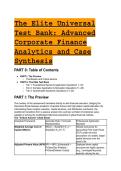
The Elite Universal
Test Bank: Advanced
Corporate Finance
Analytics and Case
Synthesis
PART 0: Table of Contents
● PART I: The Preview
○ The Mission and Critical Axioms
● PART II: The Elite Test Bank
○ Tier 1: Foundational Syntax & Application (Questions 1–10)
○ Tier 2: Complex Application & Simulation (Questions 11–20)
○ Tier 3: Grandmaster Synthesis (Questions 21–30)
PART I: The Preview
The mastery of this assessment translates directly to elite financial execution, bridging the
theoretical divide between academic corporate finance and high-stakes capital allocation. By
internalizing these complex valuation, capital structure, and distribution mechanics, the
practitioner transitions from a passive analyst into a primary architect of enterprise value,
capable of solving the multifaceted dilemmas presented in global financial markets.
The "Critical Axioms" Cheat Sheet:
Analytical Framework Axiomatic Rule / Formulaic Professional Application
Representation Standard
Weighted Average Cost of WACC = \frac{E}{V} K_e + Utilized exclusively for
Capital (WACC) \frac{D}{V} K_d (1-T) discounting Free Cash Flows
(FCF) under the strict
assumption of a stable, target
capital structure over the
asset's life.
Adjusted Present Value (APV) APV = NPV_{Unlevered} + Deployed when capital
PV(\text{Tax Shields}) - structures are highly dynamic
PV(\text{Distress Costs}) (e.g., Leveraged Buyouts),
explicitly valuing the tax
,Analytical Framework Axiomatic Rule / Formulaic Professional Application
Representation Standard
benefits of debt against the
probability of bankruptcy risk.
Dividend Irrelevance V_L = V_U (Assuming perfect Asserts that firm value is driven
Theorem capital markets) by investment cash flows, not
the payout mechanism;
distribution choice is purely a
secondary capital structure
decision.
The DuPont Identity ROE = \text{Profit Margin} Isolates operational efficiency,
\times \text{Asset Turnover} asset utilization, and financial
\times \text{Equity Multiplier} leverage to pinpoint the exact
source of equity return
generation.
Real Options Valuation Value_{Project} = NPV_{Static} Integrates managerial
+ Value_{Flexibility} adaptability (abandonment,
expansion, delay) into capital
budgeting, often utilizing
binomial models or
Black-Scholes approximations.
PART II: The Elite Test Bank
Tier 1: Foundational Syntax & Application
Q1: An infrastructure firm, mirroring the Ultra Cable Corporation case, reports a significant
year-over-year increase in absolute net profit but a simultaneous decline in its net profit margin.
The firm aggressively expanded fixed assets by drawing down cash reserves and issuing
long-term debt. Based on the principles of FINANCIAL STATEMENT ANALYSIS, which
conclusion is the MOST ACCURATE regarding the margin compression? A) The margin
compression is primarily driven by an inefficient accumulation of working capital that inflated the
denominator of the margin ratio. B) The margin compression is a direct result of capital
expenditures being fully expensed on the income statement during the period of acquisition. C)
The margin compression is primarily driven by the escalating interest tax shields and absolute
interest expense resulting from the aggressive debt issuance. D) The margin compression
indicates that the firm is failing to generate top-line sales growth proportional to its fixed asset
base.
● Answer: C (The margin compression is primarily driven by the escalating interest tax
shields and absolute interest expense resulting from the aggressive debt issuance.)
● Distractor Analysis:
○ A is incorrect: Working capital fluctuations are a balance sheet and cash flow
statement metric; they do not directly alter the net profit margin equation (Net
Income / Sales).
○ B is incorrect: Capital expenditures are capitalized on the balance sheet and
depreciated over time; they are never fully expensed on the income statement in
the acquisition year.
○ D is incorrect: The scenario specifies that net profit increased, which implies
, revenue growth was present, but the relative profitability (margin) fell strictly due to
below-the-line financing costs, not top-line stagnation.
The Mentor's Analysis: The core underlying principle centers on distinguishing operational
profitability from financial structuring costs. When facing rapid debt-funded expansion, the
immediate priority is isolating Operating Income (EBIT) from Net Income. By utilizing DuPont
Analysis, the analyst bypasses the common trap of confusing aggregate profit growth with
operational margin expansion. Professional/Academic Intuition: The operational yield of
assets must be segregated from the friction costs of the capital structure used to finance
them.
Q2: A retail conglomerate wishes to implement a sustainable growth model. The financial
planning team projects a 15% increase in sales, while the firm's historically stable Sustainable
Growth Rate (SGR) is calculated at 10%. Based on the principles of FINANCIAL
FORECASTING, which action is the MOST APPROPRIATE requirement to support this 15%
growth? A) The firm must systematically decrease its target debt-to-equity ratio to minimize the
friction of interest expenses on retained earnings. B) The firm must aggressively increase its
dividend payout ratio to signal financial strength and attract new external equity. C) The firm
must alter its financial policy by increasing financial leverage, improving profit margins, or raising
external equity capital. D) The firm must rely solely on spontaneous liabilities and retained
earnings, as the SGR already accounts for maximum external financing.
● Answer: C (The firm must alter its financial policy by increasing financial leverage,
improving profit margins, or raising external equity capital.)
● Distractor Analysis:
○ A is incorrect: Decreasing the debt-to-equity ratio lowers the equity multiplier, which
actively decreases the SGR, exacerbating the funding deficit.
○ B is incorrect: Increasing the dividend payout ratio decreases the retention ratio
(plowback), which fundamentally lowers the internal capital available for growth.
○ D is incorrect: The defining characteristic of growing beyond the SGR is that
spontaneous liabilities and retained earnings are mathematically insufficient;
external capital or structural policy shifts are mandatory.
The Mentor's Analysis: The core underlying principle establishes that rapid growth consumes
cash, and sustainable growth relies on a fixed capital structure and dividend policy. When facing
growth targets exceeding the SGR, the immediate priority is identifying external funding
mechanisms or operational efficiency improvements. By utilizing pro-forma external financing
needed (EFN) models, the analyst bypasses the common trap of assuming top-line growth
automatically funds itself. Professional/Academic Intuition: Growth beyond the Sustainable
Growth Rate mandates a fundamental alteration in operational efficiency, payout policy,
or capital structure.
Q3: A lottery winner is presented with a choice: a lump sum today or a 30-year annuity. The
nominal discount rate is 8%, compounding quarterly. Inflation is projected at 3% annually. Based
on the principles of the TIME VALUE OF MONEY, which calculation methodology is the MOST
ACCURATE for determining the present value of the annuity? A) Discount the nominal cash
flows using a simple annual rate of 8% minus the 3% inflation rate to account for purchasing
power parity. B) Discount the real cash flows using the nominal 8% quarterly compounded rate
to ensure the nominal payout matches the real required return. C) Discount the nominal annual
cash flows using the Effective Annual Rate (EAR) derived from the 8% quarterly compounded
nominal rate. D) Discount the nominal cash flows using the 8% nominal rate divided by 30 to
establish the periodic annuity factor.
● Answer: C (Discount the nominal annual cash flows using the Effective Annual Rate
Test Bank: Advanced
Corporate Finance
Analytics and Case
Synthesis
PART 0: Table of Contents
● PART I: The Preview
○ The Mission and Critical Axioms
● PART II: The Elite Test Bank
○ Tier 1: Foundational Syntax & Application (Questions 1–10)
○ Tier 2: Complex Application & Simulation (Questions 11–20)
○ Tier 3: Grandmaster Synthesis (Questions 21–30)
PART I: The Preview
The mastery of this assessment translates directly to elite financial execution, bridging the
theoretical divide between academic corporate finance and high-stakes capital allocation. By
internalizing these complex valuation, capital structure, and distribution mechanics, the
practitioner transitions from a passive analyst into a primary architect of enterprise value,
capable of solving the multifaceted dilemmas presented in global financial markets.
The "Critical Axioms" Cheat Sheet:
Analytical Framework Axiomatic Rule / Formulaic Professional Application
Representation Standard
Weighted Average Cost of WACC = \frac{E}{V} K_e + Utilized exclusively for
Capital (WACC) \frac{D}{V} K_d (1-T) discounting Free Cash Flows
(FCF) under the strict
assumption of a stable, target
capital structure over the
asset's life.
Adjusted Present Value (APV) APV = NPV_{Unlevered} + Deployed when capital
PV(\text{Tax Shields}) - structures are highly dynamic
PV(\text{Distress Costs}) (e.g., Leveraged Buyouts),
explicitly valuing the tax
,Analytical Framework Axiomatic Rule / Formulaic Professional Application
Representation Standard
benefits of debt against the
probability of bankruptcy risk.
Dividend Irrelevance V_L = V_U (Assuming perfect Asserts that firm value is driven
Theorem capital markets) by investment cash flows, not
the payout mechanism;
distribution choice is purely a
secondary capital structure
decision.
The DuPont Identity ROE = \text{Profit Margin} Isolates operational efficiency,
\times \text{Asset Turnover} asset utilization, and financial
\times \text{Equity Multiplier} leverage to pinpoint the exact
source of equity return
generation.
Real Options Valuation Value_{Project} = NPV_{Static} Integrates managerial
+ Value_{Flexibility} adaptability (abandonment,
expansion, delay) into capital
budgeting, often utilizing
binomial models or
Black-Scholes approximations.
PART II: The Elite Test Bank
Tier 1: Foundational Syntax & Application
Q1: An infrastructure firm, mirroring the Ultra Cable Corporation case, reports a significant
year-over-year increase in absolute net profit but a simultaneous decline in its net profit margin.
The firm aggressively expanded fixed assets by drawing down cash reserves and issuing
long-term debt. Based on the principles of FINANCIAL STATEMENT ANALYSIS, which
conclusion is the MOST ACCURATE regarding the margin compression? A) The margin
compression is primarily driven by an inefficient accumulation of working capital that inflated the
denominator of the margin ratio. B) The margin compression is a direct result of capital
expenditures being fully expensed on the income statement during the period of acquisition. C)
The margin compression is primarily driven by the escalating interest tax shields and absolute
interest expense resulting from the aggressive debt issuance. D) The margin compression
indicates that the firm is failing to generate top-line sales growth proportional to its fixed asset
base.
● Answer: C (The margin compression is primarily driven by the escalating interest tax
shields and absolute interest expense resulting from the aggressive debt issuance.)
● Distractor Analysis:
○ A is incorrect: Working capital fluctuations are a balance sheet and cash flow
statement metric; they do not directly alter the net profit margin equation (Net
Income / Sales).
○ B is incorrect: Capital expenditures are capitalized on the balance sheet and
depreciated over time; they are never fully expensed on the income statement in
the acquisition year.
○ D is incorrect: The scenario specifies that net profit increased, which implies
, revenue growth was present, but the relative profitability (margin) fell strictly due to
below-the-line financing costs, not top-line stagnation.
The Mentor's Analysis: The core underlying principle centers on distinguishing operational
profitability from financial structuring costs. When facing rapid debt-funded expansion, the
immediate priority is isolating Operating Income (EBIT) from Net Income. By utilizing DuPont
Analysis, the analyst bypasses the common trap of confusing aggregate profit growth with
operational margin expansion. Professional/Academic Intuition: The operational yield of
assets must be segregated from the friction costs of the capital structure used to finance
them.
Q2: A retail conglomerate wishes to implement a sustainable growth model. The financial
planning team projects a 15% increase in sales, while the firm's historically stable Sustainable
Growth Rate (SGR) is calculated at 10%. Based on the principles of FINANCIAL
FORECASTING, which action is the MOST APPROPRIATE requirement to support this 15%
growth? A) The firm must systematically decrease its target debt-to-equity ratio to minimize the
friction of interest expenses on retained earnings. B) The firm must aggressively increase its
dividend payout ratio to signal financial strength and attract new external equity. C) The firm
must alter its financial policy by increasing financial leverage, improving profit margins, or raising
external equity capital. D) The firm must rely solely on spontaneous liabilities and retained
earnings, as the SGR already accounts for maximum external financing.
● Answer: C (The firm must alter its financial policy by increasing financial leverage,
improving profit margins, or raising external equity capital.)
● Distractor Analysis:
○ A is incorrect: Decreasing the debt-to-equity ratio lowers the equity multiplier, which
actively decreases the SGR, exacerbating the funding deficit.
○ B is incorrect: Increasing the dividend payout ratio decreases the retention ratio
(plowback), which fundamentally lowers the internal capital available for growth.
○ D is incorrect: The defining characteristic of growing beyond the SGR is that
spontaneous liabilities and retained earnings are mathematically insufficient;
external capital or structural policy shifts are mandatory.
The Mentor's Analysis: The core underlying principle establishes that rapid growth consumes
cash, and sustainable growth relies on a fixed capital structure and dividend policy. When facing
growth targets exceeding the SGR, the immediate priority is identifying external funding
mechanisms or operational efficiency improvements. By utilizing pro-forma external financing
needed (EFN) models, the analyst bypasses the common trap of assuming top-line growth
automatically funds itself. Professional/Academic Intuition: Growth beyond the Sustainable
Growth Rate mandates a fundamental alteration in operational efficiency, payout policy,
or capital structure.
Q3: A lottery winner is presented with a choice: a lump sum today or a 30-year annuity. The
nominal discount rate is 8%, compounding quarterly. Inflation is projected at 3% annually. Based
on the principles of the TIME VALUE OF MONEY, which calculation methodology is the MOST
ACCURATE for determining the present value of the annuity? A) Discount the nominal cash
flows using a simple annual rate of 8% minus the 3% inflation rate to account for purchasing
power parity. B) Discount the real cash flows using the nominal 8% quarterly compounded rate
to ensure the nominal payout matches the real required return. C) Discount the nominal annual
cash flows using the Effective Annual Rate (EAR) derived from the 8% quarterly compounded
nominal rate. D) Discount the nominal cash flows using the 8% nominal rate divided by 30 to
establish the periodic annuity factor.
● Answer: C (Discount the nominal annual cash flows using the Effective Annual Rate


