

NSG 3130 - Fundamental Concepts & Skills for Nursing Practice II | Exam 4 (2026/2027 Update) Grade A | 100% Correct Verified
NSG 3130 / NSG 3130
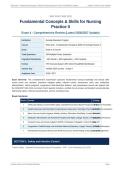
Fundamental Concepts & Skills for Nursing
Practice II
Exam 4 - Comprehensive Review (Latest 2026/2027 Update)
Institution Nursing Education Program
Course NSG 3130 - Fundamental Concepts & Skills for Nursing Practice II
Exam Exam 4 of Course
Total Questions 100 Multiple-Choice Questions
Cognitive Distribution ~25% Recall | ~55% Application | ~20% Analysis
Format 75% Scenario-based | 25% Direct Recall/Skill Identification
Answer Key Verified 100% Correct - Grade A
Academic Year
Exam Overview: This comprehensive examination assesses fundamental nursing knowledge and clinical skills
across seven core domains. Questions integrate safety, infection control, assessment, basic care, medication
administration, clinical judgment, oxygenation, fluid-electrolyte balance, and perioperative wound care aligned with
the 2026/2027 NSG 3130 curriculum. Each question includes a verified correct answer and detailed nursing rationale
addressing safety, evidence-based practice, and the nursing process.
Exam Sections:
Section Domain Q Range
1 Safety and Infection Control (Patient Safety, Standard/Transmission-Based Precautions,Q1-Q15
PPE, Error Prevention)
2 Health Assessment and Vital Signs (Comprehensive Assessment, Vital Signs, Pain Assessment,
Q16-Q30 Documentation)
3 Basic Care and Comfort (Hygiene, Mobility, Nutrition, Elimination, Rest/Sleep, Comfort Q31-Q45
Measures)
4 Medication Administration and Parenteral Therapies (Six Rights, Dosage, Routes, IV Therapy,
Q46-Q60 Blood Products)
5 Nursing Process and Clinical Judgment (ADPIE, Prioritization, Delegation, Critical Thinking)
Q61-Q75
6 Oxygenation, Fluid/Electrolyte, and Acid-Base Balance (Respiratory, Oxygen Therapy, Q76-Q90
IV Fluids, Electrolytes)
7 Perioperative Nursing and Wound Care (Pre/Post-Op Care, Wound Healing, Dressings,
Q91-Q100
Drain Management)
SECTION 1: Safety and Infection Control
Patient Safety - Standard/Transmission-Based Precautions - PPE - Error Prevention (Q1-Q15)
Verified Answers with Detailed Rationales Page 1
,NSG 3130 - Fundamental Concepts & Skills for Nursing Practice II | Exam 4 (2026/2027 Update) Grade A | 100% Correct Verified
1. An 82-year-old patient with confusion is admitted to the medical-surgical unit. Which
intervention should the nurse implement FIRST to reduce this patient's fall risk? [Application]
A. Place the patient in a room near the nurses' station and apply a bed alarm
B. Keep all four side rails raised at all times to prevent the patient from getting out of bed
unassisted [CORRECT]
C. Administer a PRN sedative as ordered to reduce restlessness
D. Restrict oral fluid intake after 8 PM to reduce nocturia
Correct Answer: B
Rationale:
For a confused patient at fall risk, the safest intervention is placing them near the nurses' station for close
observation and using a bed alarm as an early-warning device. Raising all four side rails (B) is considered a
restraint and increases the risk of entrapment, falls over the rails, and serious injury. Sedatives (C) increase
confusion and fall risk. Fluid restriction (D) risks dehydration and electrolyte imbalance in older adults.
2. Which factor is part of the Morse Fall Scale used to assess patient fall risk? [Recall]
A. Patient age greater than 65 years
B. History of falling within the last 3 months, secondary diagnosis, ambulatory aid, IV
therapy/heparin lock, gait, and mental status [CORRECT]
C. Number of medications the patient is taking
D. Body mass index greater than 30
Correct Answer: B
Rationale:
The Morse Fall Scale includes six items: (1) history of falling (immediate or within 3 months), (2) secondary
diagnosis, (3) ambulatory aid (none/crutches/walker/wheelchair/furniture), (4) IV therapy/heparin lock, (5)
gait/transferring/weak/impaired/bedrest, and (6) mental status (knows own limits/forgets limitations). Scores
>51 indicate high fall risk. Age (A), medication count (C), and BMI (D) are risk factors in other tools but not
part of the Morse Scale specifically.
3. A patient is receiving wrist restraints after repeatedly pulling at an endotracheal tube. The
provider's order is for "soft wrist restraints PRN." Which action by the nurse is correct regarding
this order? [Application]
A. Apply the restraints and document the time, then reassess in 8 hours
B. Clarify the order with the provider because PRN restraint orders are not permitted; restraints
require a specific time-limited order [CORRECT]
C. Apply the restraints and discontinue them when the patient becomes calm
D. Apply the restraints loosely to allow full range of motion
Correct Answer: B
Rationale:
Restraint orders must be time-limited and may NOT be written as PRN. According to The Joint Commission
and CMS standards, restraint orders must specify the duration (max 4 hours for adults, 2 hours for ages
9-17, 1 hour for under 9). Restraints require continuous monitoring (q15min for adults), hourly circulation
checks, range-of-motion exercises, and re-evaluation. PRN orders (B is correct) are noncompliant because
restraints must be reassessed and reordered. Loose application (D) defeats the purpose and increases injury
risk.
Verified Answers with Detailed Rationales Page 2
,NSG 3130 - Fundamental Concepts & Skills for Nursing Practice II | Exam 4 (2026/2027 Update) Grade A | 100% Correct Verified
4. A nurse enters a patient's room and discovers a small trash fire in the wastebasket. The patient
is in the bed. Which action should the nurse take FIRST according to the RACE fire safety
protocol? [Application]
A. Attempt to extinguish the fire using a Class A fire extinguisher
B. Rescue the patient by moving them out of the room to a safe area [CORRECT]
C. Activate the fire alarm pull station and call the facility emergency number
D. Close all doors and windows to contain the fire
Correct Answer: B
Rationale:
The RACE acronym guides fire response in order of priority: R = RESCUE anyone in immediate danger
(move the patient first), A = ALARM (activate the fire alarm and alert staff), C = CONFINE (close doors and
windows to limit fire spread), E = EXTINGUISH (use a fire extinguisher if safe to do so). Patient rescue
always comes first. Extinguishing (A) is last. Activating the alarm (C) follows rescue. Confinement (D) follows
the alarm.
5. When using a fire extinguisher, the PASS technique is used. What does the first "P" in PASS
stand for, and what is the correct sequence? [Recall]
A. Position - Position yourself 10 feet from the fire
B. Pull - Pull the pin on the extinguisher handle [CORRECT]
C. Press - Press the handle to release agent
D. Point - Point the nozzle at the base of the fire
Correct Answer: B
Rationale:
PASS stands for: P = PULL the pin (breaking the tamper seal), A = AIM the nozzle at the BASE of the fire
(not the flames), S = SQUEEZE the handle to release the extinguishing agent, S = SWEEP from side to side
covering the base of the fire until it is out. Knowing the correct sequence ensures effective fire suppression.
Aiming at flames (D) rather than the base is ineffective.
6. A patient is admitted with active pulmonary tuberculosis. The patient is in a private room with
negative airflow and 6-12 air exchanges per hour. Which type of personal protective equipment
(PPE) must the nurse wear when entering the room? [Application]
A. Surgical mask and eye protection
B. N95 respirator or higher-level particulate respirator [CORRECT]
C. Gown, gloves, and surgical mask
D. Full face shield and sterile gloves
Correct Answer: B
Rationale:
Pulmonary tuberculosis is transmitted via airborne droplet nuclei that remain suspended in air for long
periods. Airborne precautions require an AIIR (airborne infection isolation room) with negative pressure and
6-12 air exchanges per hour, plus an N95 or higher particulate respirator fit-tested for the nurse. Surgical
masks (A, C) do not filter small droplet nuclei. The N95 filters particles 0.3 microns with 95% efficiency. Eye
protection is not required for routine care unless splash risk exists. Sterile gloves (D) are unnecessary for
routine care.
Verified Answers with Detailed Rationales Page 3
, NSG 3130 - Fundamental Concepts & Skills for Nursing Practice II | Exam 4 (2026/2027 Update) Grade A | 100% Correct Verified
7. A patient is on contact precautions for Clostridioides difficile (C. diff) infection. After completing
care, which hand hygiene method is most appropriate after removing gloves? [Application]
A. Use alcohol-based hand sanitizer and rub until dry
B. Wash hands with soap and water for at least 20 seconds, friction for 15 seconds minimum
[CORRECT]
C. Use a disinfectant wipe on the hands
D. Apply hand lotion and re-glove for the next patient
Correct Answer: B
Rationale:
C. difficile produces spores that are NOT killed by alcohol-based hand sanitizers. Soap and water
mechanically remove spores through friction and rinsing. The CDC recommends washing hands with soap
and water for at least 20 seconds after caring for a patient with C. diff, norovirus, or Bacillus anthracis.
Alcohol-based sanitizer (A) is appropriate for routine care but ineffective against spores. Disinfectant wipes
(C) are not for skin. Lotion (D) does not clean the hands.
8. According to the CDC guidelines, the minimum duration for effective hand hygiene using an
alcohol-based hand rub is: [Recall]
A. 10 seconds
B. 20 seconds [CORRECT]
C. 30 seconds
D. 60 seconds
Correct Answer: B
Rationale:
The CDC recommends applying an alcohol-based hand rub and rubbing hands together until dry, which
typically takes about 20 seconds. All surfaces of the hands and fingers must be covered. Handwashing with
soap and water requires at least 20 seconds with friction. The WHO's "My 5 Moments for Hand Hygiene"
includes: before patient contact, before aseptic task, after body fluid exposure risk, after patient contact, and
after contact with patient surroundings. Compliance is the single most effective way to prevent
healthcare-associated infections.
9. A nurse is preparing to don PPE to care for a patient on contact and droplet precautions (e.g.,
RSV). In which order should the nurse put on the PPE? [Application]
A. Gown, mask, goggles, gloves [CORRECT]
B. Mask, gown, gloves, goggles
C. Gloves, gown, mask, goggles
D. Goggles, mask, gown, gloves
Correct Answer: A
Rationale:
The correct donning sequence is: (1) GOWN (fully cover torso from neck to knees, fasten at back of neck
and waist), (2) MASK or respirator (secure ties, mold to nose bridge), (3) GOGGLES or face shield (adjust to
fit), (4) GLOVES (last, pull cuffs over gown sleeves). This sequence ensures clean-to-dirty progression and
proper PPE integrity. Removing PPE follows a different sequence to avoid self-contamination: gloves,
goggles, gown, mask - with hand hygiene between each step.
Verified Answers with Detailed Rationales Page 4
NSG 3130 / NSG 3130
Fundamental Concepts & Skills for Nursing
Practice II
Exam 4 - Comprehensive Review (Latest 2026/2027 Update)
Institution Nursing Education Program
Course NSG 3130 - Fundamental Concepts & Skills for Nursing Practice II
Exam Exam 4 of Course
Total Questions 100 Multiple-Choice Questions
Cognitive Distribution ~25% Recall | ~55% Application | ~20% Analysis
Format 75% Scenario-based | 25% Direct Recall/Skill Identification
Answer Key Verified 100% Correct - Grade A
Academic Year
Exam Overview: This comprehensive examination assesses fundamental nursing knowledge and clinical skills
across seven core domains. Questions integrate safety, infection control, assessment, basic care, medication
administration, clinical judgment, oxygenation, fluid-electrolyte balance, and perioperative wound care aligned with
the 2026/2027 NSG 3130 curriculum. Each question includes a verified correct answer and detailed nursing rationale
addressing safety, evidence-based practice, and the nursing process.
Exam Sections:
Section Domain Q Range
1 Safety and Infection Control (Patient Safety, Standard/Transmission-Based Precautions,Q1-Q15
PPE, Error Prevention)
2 Health Assessment and Vital Signs (Comprehensive Assessment, Vital Signs, Pain Assessment,
Q16-Q30 Documentation)
3 Basic Care and Comfort (Hygiene, Mobility, Nutrition, Elimination, Rest/Sleep, Comfort Q31-Q45
Measures)
4 Medication Administration and Parenteral Therapies (Six Rights, Dosage, Routes, IV Therapy,
Q46-Q60 Blood Products)
5 Nursing Process and Clinical Judgment (ADPIE, Prioritization, Delegation, Critical Thinking)
Q61-Q75
6 Oxygenation, Fluid/Electrolyte, and Acid-Base Balance (Respiratory, Oxygen Therapy, Q76-Q90
IV Fluids, Electrolytes)
7 Perioperative Nursing and Wound Care (Pre/Post-Op Care, Wound Healing, Dressings,
Q91-Q100
Drain Management)
SECTION 1: Safety and Infection Control
Patient Safety - Standard/Transmission-Based Precautions - PPE - Error Prevention (Q1-Q15)
Verified Answers with Detailed Rationales Page 1
,NSG 3130 - Fundamental Concepts & Skills for Nursing Practice II | Exam 4 (2026/2027 Update) Grade A | 100% Correct Verified
1. An 82-year-old patient with confusion is admitted to the medical-surgical unit. Which
intervention should the nurse implement FIRST to reduce this patient's fall risk? [Application]
A. Place the patient in a room near the nurses' station and apply a bed alarm
B. Keep all four side rails raised at all times to prevent the patient from getting out of bed
unassisted [CORRECT]
C. Administer a PRN sedative as ordered to reduce restlessness
D. Restrict oral fluid intake after 8 PM to reduce nocturia
Correct Answer: B
Rationale:
For a confused patient at fall risk, the safest intervention is placing them near the nurses' station for close
observation and using a bed alarm as an early-warning device. Raising all four side rails (B) is considered a
restraint and increases the risk of entrapment, falls over the rails, and serious injury. Sedatives (C) increase
confusion and fall risk. Fluid restriction (D) risks dehydration and electrolyte imbalance in older adults.
2. Which factor is part of the Morse Fall Scale used to assess patient fall risk? [Recall]
A. Patient age greater than 65 years
B. History of falling within the last 3 months, secondary diagnosis, ambulatory aid, IV
therapy/heparin lock, gait, and mental status [CORRECT]
C. Number of medications the patient is taking
D. Body mass index greater than 30
Correct Answer: B
Rationale:
The Morse Fall Scale includes six items: (1) history of falling (immediate or within 3 months), (2) secondary
diagnosis, (3) ambulatory aid (none/crutches/walker/wheelchair/furniture), (4) IV therapy/heparin lock, (5)
gait/transferring/weak/impaired/bedrest, and (6) mental status (knows own limits/forgets limitations). Scores
>51 indicate high fall risk. Age (A), medication count (C), and BMI (D) are risk factors in other tools but not
part of the Morse Scale specifically.
3. A patient is receiving wrist restraints after repeatedly pulling at an endotracheal tube. The
provider's order is for "soft wrist restraints PRN." Which action by the nurse is correct regarding
this order? [Application]
A. Apply the restraints and document the time, then reassess in 8 hours
B. Clarify the order with the provider because PRN restraint orders are not permitted; restraints
require a specific time-limited order [CORRECT]
C. Apply the restraints and discontinue them when the patient becomes calm
D. Apply the restraints loosely to allow full range of motion
Correct Answer: B
Rationale:
Restraint orders must be time-limited and may NOT be written as PRN. According to The Joint Commission
and CMS standards, restraint orders must specify the duration (max 4 hours for adults, 2 hours for ages
9-17, 1 hour for under 9). Restraints require continuous monitoring (q15min for adults), hourly circulation
checks, range-of-motion exercises, and re-evaluation. PRN orders (B is correct) are noncompliant because
restraints must be reassessed and reordered. Loose application (D) defeats the purpose and increases injury
risk.
Verified Answers with Detailed Rationales Page 2
,NSG 3130 - Fundamental Concepts & Skills for Nursing Practice II | Exam 4 (2026/2027 Update) Grade A | 100% Correct Verified
4. A nurse enters a patient's room and discovers a small trash fire in the wastebasket. The patient
is in the bed. Which action should the nurse take FIRST according to the RACE fire safety
protocol? [Application]
A. Attempt to extinguish the fire using a Class A fire extinguisher
B. Rescue the patient by moving them out of the room to a safe area [CORRECT]
C. Activate the fire alarm pull station and call the facility emergency number
D. Close all doors and windows to contain the fire
Correct Answer: B
Rationale:
The RACE acronym guides fire response in order of priority: R = RESCUE anyone in immediate danger
(move the patient first), A = ALARM (activate the fire alarm and alert staff), C = CONFINE (close doors and
windows to limit fire spread), E = EXTINGUISH (use a fire extinguisher if safe to do so). Patient rescue
always comes first. Extinguishing (A) is last. Activating the alarm (C) follows rescue. Confinement (D) follows
the alarm.
5. When using a fire extinguisher, the PASS technique is used. What does the first "P" in PASS
stand for, and what is the correct sequence? [Recall]
A. Position - Position yourself 10 feet from the fire
B. Pull - Pull the pin on the extinguisher handle [CORRECT]
C. Press - Press the handle to release agent
D. Point - Point the nozzle at the base of the fire
Correct Answer: B
Rationale:
PASS stands for: P = PULL the pin (breaking the tamper seal), A = AIM the nozzle at the BASE of the fire
(not the flames), S = SQUEEZE the handle to release the extinguishing agent, S = SWEEP from side to side
covering the base of the fire until it is out. Knowing the correct sequence ensures effective fire suppression.
Aiming at flames (D) rather than the base is ineffective.
6. A patient is admitted with active pulmonary tuberculosis. The patient is in a private room with
negative airflow and 6-12 air exchanges per hour. Which type of personal protective equipment
(PPE) must the nurse wear when entering the room? [Application]
A. Surgical mask and eye protection
B. N95 respirator or higher-level particulate respirator [CORRECT]
C. Gown, gloves, and surgical mask
D. Full face shield and sterile gloves
Correct Answer: B
Rationale:
Pulmonary tuberculosis is transmitted via airborne droplet nuclei that remain suspended in air for long
periods. Airborne precautions require an AIIR (airborne infection isolation room) with negative pressure and
6-12 air exchanges per hour, plus an N95 or higher particulate respirator fit-tested for the nurse. Surgical
masks (A, C) do not filter small droplet nuclei. The N95 filters particles 0.3 microns with 95% efficiency. Eye
protection is not required for routine care unless splash risk exists. Sterile gloves (D) are unnecessary for
routine care.
Verified Answers with Detailed Rationales Page 3
, NSG 3130 - Fundamental Concepts & Skills for Nursing Practice II | Exam 4 (2026/2027 Update) Grade A | 100% Correct Verified
7. A patient is on contact precautions for Clostridioides difficile (C. diff) infection. After completing
care, which hand hygiene method is most appropriate after removing gloves? [Application]
A. Use alcohol-based hand sanitizer and rub until dry
B. Wash hands with soap and water for at least 20 seconds, friction for 15 seconds minimum
[CORRECT]
C. Use a disinfectant wipe on the hands
D. Apply hand lotion and re-glove for the next patient
Correct Answer: B
Rationale:
C. difficile produces spores that are NOT killed by alcohol-based hand sanitizers. Soap and water
mechanically remove spores through friction and rinsing. The CDC recommends washing hands with soap
and water for at least 20 seconds after caring for a patient with C. diff, norovirus, or Bacillus anthracis.
Alcohol-based sanitizer (A) is appropriate for routine care but ineffective against spores. Disinfectant wipes
(C) are not for skin. Lotion (D) does not clean the hands.
8. According to the CDC guidelines, the minimum duration for effective hand hygiene using an
alcohol-based hand rub is: [Recall]
A. 10 seconds
B. 20 seconds [CORRECT]
C. 30 seconds
D. 60 seconds
Correct Answer: B
Rationale:
The CDC recommends applying an alcohol-based hand rub and rubbing hands together until dry, which
typically takes about 20 seconds. All surfaces of the hands and fingers must be covered. Handwashing with
soap and water requires at least 20 seconds with friction. The WHO's "My 5 Moments for Hand Hygiene"
includes: before patient contact, before aseptic task, after body fluid exposure risk, after patient contact, and
after contact with patient surroundings. Compliance is the single most effective way to prevent
healthcare-associated infections.
9. A nurse is preparing to don PPE to care for a patient on contact and droplet precautions (e.g.,
RSV). In which order should the nurse put on the PPE? [Application]
A. Gown, mask, goggles, gloves [CORRECT]
B. Mask, gown, gloves, goggles
C. Gloves, gown, mask, goggles
D. Goggles, mask, gown, gloves
Correct Answer: A
Rationale:
The correct donning sequence is: (1) GOWN (fully cover torso from neck to knees, fasten at back of neck
and waist), (2) MASK or respirator (secure ties, mold to nose bridge), (3) GOGGLES or face shield (adjust to
fit), (4) GLOVES (last, pull cuffs over gown sleeves). This sequence ensures clean-to-dirty progression and
proper PPE integrity. Removing PPE follows a different sequence to avoid self-contamination: gloves,
goggles, gown, mask - with hand hygiene between each step.
Verified Answers with Detailed Rationales Page 4


