
WGU D236 Pathophysiology
OA and Pre-Assessment Exam Newest 2026
Test Bank
Complete Real Exam Questions and Correct Detailed Answers (Verified Answers)
Already Graded A+
Latest Version 2026/2027 | Aligned with Western Governors University D236 Pathophysiology Objective Assessment
(OA) and Pre-Assessment (PA) Objectives | 220 Questions with Comprehensive Rationales
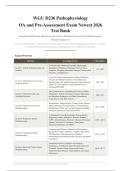
Exam Overview
Section Coverage Focus Questions
Cell Injury and Adaptations (Atrophy, Hypertrophy,
Section 1: Cellular Pathophysiology and Hyperplasia, Metaplasia, Dysplasia), Necrosis Types,
Q1 - Q30
Genetics Apoptosis, Neoplasia, Inheritance Patterns, Chromosomal
Disorders, and Epigenetics
Acute and Chronic Inflammation, Chemical Mediators,
Vascular and Cellular Responses, Tissue Repair and
Section 2: Inflammation and Immune
Healing, Innate and Adaptive Immunity, Hypersensitivity Q31 - Q55
System Disorders
Types I-IV, Autoimmunity, and Immunodeficiency
Including HIV/AIDS
Fluid Compartments, Osmolarity and Tonicity, Edema,
Section 3: Fluid, Electrolyte, and Dehydration, Sodium, Potassium, Calcium, Magnesium,
Q56 - Q75
Acid-Base Disorders and Phosphate Imbalances, Acid-Base Disturbances,
Compensation, and ABG Analysis
Hypertension, Atherosclerosis, Coronary Artery Disease,
Section 4: Cardiovascular System Myocardial Infarction, Heart Failure, Valvular Disease,
Q76 - Q105
Pathophysiology Dysrhythmias, Shock, and Vascular Disorders Including
Aneurysm, Dissection, PAD, and DVT/PE
Ventilation-Perfusion Relationships, Hypoxemia and
Respiratory Failure, Obstructive Diseases (Asthma,
Section 5: Respiratory System
COPD, Bronchiectasis), Restrictive Diseases (Pulmonary Q106 - Q130
Pathophysiology
Fibrosis, Sarcoidosis), Pneumonia, Tuberculosis,
Pulmonary Embolism, and ARDS
Cerebrovascular Disease (Ischemic and Hemorrhagic
Stroke, TIA), Seizure Disorders, Traumatic Brain Injury,
Section 6: Neurological System
CNS Infections, Neurodegenerative Disorders, Q131 - Q155
Pathophysiology
Demyelinating and Neuromuscular Disorders, and Spinal
Cord Injury
Glomerular Diseases (Nephrotic and Nephritic
Syndromes), Acute Kidney Injury (Prerenal, Intrarenal,
Section 7: Renal and Urinary System
Postrenal), Chronic Kidney Disease and Uremia, Q156 - Q175
Pathophysiology
Tubulointerstitial Diseases, Nephrolithiasis, and Urinary
Obstruction
Complete Real Exam Questions and Correct Detailed Answers | Latest Version 2026/2027 1
,WGU D236 Pathophysiology OA and Pre-Assessment Exam 2026/2027 Verified Answers | A+ Graded
Section Coverage Focus Questions
GERD and Motility Disorders, Peptic Ulcer Disease,
Section 8: Gastrointestinal and Hepatic Malabsorption (Celiac), Inflammatory Bowel Disease, GI
Q176 - Q195
System Pathophysiology Bleeding, Hepatitis, Cirrhosis, Portal Hypertension, Biliary
Disease, and Pancreatic Disorders
Diabetes Mellitus (Type 1, Type 2, Gestational,
Complications), Metabolic Syndrome, Thyroid Disorders,
Section 9: Endocrine and Metabolic
Parathyroid Disorders, Adrenal Disorders (Cushing, Q196 - Q215
System Pathophysiology
Addison, Pheochromocytoma), and Pituitary Disorders
(SIADH, DI, Acromegaly, Prolactinoma)
Sepsis and Septic Shock, Shock States Comparison,
Section 10: Multisystem Disorders and Multiple Organ Dysfunction Syndrome, Cancer
Q216 - Q220
Advanced Concepts Pathophysiology Integration, Pain Mechanisms, and
Aging-Related Pathophysiology
SECTION 1 Questions 1-30
Cellular Pathophysiology and Genetics
Coverage: Cell Injury and Adaptations (Atrophy, Hypertrophy, Hyperplasia, Metaplasia, Dysplasia), Necrosis Types,
Apoptosis, Neoplasia, Inheritance Patterns, Chromosomal Disorders, and Epigenetics
Q1: A 58-year-old man has his right leg in a cast for six weeks after a tibia fracture. When the
cast is removed, the right calf is noticeably smaller than the left and is weak. Which cellular
adaptation best explains the change in muscle mass?
A. Atrophy from decreased protein synthesis and increased protein degradation in
disused myocytes [CORRECT]
B. Hyperplasia from compensatory proliferation of skeletal muscle satellite cells
C. Dysplasia from disordered maturation of immobilized muscle fibers
D. Metaplasia from substitution of skeletal muscle by fibrous connective tissue
Correct Answer: A
Rationale: Disuse atrophy is the classic adaptation to immobilization: reduced workload decreases protein
synthesis and activates the ubiquitin-proteasome pathway, so myocytes shrink in size rather than die.
Skeletal muscle responds to load mainly by changing cell size, not cell number, so hyperplasia of satellite
cells does not account for the mass loss. Dysplasia is a premalignant disorder of maturation seen in
epithelia, not immobilized muscle. Metaplasia is replacement of one differentiated cell type by another,
such as columnar to squamous epithelium, and does not describe muscle wasting.
Complete Real Exam Questions and Correct Detailed Answers | Latest Version 2026/2027 2
,WGU D236 Pathophysiology OA and Pre-Assessment Exam 2026/2027 Verified Answers | A+ Graded
Q2: A pregnant woman at 32 weeks' gestation has marked enlargement of the uterus, which
ultrasound confirms is due to both smooth muscle cell enlargement and an increased number of
smooth muscle cells. Which pair of adaptations is demonstrated?
A. Metaplasia and dysplasia
B. Hypertrophy and hyperplasia [CORRECT]
C. Atrophy and hypertrophy
D. Hyperplasia and neoplasia
Correct Answer: B
Rationale: The gravid uterus is the textbook example of hormonally driven hypertrophy (increased cell
size) combined with hyperplasia (increased cell number) mediated by estrogen stimulation of smooth
muscle. Metaplasia and dysplasia are abnormal epithelial adaptations and do not occur in this physiologic
setting. Atrophy is shrinkage from decreased workload, the opposite of the observed change. Neoplasia is
an uncontrolled clonal proliferation, whereas the pregnancy-induced change is reversible and ceases after
delivery.
Q3: Which adaptive change is most likely occurring in the bronchial epithelium of a long-term
cigarette smoker whose biopsy shows stratified squamous epithelium replacing the normal
ciliated columnar epithelium?
A. Hyperplasia of ciliated columnar cells
B. Goblet cell atrophy
C. Metaplasia to squamous epithelium [CORRECT]
D. Squamous cell dysplasia of reserve cells
Correct Answer: C
Rationale: Metaplasia is the reversible replacement of one differentiated cell type by another better able
to withstand the adverse environment; in smokers, the fragile ciliated columnar bronchial epithelium is
replaced by tougher stratified squamous epithelium. Hyperplasia of ciliated cells does not occur, because
chronic irritation destroys rather than multiplies them. Goblet cell atrophy is incorrect because goblet cells
typically increase in number in airway irritation. Although dysplasia can later supervene in smoker
airways, the replacement of one mature tissue type by another is by definition metaplasia.
Complete Real Exam Questions and Correct Detailed Answers | Latest Version 2026/2027 3
, WGU D236 Pathophysiology OA and Pre-Assessment Exam 2026/2027 Verified Answers | A+ Graded
Q4: A Pap smear from a 29-year-old woman shows cervical epithelial cells with disorderly
maturation, increased nuclear-to-cytoplasmic ratio, and hyperchromatic nuclei that do not cross
the basement membrane. The colposcopic biopsy confirms the finding. What is the correct
interpretation and its clinical significance?
A. Metaplasia, a reversible benign adaptation requiring no follow-up
B. Invasive squamous cell carcinoma requiring immediate hysterectomy
C. Hyperplasia from chronic cervicitis that resolves with antibiotics
D. Dysplasia (cervical intraepithelial neoplasia), a premalignant lesion that may
progress to carcinoma if untreated [CORRECT]
Correct Answer: D
Rationale: Disordered maturation with enlarged, hyperchromatic nuclei and an increased
nuclear-to-cytoplasmic ratio confined above the basement membrane defines dysplasia (CIN), which is
classified as a premalignant change that can progress through grades to invasive carcinoma. Metaplasia and
hyperplasia are orderly, reversible adaptations lacking cytologic atypia. Invasion is specifically excluded
here because the basement membrane is intact, so invasive carcinoma and its treatment are not applicable.
Recognizing the premalignant nature of dysplasia is why surveillance and excision prevent cervical cancer.
Q5: A patient suffers a massive ischemic stroke. Within minutes, neuronal cell bodies swell, and
lab studies show efflux of intracellular potassium and influx of sodium and water. Which early
mechanism of hypoxic cell injury is responsible?
A. Failure of the Na+/K+ ATPase pump from ATP depletion, causing cell swelling
[CORRECT]
B. Rupture of lysosomal membranes with enzymatic digestion of the cell
C. Irreversible mitochondrial membrane damage with calcium influx
D. Oxidative damage to nuclear DNA by hydroxyl radicals
Correct Answer: A
Rationale: The earliest and most sensitive sign of ischemic injury is failure of energy-dependent Na+/K+
ATPase pumps; without ATP, sodium accumulates intracellularly, water follows osmotically, and the cell
swells with loss of potassium. Lysosomal membrane rupture and enzymatic digestion characterize the
later, irreversible stage of injury. Severe mitochondrial damage with massive calcium influx also marks
the point of no return rather than the earliest change. DNA oxidative damage is an important mechanism
of free radical injury but is not the first event producing the observed ion shifts.
Complete Real Exam Questions and Correct Detailed Answers | Latest Version 2026/2027 4
OA and Pre-Assessment Exam Newest 2026
Test Bank
Complete Real Exam Questions and Correct Detailed Answers (Verified Answers)
Already Graded A+
Latest Version 2026/2027 | Aligned with Western Governors University D236 Pathophysiology Objective Assessment
(OA) and Pre-Assessment (PA) Objectives | 220 Questions with Comprehensive Rationales
Exam Overview
Section Coverage Focus Questions
Cell Injury and Adaptations (Atrophy, Hypertrophy,
Section 1: Cellular Pathophysiology and Hyperplasia, Metaplasia, Dysplasia), Necrosis Types,
Q1 - Q30
Genetics Apoptosis, Neoplasia, Inheritance Patterns, Chromosomal
Disorders, and Epigenetics
Acute and Chronic Inflammation, Chemical Mediators,
Vascular and Cellular Responses, Tissue Repair and
Section 2: Inflammation and Immune
Healing, Innate and Adaptive Immunity, Hypersensitivity Q31 - Q55
System Disorders
Types I-IV, Autoimmunity, and Immunodeficiency
Including HIV/AIDS
Fluid Compartments, Osmolarity and Tonicity, Edema,
Section 3: Fluid, Electrolyte, and Dehydration, Sodium, Potassium, Calcium, Magnesium,
Q56 - Q75
Acid-Base Disorders and Phosphate Imbalances, Acid-Base Disturbances,
Compensation, and ABG Analysis
Hypertension, Atherosclerosis, Coronary Artery Disease,
Section 4: Cardiovascular System Myocardial Infarction, Heart Failure, Valvular Disease,
Q76 - Q105
Pathophysiology Dysrhythmias, Shock, and Vascular Disorders Including
Aneurysm, Dissection, PAD, and DVT/PE
Ventilation-Perfusion Relationships, Hypoxemia and
Respiratory Failure, Obstructive Diseases (Asthma,
Section 5: Respiratory System
COPD, Bronchiectasis), Restrictive Diseases (Pulmonary Q106 - Q130
Pathophysiology
Fibrosis, Sarcoidosis), Pneumonia, Tuberculosis,
Pulmonary Embolism, and ARDS
Cerebrovascular Disease (Ischemic and Hemorrhagic
Stroke, TIA), Seizure Disorders, Traumatic Brain Injury,
Section 6: Neurological System
CNS Infections, Neurodegenerative Disorders, Q131 - Q155
Pathophysiology
Demyelinating and Neuromuscular Disorders, and Spinal
Cord Injury
Glomerular Diseases (Nephrotic and Nephritic
Syndromes), Acute Kidney Injury (Prerenal, Intrarenal,
Section 7: Renal and Urinary System
Postrenal), Chronic Kidney Disease and Uremia, Q156 - Q175
Pathophysiology
Tubulointerstitial Diseases, Nephrolithiasis, and Urinary
Obstruction
Complete Real Exam Questions and Correct Detailed Answers | Latest Version 2026/2027 1
,WGU D236 Pathophysiology OA and Pre-Assessment Exam 2026/2027 Verified Answers | A+ Graded
Section Coverage Focus Questions
GERD and Motility Disorders, Peptic Ulcer Disease,
Section 8: Gastrointestinal and Hepatic Malabsorption (Celiac), Inflammatory Bowel Disease, GI
Q176 - Q195
System Pathophysiology Bleeding, Hepatitis, Cirrhosis, Portal Hypertension, Biliary
Disease, and Pancreatic Disorders
Diabetes Mellitus (Type 1, Type 2, Gestational,
Complications), Metabolic Syndrome, Thyroid Disorders,
Section 9: Endocrine and Metabolic
Parathyroid Disorders, Adrenal Disorders (Cushing, Q196 - Q215
System Pathophysiology
Addison, Pheochromocytoma), and Pituitary Disorders
(SIADH, DI, Acromegaly, Prolactinoma)
Sepsis and Septic Shock, Shock States Comparison,
Section 10: Multisystem Disorders and Multiple Organ Dysfunction Syndrome, Cancer
Q216 - Q220
Advanced Concepts Pathophysiology Integration, Pain Mechanisms, and
Aging-Related Pathophysiology
SECTION 1 Questions 1-30
Cellular Pathophysiology and Genetics
Coverage: Cell Injury and Adaptations (Atrophy, Hypertrophy, Hyperplasia, Metaplasia, Dysplasia), Necrosis Types,
Apoptosis, Neoplasia, Inheritance Patterns, Chromosomal Disorders, and Epigenetics
Q1: A 58-year-old man has his right leg in a cast for six weeks after a tibia fracture. When the
cast is removed, the right calf is noticeably smaller than the left and is weak. Which cellular
adaptation best explains the change in muscle mass?
A. Atrophy from decreased protein synthesis and increased protein degradation in
disused myocytes [CORRECT]
B. Hyperplasia from compensatory proliferation of skeletal muscle satellite cells
C. Dysplasia from disordered maturation of immobilized muscle fibers
D. Metaplasia from substitution of skeletal muscle by fibrous connective tissue
Correct Answer: A
Rationale: Disuse atrophy is the classic adaptation to immobilization: reduced workload decreases protein
synthesis and activates the ubiquitin-proteasome pathway, so myocytes shrink in size rather than die.
Skeletal muscle responds to load mainly by changing cell size, not cell number, so hyperplasia of satellite
cells does not account for the mass loss. Dysplasia is a premalignant disorder of maturation seen in
epithelia, not immobilized muscle. Metaplasia is replacement of one differentiated cell type by another,
such as columnar to squamous epithelium, and does not describe muscle wasting.
Complete Real Exam Questions and Correct Detailed Answers | Latest Version 2026/2027 2
,WGU D236 Pathophysiology OA and Pre-Assessment Exam 2026/2027 Verified Answers | A+ Graded
Q2: A pregnant woman at 32 weeks' gestation has marked enlargement of the uterus, which
ultrasound confirms is due to both smooth muscle cell enlargement and an increased number of
smooth muscle cells. Which pair of adaptations is demonstrated?
A. Metaplasia and dysplasia
B. Hypertrophy and hyperplasia [CORRECT]
C. Atrophy and hypertrophy
D. Hyperplasia and neoplasia
Correct Answer: B
Rationale: The gravid uterus is the textbook example of hormonally driven hypertrophy (increased cell
size) combined with hyperplasia (increased cell number) mediated by estrogen stimulation of smooth
muscle. Metaplasia and dysplasia are abnormal epithelial adaptations and do not occur in this physiologic
setting. Atrophy is shrinkage from decreased workload, the opposite of the observed change. Neoplasia is
an uncontrolled clonal proliferation, whereas the pregnancy-induced change is reversible and ceases after
delivery.
Q3: Which adaptive change is most likely occurring in the bronchial epithelium of a long-term
cigarette smoker whose biopsy shows stratified squamous epithelium replacing the normal
ciliated columnar epithelium?
A. Hyperplasia of ciliated columnar cells
B. Goblet cell atrophy
C. Metaplasia to squamous epithelium [CORRECT]
D. Squamous cell dysplasia of reserve cells
Correct Answer: C
Rationale: Metaplasia is the reversible replacement of one differentiated cell type by another better able
to withstand the adverse environment; in smokers, the fragile ciliated columnar bronchial epithelium is
replaced by tougher stratified squamous epithelium. Hyperplasia of ciliated cells does not occur, because
chronic irritation destroys rather than multiplies them. Goblet cell atrophy is incorrect because goblet cells
typically increase in number in airway irritation. Although dysplasia can later supervene in smoker
airways, the replacement of one mature tissue type by another is by definition metaplasia.
Complete Real Exam Questions and Correct Detailed Answers | Latest Version 2026/2027 3
, WGU D236 Pathophysiology OA and Pre-Assessment Exam 2026/2027 Verified Answers | A+ Graded
Q4: A Pap smear from a 29-year-old woman shows cervical epithelial cells with disorderly
maturation, increased nuclear-to-cytoplasmic ratio, and hyperchromatic nuclei that do not cross
the basement membrane. The colposcopic biopsy confirms the finding. What is the correct
interpretation and its clinical significance?
A. Metaplasia, a reversible benign adaptation requiring no follow-up
B. Invasive squamous cell carcinoma requiring immediate hysterectomy
C. Hyperplasia from chronic cervicitis that resolves with antibiotics
D. Dysplasia (cervical intraepithelial neoplasia), a premalignant lesion that may
progress to carcinoma if untreated [CORRECT]
Correct Answer: D
Rationale: Disordered maturation with enlarged, hyperchromatic nuclei and an increased
nuclear-to-cytoplasmic ratio confined above the basement membrane defines dysplasia (CIN), which is
classified as a premalignant change that can progress through grades to invasive carcinoma. Metaplasia and
hyperplasia are orderly, reversible adaptations lacking cytologic atypia. Invasion is specifically excluded
here because the basement membrane is intact, so invasive carcinoma and its treatment are not applicable.
Recognizing the premalignant nature of dysplasia is why surveillance and excision prevent cervical cancer.
Q5: A patient suffers a massive ischemic stroke. Within minutes, neuronal cell bodies swell, and
lab studies show efflux of intracellular potassium and influx of sodium and water. Which early
mechanism of hypoxic cell injury is responsible?
A. Failure of the Na+/K+ ATPase pump from ATP depletion, causing cell swelling
[CORRECT]
B. Rupture of lysosomal membranes with enzymatic digestion of the cell
C. Irreversible mitochondrial membrane damage with calcium influx
D. Oxidative damage to nuclear DNA by hydroxyl radicals
Correct Answer: A
Rationale: The earliest and most sensitive sign of ischemic injury is failure of energy-dependent Na+/K+
ATPase pumps; without ATP, sodium accumulates intracellularly, water follows osmotically, and the cell
swells with loss of potassium. Lysosomal membrane rupture and enzymatic digestion characterize the
later, irreversible stage of injury. Severe mitochondrial damage with massive calcium influx also marks
the point of no return rather than the earliest change. DNA oxidative damage is an important mechanism
of free radical injury but is not the first event producing the observed ion shifts.
Complete Real Exam Questions and Correct Detailed Answers | Latest Version 2026/2027 4


