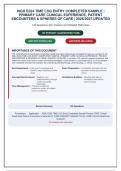
WGU E224 TIME LOG ENTRY COMPLETED SAMPLE |
PRIMARY CARE CLINICAL EXPERIENCE, PATIENT
ENCOUNTERS & SPHERES OF CARE | 2026/2027 UPDATED
140 Questions with Answers and Detailed Rationales
100 PERCENT GUARANTEED PASS
INSTANT DOWNLOAD ANSWERS INCLUDED
IMPORTANCE OF THIS DOCUMENT
This comprehensive examination preparation guide has been meticulously developed to help you succeed in the
WGU E224 TIME LOG ENTRY COMPLETED SAMPLE | PRIMARY CARE CLINICAL EXPERIENCE, PATIENT
ENCOUNTERS & SPHERES OF CARE | 2026/2027 UPDATED. It contains 140 carefully selected questions that
reflect the most current exam content and testing strategies. Each question is accompanied by a correct answer
and a detailed rationale that explains the underlying pathophysiology, pharmacology, or clinical reasoning.
Self-Assessment – Test your knowledge and Exam Preparation – Familiarize yourself with the
identify areas requiring further question format and content
study areas
Concept Reinforcement – Deepen your Confidence Building – Develop test-taking
understanding through strategies and reduce
evidence-based exam anxiety
rationales
Time Management – Practice answering
questions under simulated
exam conditions
Review Summary 140 Questions
Foundations - Application - WGU E224 TIME LOG Entry Completed Sample Primary CARE Clinical
Experience Patient Encounters & Spheres OF CARE 2026/2027 Updated Primary CARE Clinical Experience
Graduate
All answers with rationales
,Table of Contents
Content Area Questions Key Topics
Primary CARE Clinical 1-24 Primary, TIME LOG, Encounter, Diabetes, Chronic
Experience
Patient Encounters 25-48 Primary CARE, TIME LOG, Health, Documenting, Visit
Spheres OF CARE 49-72 Primary, Current, Clinic, Documentation, Chronic
TIME LOG Entry 73-96 Primary CARE, Clinical, Patient S, CARE Setting, Appropriate
Documentation AND 97-120 Primary, Appropriate, Setting, History, Element
Compliance
Clinical Skills Assessment 121-140 Primary CARE, Chronic, Effective, Model, Management
TOTAL 140 All questions include answers and detailed rationales
,Section A - Primary CARE Clinical Experience
Q1.
A 45-year-old patient with type 2 diabetes and hypertension presents with a 3-day history
of fever, cough, and purulent sputum. Chest X-ray shows a right lower lobe infiltrate.
Which finding most strongly suggests the need for hospital admission rather than
outpatient management?
A. Oxygen saturation of 94% on room air B. White blood cell count of 15,000/µL
C. Respiratory rate of 26 breaths/min D. Blood glucose level of 180 mg/dL
Correct: A - Oxygen saturation of 94% on room air
Rationale:An oxygen saturation of 94% on room air meets criteria for severe
community-acquired pneumonia (CAP) per the CURB-65 and IDSA/ATS guidelines, indicating
a higher risk of mortality and need for inpatient care. The other findings, while abnormal, do
not alone necessitate admission in the absence of other severity criteria.
Why the other answers are wrong:
B. Leukocytosis is common in CAP and does not independently indicate severity requiring
admission.
C. Tachypnea is a severity marker but borderline; without hypoxemia or other criteria, it may
still be treated outpatient.
D. Hyperglycemia is a comorbidity factor but not a pneumonia severity criterion.
Reference: Mandell LA, et al. (2007). Infectious Diseases Society of America/American Thoracic Society
consensus guidelines on the management of community-acquired pneumonia in adults. Clin
Infect Dis.
Q2.
In a primary care clinic, a 30-year-old patient with a history of asthma is prescribed a
short-acting beta-agonist (SABA) for rescue therapy. Which instruction is essential to
prevent medication overuse and ensure safety?
A. Use the inhaler at least twice daily to B. If needing more than 2 times per week,
prevent symptoms schedule a follow-up for controller therapy
C. Rinse mouth immediately after each use D. Shake the inhaler vigorously for 5
to reduce systemic absorption seconds before each use
Correct: B - If needing more than 2 times per week, schedule a follow-up for controller
therapy
Page 3
, Section A - Primary CARE Clinical Experience
Rationale: Per the NAEPP EPR-3 guidelines, SABA use for symptom control more than 2
days per week indicates inadequate asthma control and necessitates stepping up controller
therapy. This threshold is critical to prevent overreliance on rescue inhalers and reduce the
risk of asthma-related morbidity.
Why the other answers are wrong:
A. Regular daily use of SABA is not recommended; it is only for as-needed relief.
C. Rinsing mouth is important for inhaled corticosteroids, not SABAs, to prevent oral
candidiasis.
D. Shaking the inhaler is a general technique but not the primary safety concern regarding
overuse.
Reference: National Asthma Education and Prevention Program. (2007). Expert Panel Report 3:
Guidelines for the Diagnosis and Management of Asthma.
Q3.
Which approach best aligns with the principles of patient-centered medical home (PCMH)
in managing a patient with multiple chronic conditions who frequently visits the
emergency department for uncontrolled symptoms?
A. Refer the patient to a specialist for each B. Schedule a comprehensive care
chronic condition to ensure comprehensive management visit with a care coordinator to
care develop a personalized care plan
C. Advise the patient to use the emergency D. Prescribe medications for each condition
department for acute exacerbations to avoid without reviewing the full medication list to
delays in care save time
Correct: B - Schedule a comprehensive care management visit with a care coordinator to
develop a personalized care plan
Rationale:PCMH emphasizes comprehensive, coordinated, and patient-centered care. A
dedicated care management visit allows for medication reconciliation, identification of gaps in
care, and creation of a proactive plan, reducing avoidable ED visits. This approach addresses
the root causes of uncontrolled symptoms rather than episodic treatment.
Why the other answers are wrong:
A. Multiple specialist referrals without coordination can fragment care and increase costs.
C. Encouraging ED use contradicts PCMH principles of proactive and preventive care.
D. Failing to reconcile medications risks adverse drug interactions and is unsafe.
Reference: Agency for Healthcare Research and Quality. (2020). Patient-Centered Medical Home
(PCMH) Model.
Q4.
A primary care team is implementing a screening program for colorectal cancer. Which
strategy is most consistent with the USPSTF 2021 recommendations for average-risk
adults aged 50-75?
Page 4
PRIMARY CARE CLINICAL EXPERIENCE, PATIENT
ENCOUNTERS & SPHERES OF CARE | 2026/2027 UPDATED
140 Questions with Answers and Detailed Rationales
100 PERCENT GUARANTEED PASS
INSTANT DOWNLOAD ANSWERS INCLUDED
IMPORTANCE OF THIS DOCUMENT
This comprehensive examination preparation guide has been meticulously developed to help you succeed in the
WGU E224 TIME LOG ENTRY COMPLETED SAMPLE | PRIMARY CARE CLINICAL EXPERIENCE, PATIENT
ENCOUNTERS & SPHERES OF CARE | 2026/2027 UPDATED. It contains 140 carefully selected questions that
reflect the most current exam content and testing strategies. Each question is accompanied by a correct answer
and a detailed rationale that explains the underlying pathophysiology, pharmacology, or clinical reasoning.
Self-Assessment – Test your knowledge and Exam Preparation – Familiarize yourself with the
identify areas requiring further question format and content
study areas
Concept Reinforcement – Deepen your Confidence Building – Develop test-taking
understanding through strategies and reduce
evidence-based exam anxiety
rationales
Time Management – Practice answering
questions under simulated
exam conditions
Review Summary 140 Questions
Foundations - Application - WGU E224 TIME LOG Entry Completed Sample Primary CARE Clinical
Experience Patient Encounters & Spheres OF CARE 2026/2027 Updated Primary CARE Clinical Experience
Graduate
All answers with rationales
,Table of Contents
Content Area Questions Key Topics
Primary CARE Clinical 1-24 Primary, TIME LOG, Encounter, Diabetes, Chronic
Experience
Patient Encounters 25-48 Primary CARE, TIME LOG, Health, Documenting, Visit
Spheres OF CARE 49-72 Primary, Current, Clinic, Documentation, Chronic
TIME LOG Entry 73-96 Primary CARE, Clinical, Patient S, CARE Setting, Appropriate
Documentation AND 97-120 Primary, Appropriate, Setting, History, Element
Compliance
Clinical Skills Assessment 121-140 Primary CARE, Chronic, Effective, Model, Management
TOTAL 140 All questions include answers and detailed rationales
,Section A - Primary CARE Clinical Experience
Q1.
A 45-year-old patient with type 2 diabetes and hypertension presents with a 3-day history
of fever, cough, and purulent sputum. Chest X-ray shows a right lower lobe infiltrate.
Which finding most strongly suggests the need for hospital admission rather than
outpatient management?
A. Oxygen saturation of 94% on room air B. White blood cell count of 15,000/µL
C. Respiratory rate of 26 breaths/min D. Blood glucose level of 180 mg/dL
Correct: A - Oxygen saturation of 94% on room air
Rationale:An oxygen saturation of 94% on room air meets criteria for severe
community-acquired pneumonia (CAP) per the CURB-65 and IDSA/ATS guidelines, indicating
a higher risk of mortality and need for inpatient care. The other findings, while abnormal, do
not alone necessitate admission in the absence of other severity criteria.
Why the other answers are wrong:
B. Leukocytosis is common in CAP and does not independently indicate severity requiring
admission.
C. Tachypnea is a severity marker but borderline; without hypoxemia or other criteria, it may
still be treated outpatient.
D. Hyperglycemia is a comorbidity factor but not a pneumonia severity criterion.
Reference: Mandell LA, et al. (2007). Infectious Diseases Society of America/American Thoracic Society
consensus guidelines on the management of community-acquired pneumonia in adults. Clin
Infect Dis.
Q2.
In a primary care clinic, a 30-year-old patient with a history of asthma is prescribed a
short-acting beta-agonist (SABA) for rescue therapy. Which instruction is essential to
prevent medication overuse and ensure safety?
A. Use the inhaler at least twice daily to B. If needing more than 2 times per week,
prevent symptoms schedule a follow-up for controller therapy
C. Rinse mouth immediately after each use D. Shake the inhaler vigorously for 5
to reduce systemic absorption seconds before each use
Correct: B - If needing more than 2 times per week, schedule a follow-up for controller
therapy
Page 3
, Section A - Primary CARE Clinical Experience
Rationale: Per the NAEPP EPR-3 guidelines, SABA use for symptom control more than 2
days per week indicates inadequate asthma control and necessitates stepping up controller
therapy. This threshold is critical to prevent overreliance on rescue inhalers and reduce the
risk of asthma-related morbidity.
Why the other answers are wrong:
A. Regular daily use of SABA is not recommended; it is only for as-needed relief.
C. Rinsing mouth is important for inhaled corticosteroids, not SABAs, to prevent oral
candidiasis.
D. Shaking the inhaler is a general technique but not the primary safety concern regarding
overuse.
Reference: National Asthma Education and Prevention Program. (2007). Expert Panel Report 3:
Guidelines for the Diagnosis and Management of Asthma.
Q3.
Which approach best aligns with the principles of patient-centered medical home (PCMH)
in managing a patient with multiple chronic conditions who frequently visits the
emergency department for uncontrolled symptoms?
A. Refer the patient to a specialist for each B. Schedule a comprehensive care
chronic condition to ensure comprehensive management visit with a care coordinator to
care develop a personalized care plan
C. Advise the patient to use the emergency D. Prescribe medications for each condition
department for acute exacerbations to avoid without reviewing the full medication list to
delays in care save time
Correct: B - Schedule a comprehensive care management visit with a care coordinator to
develop a personalized care plan
Rationale:PCMH emphasizes comprehensive, coordinated, and patient-centered care. A
dedicated care management visit allows for medication reconciliation, identification of gaps in
care, and creation of a proactive plan, reducing avoidable ED visits. This approach addresses
the root causes of uncontrolled symptoms rather than episodic treatment.
Why the other answers are wrong:
A. Multiple specialist referrals without coordination can fragment care and increase costs.
C. Encouraging ED use contradicts PCMH principles of proactive and preventive care.
D. Failing to reconcile medications risks adverse drug interactions and is unsafe.
Reference: Agency for Healthcare Research and Quality. (2020). Patient-Centered Medical Home
(PCMH) Model.
Q4.
A primary care team is implementing a screening program for colorectal cancer. Which
strategy is most consistent with the USPSTF 2021 recommendations for average-risk
adults aged 50-75?
Page 4