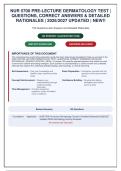
NUR 5700 PRE-LECTURE DERMATOLOGY TEST |
QUESTIONS, CORRECT ANSWERS & DETAILED
RATIONALES | 2026/2027 UPDATED | NEW!!
150 Questions with Answers and Detailed Rationales
100 PERCENT GUARANTEED PASS
INSTANT DOWNLOAD ANSWERS INCLUDED
IMPORTANCE OF THIS DOCUMENT
This comprehensive examination preparation guide has been meticulously developed to help you succeed in the
NUR 5700 PRE-LECTURE DERMATOLOGY TEST | QUESTIONS, CORRECT ANSWERS & DETAILED
RATIONALES | 2026/2027 UPDATED | NEW!!. It contains 150 carefully selected questions that reflect the most
current exam content and testing strategies. Each question is accompanied by a correct answer and a detailed
rationale that explains the underlying pathophysiology, pharmacology, or clinical reasoning.
Self-Assessment – Test your knowledge and Exam Preparation – Familiarize yourself with the
identify areas requiring further question format and content
study areas
Concept Reinforcement – Deepen your Confidence Building – Develop test-taking
understanding through strategies and reduce
evidence-based exam anxiety
rationales
Time Management – Practice answering
questions under simulated
exam conditions
Review Summary 150 Questions
Foundations - Application - NUR 5700 Pre-lecture Dermatology Correct & Detailed Rationales 2026/2027
Updated NEW Dermatology Nursing Graduate
All answers with rationales
,Table of Contents
Content Area Questions Key Topics
SKIN Anatomy AND 1-25 Topical, Severe, Systemic, Therapy, Mechanism
Physiology
Primary AND Secondary 26-50 Appropriate, Dermatitis, Topical, Atopic, Mechanism
SKIN Lesions
Infectious Dermatologic 51-75 Presents, Psoriasis, Clinical, Appropriate, Topical
Conditions
Inflammatory AND 76-100 Psoriasis, Appropriate, Plaque, Biologic, Therapy
Autoimmune SKIN Disorders
SKIN Manifestations OF 101-125 Presents, Systemic, Therapy, Topical, Erythematous
Systemic Diseases
Dermatologic Pharmacology 126-150 History, Severe, Presents, Central, Appropriate
TOTAL 150 All questions include answers and detailed rationales
,Section A - SKIN Anatomy AND Physiology
Q1.
A patient presents with erythematous, scaly plaques on the elbows and knees, nail pitting,
and joint stiffness. Which cytokine pathway is the primary therapeutic target for systemic
management of this condition?
A. IL-17 B. IL-4/IL-13
C. TNF-alpha D. IL-1 beta
Correct: A - IL-17
Rationale:The presentation is classic for psoriatic arthritis. IL-17 is a central cytokine in
psoriasis pathogenesis, and IL-17 inhibitors (e.g., secukinumab) are highly effective for both
skin and joint manifestations. TNF-alpha inhibitors are also used but not the primary target for
all patients. IL-4/IL-13 and IL-1 beta are not primary targets in psoriasis.
Why the other answers are wrong:
B. IL-4/IL-13 are central to type 2 inflammation seen in atopic dermatitis, not psoriasis.
C. TNF-alpha is a therapeutic target but not the most specific or primary cytokine in psoriasis.
D. IL-1 beta is more relevant to autoinflammatory syndromes, not typical psoriasis.
Reference: Lehne, R.A. (2026). Pharmacology for Nursing Care, 12th Ed., Ch. 75
Q2.
A patient on long-term topical corticosteroid therapy develops skin atrophy and striae.
Which mechanism best explains these adverse effects?
A. Inhibition of collagen synthesis by B. Overproduction of matrix
fibroblasts metalloproteinases by keratinocytes
C. Increased hyaluronic acid degradation in D. Enhanced apoptosis of melanocytes
the dermis leading to hypopigmentation
Correct: A - Inhibition of collagen synthesis by fibroblasts
Rationale:Topical corticosteroids inhibit fibroblast proliferation and collagen synthesis, leading
to dermal thinning, atrophy, and striae. This is a well-known adverse effect of chronic use.
While corticosteroids can affect other skin components, the primary mechanism for atrophy is
collagen suppression.
Why the other answers are wrong:
B. Matrix metalloproteinase overproduction is not a primary effect of corticosteroids.
C. Hyaluronic acid degradation is not the main cause of corticosteroid-induced atrophy.
D. Melanocyte apoptosis causes hypopigmentation but not atrophy or striae.
Reference: Lehne, R.A. (2026). Pharmacology for Nursing Care, 12th Ed., Ch. 70
Page 3
, Section A - SKIN Anatomy AND Physiology
Q3.
A patient with severe atopic dermatitis has failed topical therapies and requires systemic
treatment. Which laboratory parameter must be monitored before initiating dupilumab?
A. Eosinophil count B. Liver function tests
C. Serum creatinine D. Complete blood count with differential
Correct: A - Eosinophil count
Rationale:Dupilumab, an IL-4/IL-13 receptor antagonist, can cause transient eosinophilia, but
baseline eosinophil count is important because dupilumab may be associated with
eosinophilic conditions. However, more critically, it is contraindicated in patients with
eosinophilic conditions or parasitic infections. Liver function tests are not routinely required.
The key baseline is eosinophil count.
Why the other answers are wrong:
B. Liver function tests are not specifically required before dupilumab.
C. Serum creatinine is not a standard baseline for dupilumab.
D. Complete blood count is less specific; eosinophil count is the key parameter.
Reference: Katzung, B.G. (2025). Basic & Clinical Pharmacology, 16th Ed., Ch. 65
Q4.
Which diagnostic finding is most specific for the diagnosis of bullous pemphigoid?
A. Positive Nikolsky sign B. Subepidermal blister with eosinophils on
histology
C. Direct immunofluorescence showing D. Indirect immunofluorescence showing
linear IgG and C3 at the dermal-epidermal circulating IgG against desmoglein 3
junction
Correct: C - Direct immunofluorescence showing linear IgG and C3 at the
dermal-epidermal junction
Rationale:Bullous pemphigoid is characterized by linear deposition of IgG and C3 along the
dermal-epidermal junction on direct immunofluorescence. This is the diagnostic gold
standard. Subepidermal blister with eosinophils is suggestive but not specific. Positive
Nikolsky sign is seen in pemphigus vulgaris, and anti-desmoglein 3 antibodies are specific for
pemphigus vulgaris, not bullous pemphigoid.
Why the other answers are wrong:
A. Nikolsky sign indicates intraepidermal blistering, typical of pemphigus, not bullous
pemphigoid.
B. Subepidermal blister with eosinophils is a histologic clue but not as specific as DIF.
D. Anti-desmoglein 3 antibodies are found in pemphigus vulgaris, not bullous pemphigoid.
Reference: Bolognia, J.L. (2024). Dermatology, 5th Ed., Ch. 30
Page 4
QUESTIONS, CORRECT ANSWERS & DETAILED
RATIONALES | 2026/2027 UPDATED | NEW!!
150 Questions with Answers and Detailed Rationales
100 PERCENT GUARANTEED PASS
INSTANT DOWNLOAD ANSWERS INCLUDED
IMPORTANCE OF THIS DOCUMENT
This comprehensive examination preparation guide has been meticulously developed to help you succeed in the
NUR 5700 PRE-LECTURE DERMATOLOGY TEST | QUESTIONS, CORRECT ANSWERS & DETAILED
RATIONALES | 2026/2027 UPDATED | NEW!!. It contains 150 carefully selected questions that reflect the most
current exam content and testing strategies. Each question is accompanied by a correct answer and a detailed
rationale that explains the underlying pathophysiology, pharmacology, or clinical reasoning.
Self-Assessment – Test your knowledge and Exam Preparation – Familiarize yourself with the
identify areas requiring further question format and content
study areas
Concept Reinforcement – Deepen your Confidence Building – Develop test-taking
understanding through strategies and reduce
evidence-based exam anxiety
rationales
Time Management – Practice answering
questions under simulated
exam conditions
Review Summary 150 Questions
Foundations - Application - NUR 5700 Pre-lecture Dermatology Correct & Detailed Rationales 2026/2027
Updated NEW Dermatology Nursing Graduate
All answers with rationales
,Table of Contents
Content Area Questions Key Topics
SKIN Anatomy AND 1-25 Topical, Severe, Systemic, Therapy, Mechanism
Physiology
Primary AND Secondary 26-50 Appropriate, Dermatitis, Topical, Atopic, Mechanism
SKIN Lesions
Infectious Dermatologic 51-75 Presents, Psoriasis, Clinical, Appropriate, Topical
Conditions
Inflammatory AND 76-100 Psoriasis, Appropriate, Plaque, Biologic, Therapy
Autoimmune SKIN Disorders
SKIN Manifestations OF 101-125 Presents, Systemic, Therapy, Topical, Erythematous
Systemic Diseases
Dermatologic Pharmacology 126-150 History, Severe, Presents, Central, Appropriate
TOTAL 150 All questions include answers and detailed rationales
,Section A - SKIN Anatomy AND Physiology
Q1.
A patient presents with erythematous, scaly plaques on the elbows and knees, nail pitting,
and joint stiffness. Which cytokine pathway is the primary therapeutic target for systemic
management of this condition?
A. IL-17 B. IL-4/IL-13
C. TNF-alpha D. IL-1 beta
Correct: A - IL-17
Rationale:The presentation is classic for psoriatic arthritis. IL-17 is a central cytokine in
psoriasis pathogenesis, and IL-17 inhibitors (e.g., secukinumab) are highly effective for both
skin and joint manifestations. TNF-alpha inhibitors are also used but not the primary target for
all patients. IL-4/IL-13 and IL-1 beta are not primary targets in psoriasis.
Why the other answers are wrong:
B. IL-4/IL-13 are central to type 2 inflammation seen in atopic dermatitis, not psoriasis.
C. TNF-alpha is a therapeutic target but not the most specific or primary cytokine in psoriasis.
D. IL-1 beta is more relevant to autoinflammatory syndromes, not typical psoriasis.
Reference: Lehne, R.A. (2026). Pharmacology for Nursing Care, 12th Ed., Ch. 75
Q2.
A patient on long-term topical corticosteroid therapy develops skin atrophy and striae.
Which mechanism best explains these adverse effects?
A. Inhibition of collagen synthesis by B. Overproduction of matrix
fibroblasts metalloproteinases by keratinocytes
C. Increased hyaluronic acid degradation in D. Enhanced apoptosis of melanocytes
the dermis leading to hypopigmentation
Correct: A - Inhibition of collagen synthesis by fibroblasts
Rationale:Topical corticosteroids inhibit fibroblast proliferation and collagen synthesis, leading
to dermal thinning, atrophy, and striae. This is a well-known adverse effect of chronic use.
While corticosteroids can affect other skin components, the primary mechanism for atrophy is
collagen suppression.
Why the other answers are wrong:
B. Matrix metalloproteinase overproduction is not a primary effect of corticosteroids.
C. Hyaluronic acid degradation is not the main cause of corticosteroid-induced atrophy.
D. Melanocyte apoptosis causes hypopigmentation but not atrophy or striae.
Reference: Lehne, R.A. (2026). Pharmacology for Nursing Care, 12th Ed., Ch. 70
Page 3
, Section A - SKIN Anatomy AND Physiology
Q3.
A patient with severe atopic dermatitis has failed topical therapies and requires systemic
treatment. Which laboratory parameter must be monitored before initiating dupilumab?
A. Eosinophil count B. Liver function tests
C. Serum creatinine D. Complete blood count with differential
Correct: A - Eosinophil count
Rationale:Dupilumab, an IL-4/IL-13 receptor antagonist, can cause transient eosinophilia, but
baseline eosinophil count is important because dupilumab may be associated with
eosinophilic conditions. However, more critically, it is contraindicated in patients with
eosinophilic conditions or parasitic infections. Liver function tests are not routinely required.
The key baseline is eosinophil count.
Why the other answers are wrong:
B. Liver function tests are not specifically required before dupilumab.
C. Serum creatinine is not a standard baseline for dupilumab.
D. Complete blood count is less specific; eosinophil count is the key parameter.
Reference: Katzung, B.G. (2025). Basic & Clinical Pharmacology, 16th Ed., Ch. 65
Q4.
Which diagnostic finding is most specific for the diagnosis of bullous pemphigoid?
A. Positive Nikolsky sign B. Subepidermal blister with eosinophils on
histology
C. Direct immunofluorescence showing D. Indirect immunofluorescence showing
linear IgG and C3 at the dermal-epidermal circulating IgG against desmoglein 3
junction
Correct: C - Direct immunofluorescence showing linear IgG and C3 at the
dermal-epidermal junction
Rationale:Bullous pemphigoid is characterized by linear deposition of IgG and C3 along the
dermal-epidermal junction on direct immunofluorescence. This is the diagnostic gold
standard. Subepidermal blister with eosinophils is suggestive but not specific. Positive
Nikolsky sign is seen in pemphigus vulgaris, and anti-desmoglein 3 antibodies are specific for
pemphigus vulgaris, not bullous pemphigoid.
Why the other answers are wrong:
A. Nikolsky sign indicates intraepidermal blistering, typical of pemphigus, not bullous
pemphigoid.
B. Subepidermal blister with eosinophils is a histologic clue but not as specific as DIF.
D. Anti-desmoglein 3 antibodies are found in pemphigus vulgaris, not bullous pemphigoid.
Reference: Bolognia, J.L. (2024). Dermatology, 5th Ed., Ch. 30
Page 4