

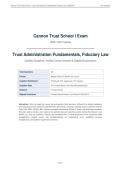
Cannon Trust School I Exam | Trust Administration Fundamentals, Fiduciary Law | 2026/2027 100 Questions
Cannon Trust School I Exam
Update
Trust Administration Fundamentals, Fiduciary Law
Certified Questions, Verified Correct Answers & Detailed Explanations
Total Questions 100
Format Multiple Choice (4 options, one correct)
Cognitive Distribution 30% Recall | 45% Application | 25% Analysis
Question Style 70% Scenario-Based | 30% Direct Recall/Definition
Sections 6 Topic Domains
Aligned Curriculum Cannon Financial Institute Trust School I (2026/2027)
Instructions: Select the single best answer for each question. Each question is followed by a detailed explanation
reflecting Cannon Trust School I foundational trust and fiduciary reasoning, including statutory authority (Uniform
Trust Code, UPIA, UPAIA, IRC), fiduciary principles (Restatement (Third) of Trusts), and professional standards.
Rationales address why the correct option is best and why distractors represent common Cannon Trust School I exam
pitfalls (e.g., trust type confusion, fiduciary duty misidentification, creation requirement errors, beneficiary rights
misapplication, prudent investor rule misunderstanding, tax fundamentals errors, spendthrift provision
misapplication, and regulatory requirement confusion).
Page 1
,Cannon Trust School I Exam | Trust Administration Fundamentals, Fiduciary Law | 2026/2027 100 Questions
Section 1: Trust Fundamentals and Creation
Trust Basics, Parties, Creation Requirements, & Types of Trusts (Q1-Q20)
Q1: Which of the following BEST defines a trust under common law principles?
A. A contract between two parties for the management of property
B. A fiduciary relationship in which one person holds legal title to property subject to an equitable obligation
to hold or use it for the benefit of another [CORRECT]
C. A business entity formed under state statute for the purpose of holding assets
D. A partnership between a grantor and trustee for investment purposes
Correct Answer: B
Rationale: A trust is a fiduciary relationship in which the trustee holds legal title to trust property (the res) subject to an equitable
obligation to administer it for the benefit of the beneficiaries. This dual-title concept (legal vs. equitable) is the historical English
equity foundation of trust law (Restatement (Third) of Trusts). Option A describes a contract; option C describes a statutory entity;
option D describes a partnership - none capture the split-title fiduciary essence.
Q2: Mr. Adams signs a document titled "Declaration of Trust" stating he is transferring $100,000 to himself
"as trustee for the benefit of my niece, Beth." Which essential element of a valid trust is demonstrated by the
identification of Beth?
A. Intent to create a trust
B. Ascertainable beneficiary [CORRECT]
C. Trust res (property)
D. Lawful purpose
Correct Answer: B
Rationale: Naming Beth as the niece identifies her with sufficient certainty to satisfy the ascertainable beneficiary requirement - one
of the elements from Restatement (Third) of Trusts section 17. Beneficiaries must be identifiable or capable of being ascertained
within the rule against perpetuities. Option A (intent) is shown by execution of the declaration. Option C (res) is the $100,000. Option
D (lawful purpose) is presumed unless contrary.
Q3: A trust requires all of the following essential elements to be valid EXCEPT:
A. Intent to create a trust by the settlor
B. Capacity of the settlor
C. Delivery of a written trust instrument notarized by a notary public [CORRECT]
D. Identifiable trust property (res)
Correct Answer: C
Rationale: While most trusts are in writing, notarization is not a universal requirement for trust validity. The four required elements
are: (1) settlor with capacity, (2) intent to create a trust, (3) ascertainable beneficiary, and (4) identifiable trust property (res)
(Restatement (Third) of Trusts section 17). Statute of Frauds requires certain trusts to be in writing, but not all require notarization.
Options A, B, and D are all mandatory elements.
Q4: Which of the following is the party who creates the trust and transfers property into it?
A. Trustee
B. Beneficiary
C. Settlor (grantor/trustor) [CORRECT]
D. Protector
Correct Answer: C
Page 2
, Cannon Trust School I Exam | Trust Administration Fundamentals, Fiduciary Law | 2026/2027 100 Questions
Rationale: The settlor (also called grantor or trustor) is the person who creates the trust by transferring property to the trustee to hold
for beneficiaries. The trustee (option A) holds legal title and administers. The beneficiary (option B) holds equitable title. The
protector (option D) is an optional oversight role not present in every trust. The settlor must have legal capacity (majority age and
sound mind) and own the property transferred.
Q5: A trust created by will that takes effect upon the testator's death is called:
A. Inter vivos (living) trust
B. Testamentary trust [CORRECT]
C. Revocable trust
D. Charitable trust
Correct Answer: B
Rationale: A testamentary trust is created by will and does not take effect until the testator's death and the will is admitted to probate.
It is supervised by the probate court. Option A (inter vivos) is created during the settlor's lifetime. Option C (revocable) refers to
amendability, not timing. Option D (charitable) refers to purpose. Testamentary trusts are always irrevocable because the settlor is
deceased.
Q6: A settlor creates a trust for the benefit of "such of my grandchildren as shall be living at my death." At
the time of creation, the settlor has one grandchild. Is this trust valid?
A. No, because beneficiaries must be identifiable at the time of trust creation
B. Yes, because the class of beneficiaries is ascertainable within the rule against perpetuities [CORRECT]
C. No, because the trust violates the rule against perpetuities
D. Yes, only if the grandchild consents
Correct Answer: B
Rationale: The trust is valid because the class of beneficiaries (grandchildren living at the settlor's death) is ascertainable within the
rule against perpetuities. The class closes at the settlor's death (a life in being), and all members are identifiable at that time. Option A
is wrong - beneficiaries need not be identified at creation, only ascertainable within the perpetuities period. Option C misapplies the
rule. Option D has no legal basis.
Q7: Which type of trust allows the settlor to revoke or amend the trust during his or her lifetime?
A. Irrevocable trust
B. Revocable trust [CORRECT]
C. Testamentary trust
D. Spendthrift trust
Correct Answer: B
Rationale: A revocable trust allows the settlor to revoke (terminate) or amend the trust during lifetime, per UTC section 602. The
settlor retains significant control, which means trust assets are considered part of the settlor's gross estate for estate tax purposes and
are reachable by the settlor's creditors. Option A (irrevocable) cannot be amended. Option C (testamentary) is by definition
irrevocable after death. Option D refers to beneficiary protection, not settlor control.
Q8: Which of the following BEST describes an irrevocable trust?
A. The settlor retains the right to receive trust income for life
B. The settlor cannot modify or revoke the trust after creation, except as provided in the trust instrument or
by court order [CORRECT]
C. The trustee has unlimited discretion to amend the trust
D. The trust automatically terminates after 21 years
Correct Answer: B
Page 3
Cannon Trust School I Exam
Update
Trust Administration Fundamentals, Fiduciary Law
Certified Questions, Verified Correct Answers & Detailed Explanations
Total Questions 100
Format Multiple Choice (4 options, one correct)
Cognitive Distribution 30% Recall | 45% Application | 25% Analysis
Question Style 70% Scenario-Based | 30% Direct Recall/Definition
Sections 6 Topic Domains
Aligned Curriculum Cannon Financial Institute Trust School I (2026/2027)
Instructions: Select the single best answer for each question. Each question is followed by a detailed explanation
reflecting Cannon Trust School I foundational trust and fiduciary reasoning, including statutory authority (Uniform
Trust Code, UPIA, UPAIA, IRC), fiduciary principles (Restatement (Third) of Trusts), and professional standards.
Rationales address why the correct option is best and why distractors represent common Cannon Trust School I exam
pitfalls (e.g., trust type confusion, fiduciary duty misidentification, creation requirement errors, beneficiary rights
misapplication, prudent investor rule misunderstanding, tax fundamentals errors, spendthrift provision
misapplication, and regulatory requirement confusion).
Page 1
,Cannon Trust School I Exam | Trust Administration Fundamentals, Fiduciary Law | 2026/2027 100 Questions
Section 1: Trust Fundamentals and Creation
Trust Basics, Parties, Creation Requirements, & Types of Trusts (Q1-Q20)
Q1: Which of the following BEST defines a trust under common law principles?
A. A contract between two parties for the management of property
B. A fiduciary relationship in which one person holds legal title to property subject to an equitable obligation
to hold or use it for the benefit of another [CORRECT]
C. A business entity formed under state statute for the purpose of holding assets
D. A partnership between a grantor and trustee for investment purposes
Correct Answer: B
Rationale: A trust is a fiduciary relationship in which the trustee holds legal title to trust property (the res) subject to an equitable
obligation to administer it for the benefit of the beneficiaries. This dual-title concept (legal vs. equitable) is the historical English
equity foundation of trust law (Restatement (Third) of Trusts). Option A describes a contract; option C describes a statutory entity;
option D describes a partnership - none capture the split-title fiduciary essence.
Q2: Mr. Adams signs a document titled "Declaration of Trust" stating he is transferring $100,000 to himself
"as trustee for the benefit of my niece, Beth." Which essential element of a valid trust is demonstrated by the
identification of Beth?
A. Intent to create a trust
B. Ascertainable beneficiary [CORRECT]
C. Trust res (property)
D. Lawful purpose
Correct Answer: B
Rationale: Naming Beth as the niece identifies her with sufficient certainty to satisfy the ascertainable beneficiary requirement - one
of the elements from Restatement (Third) of Trusts section 17. Beneficiaries must be identifiable or capable of being ascertained
within the rule against perpetuities. Option A (intent) is shown by execution of the declaration. Option C (res) is the $100,000. Option
D (lawful purpose) is presumed unless contrary.
Q3: A trust requires all of the following essential elements to be valid EXCEPT:
A. Intent to create a trust by the settlor
B. Capacity of the settlor
C. Delivery of a written trust instrument notarized by a notary public [CORRECT]
D. Identifiable trust property (res)
Correct Answer: C
Rationale: While most trusts are in writing, notarization is not a universal requirement for trust validity. The four required elements
are: (1) settlor with capacity, (2) intent to create a trust, (3) ascertainable beneficiary, and (4) identifiable trust property (res)
(Restatement (Third) of Trusts section 17). Statute of Frauds requires certain trusts to be in writing, but not all require notarization.
Options A, B, and D are all mandatory elements.
Q4: Which of the following is the party who creates the trust and transfers property into it?
A. Trustee
B. Beneficiary
C. Settlor (grantor/trustor) [CORRECT]
D. Protector
Correct Answer: C
Page 2
, Cannon Trust School I Exam | Trust Administration Fundamentals, Fiduciary Law | 2026/2027 100 Questions
Rationale: The settlor (also called grantor or trustor) is the person who creates the trust by transferring property to the trustee to hold
for beneficiaries. The trustee (option A) holds legal title and administers. The beneficiary (option B) holds equitable title. The
protector (option D) is an optional oversight role not present in every trust. The settlor must have legal capacity (majority age and
sound mind) and own the property transferred.
Q5: A trust created by will that takes effect upon the testator's death is called:
A. Inter vivos (living) trust
B. Testamentary trust [CORRECT]
C. Revocable trust
D. Charitable trust
Correct Answer: B
Rationale: A testamentary trust is created by will and does not take effect until the testator's death and the will is admitted to probate.
It is supervised by the probate court. Option A (inter vivos) is created during the settlor's lifetime. Option C (revocable) refers to
amendability, not timing. Option D (charitable) refers to purpose. Testamentary trusts are always irrevocable because the settlor is
deceased.
Q6: A settlor creates a trust for the benefit of "such of my grandchildren as shall be living at my death." At
the time of creation, the settlor has one grandchild. Is this trust valid?
A. No, because beneficiaries must be identifiable at the time of trust creation
B. Yes, because the class of beneficiaries is ascertainable within the rule against perpetuities [CORRECT]
C. No, because the trust violates the rule against perpetuities
D. Yes, only if the grandchild consents
Correct Answer: B
Rationale: The trust is valid because the class of beneficiaries (grandchildren living at the settlor's death) is ascertainable within the
rule against perpetuities. The class closes at the settlor's death (a life in being), and all members are identifiable at that time. Option A
is wrong - beneficiaries need not be identified at creation, only ascertainable within the perpetuities period. Option C misapplies the
rule. Option D has no legal basis.
Q7: Which type of trust allows the settlor to revoke or amend the trust during his or her lifetime?
A. Irrevocable trust
B. Revocable trust [CORRECT]
C. Testamentary trust
D. Spendthrift trust
Correct Answer: B
Rationale: A revocable trust allows the settlor to revoke (terminate) or amend the trust during lifetime, per UTC section 602. The
settlor retains significant control, which means trust assets are considered part of the settlor's gross estate for estate tax purposes and
are reachable by the settlor's creditors. Option A (irrevocable) cannot be amended. Option C (testamentary) is by definition
irrevocable after death. Option D refers to beneficiary protection, not settlor control.
Q8: Which of the following BEST describes an irrevocable trust?
A. The settlor retains the right to receive trust income for life
B. The settlor cannot modify or revoke the trust after creation, except as provided in the trust instrument or
by court order [CORRECT]
C. The trustee has unlimited discretion to amend the trust
D. The trust automatically terminates after 21 years
Correct Answer: B
Page 3


