
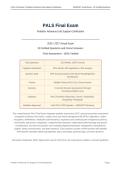
PALS Final Exam | Pediatric Advanced Life Support Certification 2026/2027 Actual Exam - 50 Verified Questions
PALS Final Exam
Pediatric Advanced Life Support Certification
Actual Exam
50 Verified Questions and Correct Answers
Final Assessment - 100% Verified
Total Questions: 50 (Verified, 100% Correct)
Cognitive Distribution: 25% Recall | 55% Application | 20% Analysis
Question Style: 80% Scenario-based | 20% Direct Recall/Algorithm
Identification
Format: Multiple Choice (A-D), One Correct Answer
Sections: 5 Content Domains (Assessment through
Post-Resuscitation Care)
Audience: PALS Providers (Physicians, Nurses, Paramedics,
Respiratory Therapists)
Guideline Alignment: AHA PALS 2020 Updates + 2026/2027 Revisions
This comprehensive PALS Final Exam integrates pediatric assessment (PAT, primary/secondary assessment,
recognition of distress and shock), cardiac arrest and shock management (BLS/PALS algorithms, rhythm
recognition, defibrillation, medication administration), respiratory and cardiovascular emergencies (asthma,
bronchiolitis, pneumonia, anaphylaxis, congenital heart disease), weight-based pharmacology and special
considerations, and post-resuscitation care including targeted temperature management, hemodynamic
support, family communication, and team dynamics. Each question includes verified answers with detailed
AHA-specific rationales addressing algorithm steps, physiology, pharmacology, and team dynamics.
Generated: September 2026 | Aligned with current AHA PALS, Surviving Sepsis Pediatric, and AAP guidelines.
Pediatric Advanced Life Support | Final Assessment Page 1
,PALS Final Exam | Pediatric Advanced Life Support Certification 2026/2027 Actual Exam - 50 Verified Questions
Table of Contents
Sections: The exam is organized into 5 content domains covering the full scope of Pediatric Advanced Life Support
certification requirements.
Section 1: Section 1: Pediatric Assessment and Recognition of Respiratory Distress/Failure (Systematic
Approach, Primary/Secondary Assessment, & Respiratory Emergencies) (Q1 - Q12, 12 questions)
Section 2: Section 2: Pediatric Cardiac Arrest and Shock Management (BLS/PALS Algorithms, Rhythm
Recognition, Defibrillation, & Medication Administration) (Q13 - Q25, 13 questions)
Section 3: Section 3: Pediatric Respiratory and Cardiovascular Emergencies (Status Asthmaticus, Bronchiolitis,
Pneumonia, Anaphylaxis, & Congenital Heart Disease) (Q26 - Q35, 10 questions)
Section 4: Section 4: Pediatric Pharmacology and Special Considerations (Weight-Based Dosing, Medication
Calculations, & High-Alert Medications) (Q36 - Q42, 7 questions)
Section 5: Section 5: Post-Resuscitation Care and Team Dynamics (ROSC Management, Therapeutic
Hypothermia, Family Communication, & Team Leadership) (Q43 - Q50, 8 questions)
Total: 50 questions across 5 sections, with verified answers and rationales.
Pediatric Advanced Life Support | Final Assessment Page 2
,PALS Final Exam | Pediatric Advanced Life Support Certification 2026/2027 Actual Exam - 50 Verified Questions
Section 1: Pediatric Assessment and Recognition of Respiratory Distress/Failure
(Systematic Approach, Primary/Secondary Assessment, & Respiratory
Emergencies) (Q1 - Q12)
Q1: A 2-year-old presents to the emergency department with a 2-day history of viral upper respiratory
symptoms. The mother reports the child has been fussy, taking less oral intake, and breathing faster than
usual. On initial observation, the child sits upright on the stretcher, appears alert and interactive, has visible
retractions, nasal flaring, and normal skin color. According to the Pediatric Assessment Triangle (PAT), what
is the most accurate interpretation of this presentation?
A. Stable; no immediate intervention required
B. Respiratory distress with compensated physiology; the Appearance component is normal (alert,
interactive), Work of Breathing is abnormal (retractions, nasal flaring), and Circulation to Skin is
normal (pink); proceed with primary assessment [CORRECT]
C. Respiratory failure imminent; immediate bag-valve-mask ventilation required
D. Cardiac shock; abnormal Circulation to Skin component requires fluid bolus
Correct Answer: B
Rationale: The Pediatric Assessment Triangle (PAT) uses three components evaluated across the room before
touching the patient: Appearance (TICLS - Tone, Interactiveness, Consolability, Look/Gaze, Speech/Cry), Work of
Breathing, and Circulation to Skin. This child has a normal Appearance (alert, interactive), abnormal Work of
Breathing (retractions, nasal flaring), and normal Circulation to Skin (pink), defining respiratory distress with
compensated physiology. Respiratory failure would show abnormal Appearance (lethargic, unresponsive) in addition
to abnormal work of breathing. The PAT guides urgency: distress → primary assessment; failure → immediate
intervention. Cardiac etiologies typically present with abnormal Appearance and Circulation components.
Pediatric Advanced Life Support | Final Assessment Page 3
, PALS Final Exam | Pediatric Advanced Life Support Certification 2026/2027 Actual Exam - 50 Verified Questions
Q2: A 4-year-old with suspected bronchiolitis is brought in by parents who note increased work of breathing.
On assessment, the child has grunting, marked intercostal and subcostal retractions, head bobbing, and
oxygen saturation of 88% on room air. Mental status is markedly decreased. Which finding most strongly
indicates progression from respiratory distress to respiratory failure?
A. Persistent tachypnea with retractions
B. Markedly decreased mental status (a sign of inadequate oxygenation and ventilation, indicating
failure of compensatory mechanisms) combined with hypoxemia despite high-flow oxygen [CORRECT]
C. Persistent nasal flaring
D. Decreased bowel sounds on abdominal exam
Correct Answer: B
Rationale: Respiratory failure is defined by inadequate oxygenation, ventilation, or both, requiring immediate
intervention. Key indicators include: (1) markedly decreased mental status (a late sign of hypoxia/hypercapnia
indicating the brain is no longer being adequately oxygenated), (2) bradypnea or apnea (fatigue of respiratory
muscles, imminent arrest), (3) cyanosis despite oxygen therapy, (4) hypoxemia unresponsive to supplemental
oxygen, and (5) grunting, head bobbing, severe retractions with decreased level of consciousness. The transition
from distress to failure signals exhaustion of compensatory mechanisms. Persistent tachypnea and retractions (option
A) and nasal flaring (option C) are signs of distress, not failure. The AGACNP should immediately prepare for
advanced airway management and assisted ventilation.
Q3: An 8-month-old infant presents with barking cough, inspiratory stridor at rest, mild retractions, and
minimal distress. The infant is alert and crying. Using the Westley Croup Score components, which initial
pharmacologic intervention is most appropriate for this moderate croup presentation?
A. Immediate intubation for airway protection
B. Nebulized racemic epinephrine 0.5 mL of 2.25% solution in 3 mL normal saline AND oral or IV
dexamethasone 0.6 mg/kg (maximum 16 mg) as a single dose [CORRECT]
C. Nebulized albuterol alone
D. Heliox therapy as first-line
Correct Answer: B
Rationale: Moderate croup (Westley score 3-7) with stridor at rest and retractions requires both nebulized racemic
epinephrine (alpha-1 mediated vasoconstriction reduces subglottic edema) and corticosteroids (dexamethasone 0.6
mg/kg once, max 16 mg) to reduce inflammation. Racemic epinephrine provides rapid but transient relief (30 min to
2 hours); dexamethasone provides sustained effect over 4-6 hours and prevents relapse. The child must be observed
for at least 2-4 hours after racemic epinephrine for rebound. Intubation (option A) is reserved for severe croup with
impending failure. Albuterol (option C) does not address subglottic edema. Heliox (option D) is reserved for severe
refractory cases due to lower work of breathing through less dense gas mixture.
Pediatric Advanced Life Support | Final Assessment Page 4
PALS Final Exam
Pediatric Advanced Life Support Certification
Actual Exam
50 Verified Questions and Correct Answers
Final Assessment - 100% Verified
Total Questions: 50 (Verified, 100% Correct)
Cognitive Distribution: 25% Recall | 55% Application | 20% Analysis
Question Style: 80% Scenario-based | 20% Direct Recall/Algorithm
Identification
Format: Multiple Choice (A-D), One Correct Answer
Sections: 5 Content Domains (Assessment through
Post-Resuscitation Care)
Audience: PALS Providers (Physicians, Nurses, Paramedics,
Respiratory Therapists)
Guideline Alignment: AHA PALS 2020 Updates + 2026/2027 Revisions
This comprehensive PALS Final Exam integrates pediatric assessment (PAT, primary/secondary assessment,
recognition of distress and shock), cardiac arrest and shock management (BLS/PALS algorithms, rhythm
recognition, defibrillation, medication administration), respiratory and cardiovascular emergencies (asthma,
bronchiolitis, pneumonia, anaphylaxis, congenital heart disease), weight-based pharmacology and special
considerations, and post-resuscitation care including targeted temperature management, hemodynamic
support, family communication, and team dynamics. Each question includes verified answers with detailed
AHA-specific rationales addressing algorithm steps, physiology, pharmacology, and team dynamics.
Generated: September 2026 | Aligned with current AHA PALS, Surviving Sepsis Pediatric, and AAP guidelines.
Pediatric Advanced Life Support | Final Assessment Page 1
,PALS Final Exam | Pediatric Advanced Life Support Certification 2026/2027 Actual Exam - 50 Verified Questions
Table of Contents
Sections: The exam is organized into 5 content domains covering the full scope of Pediatric Advanced Life Support
certification requirements.
Section 1: Section 1: Pediatric Assessment and Recognition of Respiratory Distress/Failure (Systematic
Approach, Primary/Secondary Assessment, & Respiratory Emergencies) (Q1 - Q12, 12 questions)
Section 2: Section 2: Pediatric Cardiac Arrest and Shock Management (BLS/PALS Algorithms, Rhythm
Recognition, Defibrillation, & Medication Administration) (Q13 - Q25, 13 questions)
Section 3: Section 3: Pediatric Respiratory and Cardiovascular Emergencies (Status Asthmaticus, Bronchiolitis,
Pneumonia, Anaphylaxis, & Congenital Heart Disease) (Q26 - Q35, 10 questions)
Section 4: Section 4: Pediatric Pharmacology and Special Considerations (Weight-Based Dosing, Medication
Calculations, & High-Alert Medications) (Q36 - Q42, 7 questions)
Section 5: Section 5: Post-Resuscitation Care and Team Dynamics (ROSC Management, Therapeutic
Hypothermia, Family Communication, & Team Leadership) (Q43 - Q50, 8 questions)
Total: 50 questions across 5 sections, with verified answers and rationales.
Pediatric Advanced Life Support | Final Assessment Page 2
,PALS Final Exam | Pediatric Advanced Life Support Certification 2026/2027 Actual Exam - 50 Verified Questions
Section 1: Pediatric Assessment and Recognition of Respiratory Distress/Failure
(Systematic Approach, Primary/Secondary Assessment, & Respiratory
Emergencies) (Q1 - Q12)
Q1: A 2-year-old presents to the emergency department with a 2-day history of viral upper respiratory
symptoms. The mother reports the child has been fussy, taking less oral intake, and breathing faster than
usual. On initial observation, the child sits upright on the stretcher, appears alert and interactive, has visible
retractions, nasal flaring, and normal skin color. According to the Pediatric Assessment Triangle (PAT), what
is the most accurate interpretation of this presentation?
A. Stable; no immediate intervention required
B. Respiratory distress with compensated physiology; the Appearance component is normal (alert,
interactive), Work of Breathing is abnormal (retractions, nasal flaring), and Circulation to Skin is
normal (pink); proceed with primary assessment [CORRECT]
C. Respiratory failure imminent; immediate bag-valve-mask ventilation required
D. Cardiac shock; abnormal Circulation to Skin component requires fluid bolus
Correct Answer: B
Rationale: The Pediatric Assessment Triangle (PAT) uses three components evaluated across the room before
touching the patient: Appearance (TICLS - Tone, Interactiveness, Consolability, Look/Gaze, Speech/Cry), Work of
Breathing, and Circulation to Skin. This child has a normal Appearance (alert, interactive), abnormal Work of
Breathing (retractions, nasal flaring), and normal Circulation to Skin (pink), defining respiratory distress with
compensated physiology. Respiratory failure would show abnormal Appearance (lethargic, unresponsive) in addition
to abnormal work of breathing. The PAT guides urgency: distress → primary assessment; failure → immediate
intervention. Cardiac etiologies typically present with abnormal Appearance and Circulation components.
Pediatric Advanced Life Support | Final Assessment Page 3
, PALS Final Exam | Pediatric Advanced Life Support Certification 2026/2027 Actual Exam - 50 Verified Questions
Q2: A 4-year-old with suspected bronchiolitis is brought in by parents who note increased work of breathing.
On assessment, the child has grunting, marked intercostal and subcostal retractions, head bobbing, and
oxygen saturation of 88% on room air. Mental status is markedly decreased. Which finding most strongly
indicates progression from respiratory distress to respiratory failure?
A. Persistent tachypnea with retractions
B. Markedly decreased mental status (a sign of inadequate oxygenation and ventilation, indicating
failure of compensatory mechanisms) combined with hypoxemia despite high-flow oxygen [CORRECT]
C. Persistent nasal flaring
D. Decreased bowel sounds on abdominal exam
Correct Answer: B
Rationale: Respiratory failure is defined by inadequate oxygenation, ventilation, or both, requiring immediate
intervention. Key indicators include: (1) markedly decreased mental status (a late sign of hypoxia/hypercapnia
indicating the brain is no longer being adequately oxygenated), (2) bradypnea or apnea (fatigue of respiratory
muscles, imminent arrest), (3) cyanosis despite oxygen therapy, (4) hypoxemia unresponsive to supplemental
oxygen, and (5) grunting, head bobbing, severe retractions with decreased level of consciousness. The transition
from distress to failure signals exhaustion of compensatory mechanisms. Persistent tachypnea and retractions (option
A) and nasal flaring (option C) are signs of distress, not failure. The AGACNP should immediately prepare for
advanced airway management and assisted ventilation.
Q3: An 8-month-old infant presents with barking cough, inspiratory stridor at rest, mild retractions, and
minimal distress. The infant is alert and crying. Using the Westley Croup Score components, which initial
pharmacologic intervention is most appropriate for this moderate croup presentation?
A. Immediate intubation for airway protection
B. Nebulized racemic epinephrine 0.5 mL of 2.25% solution in 3 mL normal saline AND oral or IV
dexamethasone 0.6 mg/kg (maximum 16 mg) as a single dose [CORRECT]
C. Nebulized albuterol alone
D. Heliox therapy as first-line
Correct Answer: B
Rationale: Moderate croup (Westley score 3-7) with stridor at rest and retractions requires both nebulized racemic
epinephrine (alpha-1 mediated vasoconstriction reduces subglottic edema) and corticosteroids (dexamethasone 0.6
mg/kg once, max 16 mg) to reduce inflammation. Racemic epinephrine provides rapid but transient relief (30 min to
2 hours); dexamethasone provides sustained effect over 4-6 hours and prevents relapse. The child must be observed
for at least 2-4 hours after racemic epinephrine for rebound. Intubation (option A) is reserved for severe croup with
impending failure. Albuterol (option C) does not address subglottic edema. Heliox (option D) is reserved for severe
refractory cases due to lower work of breathing through less dense gas mixture.
Pediatric Advanced Life Support | Final Assessment Page 4


