

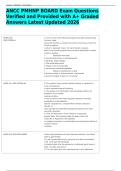
Science Medicine Psychiatry
ANCC PMHNP BOARD Exam Questions
Verified and Provided with A+ Graded
Answers Latest Updated 2026
MOOD D/O: A. Five (or more) of the following symptoms have been present during
MDD CRITERIA A the same 2-week
period and represent a change from previous functioning; at least one
of the symptoms
is either (1) depressed mood or (2) loss of interest or pleasure.
Note: Do not include symptoms that are clearly attributable to another
medical condition.
1. Depressed mood daily
2.Loss of pleasure of joy in activities/inerests
3.Significant weight loss/gain
4. insomnia/hypersomnia
5.fatigue or loss of energy daily
6.psychomotor retardationagitation
7. feelings of worthlessness or guilt
8.diminished ability to think/concentrate, indecisiveness
9.recurrent thoughts of death, SI, or SI attempt
MOOD D/O: MDD CRITERIA B-E B. The symptoms cause clinically significant distress or impairment in
social, occupational,
or other important areas of functioning.
C. The episode is not attributable to the physiological effects of a
substance or to another
medical condition.
D. The occurrence of the major depressive episode is not better
explained by schizoaffective
disorder, schizophrenia, schizophreniform disorder, delusional
disorder, or
other specified and unspecified schizophrenia spectrum and other
psychotic disorders.
E. There has never been a manic episode or a hypomanic
episode. Note: This exclusion does not apply if all of the
manic-like or hypomanic-like episodes
are substance-induced or are attributable to the physiological effects of
another medical
condition.
MOOD D/O: MDD PREVALENCE Twelve-month prevalence of major depressive disorder in the United
States is approximately
7%, with marked differences by age group such that the prevalence
in 18- to 29-year-old individuals
is threefold higher than the prevalence in individuals age 60 years or
older. Females experience
1.5- to 3-fold higher rates than males beginning in early adolescence.
, MOOD D/O: MDD DEVELOPMENT AND COURSE -Recovery typically begins within 3 months of onset for two in five
individuals with major
depression and within 1 year for four in five individuals.
-The risk is higher in individuals whose preceding episode was severe,
in younger individuals, and in individuals who have already
experienced multiple episodes.
-The persistence of even mild depressive symptoms during remission
is a powerful
predictor of recurrence.
MOOD D/O: MDD RISK FACTORS -Neuroticism (negative affectivity) is a well-established risk factor for the
onset of major depressive disorder
-Adverse childhood experiences, particularly when there are multiple
experiences of diverse types, constitute a set of potent risk factors
for major depressive disorder.
-Stressful life events are well recognized as precipitants of major
depressive episodes,but the presence or absence of adverse life events
near the onset of episodes does not appear to provide a useful guide to
prognosis or treatment selection.
-First-degree family members of individuals with major
depressive disorder have a risk for major depressive disorder
two- to fourfold higher than that of the general population.
-Relative risks appear to be higher for early-onset and recurrent forms.
Heritability is approximately 40%, and the personality trait neuroticism
accounts
for a substantial portion of this genetic liability.
ANCC PMHNP BOARD Exam Questions
Verified and Provided with A+ Graded
Answers Latest Updated 2026
MOOD D/O: A. Five (or more) of the following symptoms have been present during
MDD CRITERIA A the same 2-week
period and represent a change from previous functioning; at least one
of the symptoms
is either (1) depressed mood or (2) loss of interest or pleasure.
Note: Do not include symptoms that are clearly attributable to another
medical condition.
1. Depressed mood daily
2.Loss of pleasure of joy in activities/inerests
3.Significant weight loss/gain
4. insomnia/hypersomnia
5.fatigue or loss of energy daily
6.psychomotor retardationagitation
7. feelings of worthlessness or guilt
8.diminished ability to think/concentrate, indecisiveness
9.recurrent thoughts of death, SI, or SI attempt
MOOD D/O: MDD CRITERIA B-E B. The symptoms cause clinically significant distress or impairment in
social, occupational,
or other important areas of functioning.
C. The episode is not attributable to the physiological effects of a
substance or to another
medical condition.
D. The occurrence of the major depressive episode is not better
explained by schizoaffective
disorder, schizophrenia, schizophreniform disorder, delusional
disorder, or
other specified and unspecified schizophrenia spectrum and other
psychotic disorders.
E. There has never been a manic episode or a hypomanic
episode. Note: This exclusion does not apply if all of the
manic-like or hypomanic-like episodes
are substance-induced or are attributable to the physiological effects of
another medical
condition.
MOOD D/O: MDD PREVALENCE Twelve-month prevalence of major depressive disorder in the United
States is approximately
7%, with marked differences by age group such that the prevalence
in 18- to 29-year-old individuals
is threefold higher than the prevalence in individuals age 60 years or
older. Females experience
1.5- to 3-fold higher rates than males beginning in early adolescence.
, MOOD D/O: MDD DEVELOPMENT AND COURSE -Recovery typically begins within 3 months of onset for two in five
individuals with major
depression and within 1 year for four in five individuals.
-The risk is higher in individuals whose preceding episode was severe,
in younger individuals, and in individuals who have already
experienced multiple episodes.
-The persistence of even mild depressive symptoms during remission
is a powerful
predictor of recurrence.
MOOD D/O: MDD RISK FACTORS -Neuroticism (negative affectivity) is a well-established risk factor for the
onset of major depressive disorder
-Adverse childhood experiences, particularly when there are multiple
experiences of diverse types, constitute a set of potent risk factors
for major depressive disorder.
-Stressful life events are well recognized as precipitants of major
depressive episodes,but the presence or absence of adverse life events
near the onset of episodes does not appear to provide a useful guide to
prognosis or treatment selection.
-First-degree family members of individuals with major
depressive disorder have a risk for major depressive disorder
two- to fourfold higher than that of the general population.
-Relative risks appear to be higher for early-onset and recurrent forms.
Heritability is approximately 40%, and the personality trait neuroticism
accounts
for a substantial portion of this genetic liability.


