

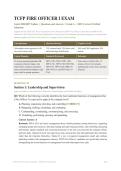
TCFP FIRE OFFICER I EXAM
Latest 2026/2027 Update | Questions and Answers | Grade A | 100% Correct (Verified
Solutions)
Aligned with the 2026-2027 Texas Commission on Fire Protection (TCFP) Fire Officer I curriculum and NFPA 1021:
Standard for Fire Officer Professional Qualifications. First-level officer leadership, personnel management, and operational
planning emphasis with real-world scenarios for company-officer decision making.
Total Questions Question Structure Cognitive Levels
100 multiple-choice questions (A-D), 75% scenario-based, 25% direct recall 30% recall, 50% application, 20%
one correct answer each and terminology identification analysis
Content Domains Standards Referenced Rationales
10 sections spanning leadership, HR, NFPA 1021 (2020), NFPA 1500, Every answer verified with a 3-5
community relations, budget, code NFPA 1521, NFPA 1582/1583/1584, sentence officer-level rationale
enforcement, emergency operations, NFPA 921, NFPA 1620, OSHA 29 explaining the correct choice and each
safety, professional development, legal CFR 1910.134, and TCFP rules (37 distractor
issues, and fire ground operations TAC)
QUESTIONS 1-20
Section 1: Leadership and Supervision
Supervisory Roles, Leadership Styles, Motivation, Team Building, and Conflict Resolution
Q1: Which of the following correctly identifies the four traditional functions of management that
a Fire Officer I is expected to apply at the company level?
A. Planning, organizing, directing, and controlling [CORRECT]
B. Budgeting, staffing, scheduling, and evaluating
C. Commanding, coordinating, communicating, and correcting
D. Visualizing, performing, praising, and punishing
Correct Answer: A
Rationale: NFPA 1021 and classic management theory identify planning (setting objectives), organizing
(arranging people and resources), directing (leading and supervising personnel), and controlling (measuring
performance against standards and correcting deviations) as the four core functions the company officer
performs daily. Options B and C list supervisory tasks and activities that fall underneath these functions
rather than the functions themselves. Option D is not a recognized management model and confuses
leadership conduct with management structure. TCFP Fire Officer I candidates are specifically tested on
distinguishing the formal functions of management from individual supervisory tasks.
TCFP Fire Officer I Exam Preparation - 2026/2027 Verified Edition Page 1
,TCFP Fire Officer I Exam (Latest 2026/2027 Update) 100 Questions | Grade A | Verified Solutions
Q2: Captain Ruiz wants the crew to complete apparatus checks before 0900 each shift. She assigns
each member specific compartments to inspect, sets the 0900 deadline, and then follows up by
verifying completed work against the standard checklist. Which management function is Captain
Ruiz primarily exercising during the follow-up verification step?
A. Planning
B. Organizing
C. Controlling [CORRECT]
D. Budgeting
Correct Answer: C
Rationale: Controlling is the management function of measuring performance against established
standards and taking corrective action, which is exactly what verification against the standard checklist
accomplishes. Organizing occurred when she assigned compartments to members, and directing occurs as
she guides the work, but neither describes the verification loop. Planning refers to setting the objective and
deadline, not auditing results against them. Budgeting is a fiscal management function unrelated to task
verification, making it a distractor for candidates who associate control with money rather than
performance.
Q3: Under the principle of unity of command, as applied in both routine fire department
operations and the Incident Command System, each firefighter should:
A. Report to at least two supervisors so that accountability is redundant
B. Report to only one designated supervisor at any given time [CORRECT]
C. Choose his or her own supervisor at the start of each work period
D. Report directly to the fire chief at all times
Correct Answer: B
Rationale: Unity of command means each individual reports to one designated supervisor, which prevents
conflicting orders and preserves a single, unbroken accountability chain from the firefighter to the incident
commander. Option A describes the opposite principle and creates conflicting priorities. Option C
describes self-assignment, which destroys organizational control and is a common exam pitfall. Option D
bypasses the chain of command and exceeds any single officer's span of control, a violation NFPA 1021
and NIMS both guard against.
TCFP Fire Officer I Exam Preparation - 2026/2027 Verified Edition Page 2
,TCFP Fire Officer I Exam (Latest 2026/2027 Update) 100 Questions | Grade A | Verified Solutions
Q4: Lieutenant Ortega supervises a crew of veteran, highly experienced firefighters who are
skilled, motivated, and fully capable of working independently on routine station duties. According
to situational leadership theory, which leadership style is most appropriate for this crew when
handling routine tasks?
A. Authoritarian (autocratic) direction with detailed orders
B. Close, step-by-step coaching on each task
C. Transactional micromanagement of every assignment
D. Laissez-faire (delegating) style with periodic monitoring and follow-up [CORRECT]
Correct Answer: D
Rationale: Situational leadership theory requires matching the leadership style to follower maturity; a
delegating or laissez-faire approach suits experienced, self-directed crews, provided the officer retains
accountability through periodic monitoring and follow-up. Authoritarian direction and step-by-step
coaching are appropriate for new or low-ability crews and would insult and demotivate veterans.
Transactional micromanagement wastes the crew's capability and the officer's time. The critical TCFP
distinction is that even a laissez-faire officer remains fully responsible for outcomes, so the style never
excuses abandonment of supervision.
Q5: Which of the following best describes transformational leadership?
A. Exchanging rewards and incentives for compliant performance
B. Inspiring followers through vision, idealized influence, and individualized consideration
[CORRECT]
C. Avoiding intervention until subordinates request assistance
D. Making all decisions alone and announcing them to the crew
Correct Answer: B
Rationale: Transformational leadership elevates follower motivation and performance through idealized
influence (role modeling), inspirational motivation (compelling vision), intellectual stimulation, and
individualized consideration of each member's needs. Option A describes transactional leadership, which is
built on contingent reward and is the most common distractor against transformational leadership on
certification exams. Option C describes laissez-faire leadership, and Option D describes the authoritarian
style. Fire Officer I candidates must be able to separate all five major styles because each fits different
crews and situations.
TCFP Fire Officer I Exam Preparation - 2026/2027 Verified Edition Page 3
, TCFP Fire Officer I Exam (Latest 2026/2027 Update) 100 Questions | Grade A | Verified Solutions
Q6: Captain Boyd promises his crew that anyone who completes all scheduled hydrant testing this
month will receive preferred duty-day assignments and a written commendation. Which leadership
approach is Captain Boyd using?
A. Transactional leadership [CORRECT]
B. Transformational leadership
C. Laissez-faire leadership
D. Democratic leadership
Correct Answer: A
Rationale: Transactional leadership is based on contingent reward: the leader exchanges valued outcomes
for specified performance and monitors compliance through that exchange. Transformational leadership
would instead connect hydrant testing to a vision of community protection and member growth.
Laissez-faire involves the absence of direction and reward structures, while democratic leadership shares
decision making with the crew. Recognizing contingent-reward behavior as transactional is a frequently
tested TCFP Fire Officer I leadership-style discrimination point.
Q7: In Maslow's hierarchy of needs, which sequence correctly orders human needs from the most
basic level to the highest level?
A. Safety, physiological, esteem, social, self-actualization
B. Physiological, esteem, safety, self-actualization, social
C. Social, safety, physiological, self-actualization, esteem
D. Physiological, safety, social, esteem, self-actualization [CORRECT]
Correct Answer: D
Rationale: Maslow's hierarchy ascends from physiological needs (food, water, rest), to safety and security,
to social needs (belonging and affiliation), to esteem (recognition and respect), and finally to
self-actualization, the full use of one's potential. Each option except D scrambles this recognized order, and
exam distractors typically transpose the middle three levels. For the fire officer, the model explains why
fair pay and safe working conditions must precede recognition programs and development opportunities.
Misordering the hierarchy is one of the most common TCFP Fire Officer I recall errors.
TCFP Fire Officer I Exam Preparation - 2026/2027 Verified Edition Page 4
Latest 2026/2027 Update | Questions and Answers | Grade A | 100% Correct (Verified
Solutions)
Aligned with the 2026-2027 Texas Commission on Fire Protection (TCFP) Fire Officer I curriculum and NFPA 1021:
Standard for Fire Officer Professional Qualifications. First-level officer leadership, personnel management, and operational
planning emphasis with real-world scenarios for company-officer decision making.
Total Questions Question Structure Cognitive Levels
100 multiple-choice questions (A-D), 75% scenario-based, 25% direct recall 30% recall, 50% application, 20%
one correct answer each and terminology identification analysis
Content Domains Standards Referenced Rationales
10 sections spanning leadership, HR, NFPA 1021 (2020), NFPA 1500, Every answer verified with a 3-5
community relations, budget, code NFPA 1521, NFPA 1582/1583/1584, sentence officer-level rationale
enforcement, emergency operations, NFPA 921, NFPA 1620, OSHA 29 explaining the correct choice and each
safety, professional development, legal CFR 1910.134, and TCFP rules (37 distractor
issues, and fire ground operations TAC)
QUESTIONS 1-20
Section 1: Leadership and Supervision
Supervisory Roles, Leadership Styles, Motivation, Team Building, and Conflict Resolution
Q1: Which of the following correctly identifies the four traditional functions of management that
a Fire Officer I is expected to apply at the company level?
A. Planning, organizing, directing, and controlling [CORRECT]
B. Budgeting, staffing, scheduling, and evaluating
C. Commanding, coordinating, communicating, and correcting
D. Visualizing, performing, praising, and punishing
Correct Answer: A
Rationale: NFPA 1021 and classic management theory identify planning (setting objectives), organizing
(arranging people and resources), directing (leading and supervising personnel), and controlling (measuring
performance against standards and correcting deviations) as the four core functions the company officer
performs daily. Options B and C list supervisory tasks and activities that fall underneath these functions
rather than the functions themselves. Option D is not a recognized management model and confuses
leadership conduct with management structure. TCFP Fire Officer I candidates are specifically tested on
distinguishing the formal functions of management from individual supervisory tasks.
TCFP Fire Officer I Exam Preparation - 2026/2027 Verified Edition Page 1
,TCFP Fire Officer I Exam (Latest 2026/2027 Update) 100 Questions | Grade A | Verified Solutions
Q2: Captain Ruiz wants the crew to complete apparatus checks before 0900 each shift. She assigns
each member specific compartments to inspect, sets the 0900 deadline, and then follows up by
verifying completed work against the standard checklist. Which management function is Captain
Ruiz primarily exercising during the follow-up verification step?
A. Planning
B. Organizing
C. Controlling [CORRECT]
D. Budgeting
Correct Answer: C
Rationale: Controlling is the management function of measuring performance against established
standards and taking corrective action, which is exactly what verification against the standard checklist
accomplishes. Organizing occurred when she assigned compartments to members, and directing occurs as
she guides the work, but neither describes the verification loop. Planning refers to setting the objective and
deadline, not auditing results against them. Budgeting is a fiscal management function unrelated to task
verification, making it a distractor for candidates who associate control with money rather than
performance.
Q3: Under the principle of unity of command, as applied in both routine fire department
operations and the Incident Command System, each firefighter should:
A. Report to at least two supervisors so that accountability is redundant
B. Report to only one designated supervisor at any given time [CORRECT]
C. Choose his or her own supervisor at the start of each work period
D. Report directly to the fire chief at all times
Correct Answer: B
Rationale: Unity of command means each individual reports to one designated supervisor, which prevents
conflicting orders and preserves a single, unbroken accountability chain from the firefighter to the incident
commander. Option A describes the opposite principle and creates conflicting priorities. Option C
describes self-assignment, which destroys organizational control and is a common exam pitfall. Option D
bypasses the chain of command and exceeds any single officer's span of control, a violation NFPA 1021
and NIMS both guard against.
TCFP Fire Officer I Exam Preparation - 2026/2027 Verified Edition Page 2
,TCFP Fire Officer I Exam (Latest 2026/2027 Update) 100 Questions | Grade A | Verified Solutions
Q4: Lieutenant Ortega supervises a crew of veteran, highly experienced firefighters who are
skilled, motivated, and fully capable of working independently on routine station duties. According
to situational leadership theory, which leadership style is most appropriate for this crew when
handling routine tasks?
A. Authoritarian (autocratic) direction with detailed orders
B. Close, step-by-step coaching on each task
C. Transactional micromanagement of every assignment
D. Laissez-faire (delegating) style with periodic monitoring and follow-up [CORRECT]
Correct Answer: D
Rationale: Situational leadership theory requires matching the leadership style to follower maturity; a
delegating or laissez-faire approach suits experienced, self-directed crews, provided the officer retains
accountability through periodic monitoring and follow-up. Authoritarian direction and step-by-step
coaching are appropriate for new or low-ability crews and would insult and demotivate veterans.
Transactional micromanagement wastes the crew's capability and the officer's time. The critical TCFP
distinction is that even a laissez-faire officer remains fully responsible for outcomes, so the style never
excuses abandonment of supervision.
Q5: Which of the following best describes transformational leadership?
A. Exchanging rewards and incentives for compliant performance
B. Inspiring followers through vision, idealized influence, and individualized consideration
[CORRECT]
C. Avoiding intervention until subordinates request assistance
D. Making all decisions alone and announcing them to the crew
Correct Answer: B
Rationale: Transformational leadership elevates follower motivation and performance through idealized
influence (role modeling), inspirational motivation (compelling vision), intellectual stimulation, and
individualized consideration of each member's needs. Option A describes transactional leadership, which is
built on contingent reward and is the most common distractor against transformational leadership on
certification exams. Option C describes laissez-faire leadership, and Option D describes the authoritarian
style. Fire Officer I candidates must be able to separate all five major styles because each fits different
crews and situations.
TCFP Fire Officer I Exam Preparation - 2026/2027 Verified Edition Page 3
, TCFP Fire Officer I Exam (Latest 2026/2027 Update) 100 Questions | Grade A | Verified Solutions
Q6: Captain Boyd promises his crew that anyone who completes all scheduled hydrant testing this
month will receive preferred duty-day assignments and a written commendation. Which leadership
approach is Captain Boyd using?
A. Transactional leadership [CORRECT]
B. Transformational leadership
C. Laissez-faire leadership
D. Democratic leadership
Correct Answer: A
Rationale: Transactional leadership is based on contingent reward: the leader exchanges valued outcomes
for specified performance and monitors compliance through that exchange. Transformational leadership
would instead connect hydrant testing to a vision of community protection and member growth.
Laissez-faire involves the absence of direction and reward structures, while democratic leadership shares
decision making with the crew. Recognizing contingent-reward behavior as transactional is a frequently
tested TCFP Fire Officer I leadership-style discrimination point.
Q7: In Maslow's hierarchy of needs, which sequence correctly orders human needs from the most
basic level to the highest level?
A. Safety, physiological, esteem, social, self-actualization
B. Physiological, esteem, safety, self-actualization, social
C. Social, safety, physiological, self-actualization, esteem
D. Physiological, safety, social, esteem, self-actualization [CORRECT]
Correct Answer: D
Rationale: Maslow's hierarchy ascends from physiological needs (food, water, rest), to safety and security,
to social needs (belonging and affiliation), to esteem (recognition and respect), and finally to
self-actualization, the full use of one's potential. Each option except D scrambles this recognized order, and
exam distractors typically transpose the middle three levels. For the fire officer, the model explains why
fair pay and safe working conditions must precede recognition programs and development opportunities.
Misordering the hierarchy is one of the most common TCFP Fire Officer I recall errors.
TCFP Fire Officer I Exam Preparation - 2026/2027 Verified Edition Page 4


