

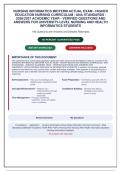
NURSING INFORMATICS MIDTERM ACTUAL EXAM - HIGHER
EDUCATION NURSING CURRICULUM / ANA STANDARDS -
2026/2027 ACADEMIC YEAR - VERIFIED QUESTIONS AND
ANSWERS FOR UNIVERSITY-LEVEL NURSING AND HEALTH
INFORMATICS STUDENTS
192 Questions with Answers and Detailed Rationales
100 PERCENT GUARANTEED PASS
INSTANT DOWNLOAD ANSWERS INCLUDED
IMPORTANCE OF THIS DOCUMENT
This comprehensive examination preparation guide has been meticulously developed to help you succeed in the
NURSING INFORMATICS MIDTERM ACTUAL EXAM - HIGHER EDUCATION NURSING CURRICULUM / ANA
STANDARDS - 2026/2027 ACADEMIC YEAR - VERIFIED QUESTIONS AND ANSWERS FOR
UNIVERSITY-LEVEL NURSING AND HEALTH INFORMATICS STUDENTS. It contains 192 carefully selected
questions that reflect the most current exam content and testing strategies. Each question is accompanied by a
correct answer and a detailed rationale that explains the underlying pathophysiology, pharmacology, or clinical
reasoning.
Self-Assessment – Test your knowledge and Exam Preparation – Familiarize yourself with the
identify areas requiring further question format and content
study areas
Concept Reinforcement – Deepen your Confidence Building – Develop test-taking
understanding through strategies and reduce
evidence-based exam anxiety
rationales
Time Management – Practice answering
questions under simulated
exam conditions
Review Summary 192 Questions
Foundations - Application - Nursing Informatics Actual Higher Education Nursing Curriculum / ANA
Standards 2026/2027 Academic YEAR AND FOR University-level Nursing AND Health Informatics Students
Nursing Informatics Graduate
All answers with rationales
,Table of Contents
Content Area Questions Key Topics
Nursing Informatics Actual 1-32 Informaticist, System, Health, Alert, Clinical
Higher Education Nursing
Curriculum / ANA Standards
2026/2027 Academic YEAR
AND FOR University-level
Nursing AND Health
Informatics Students Nursing
Informatics Graduate
System 33-64 Alert, Clinical, Nursing, Informaticist, Context
Clinical 65-96 Alert, System, Informaticist, Nursing, Support
Nursing 97-128 System, Informaticist, Clinical, Health, Support
Alert 129-160 Nursing, System, Informaticist, Informatics, Clinical
Support 161-192 Informaticist, System, Clinical, Nursing, Alert
TOTAL 192 All questions include answers and detailed rationales
,Section A - Nursing Informatics Actual Higher Education
Nursing Curriculum / ANA Standards 2026/2027 Academic
YEAR AND FOR University-level Nursing AND Health
Informatics Students Nursing Informatics Graduate
Q1.
In a post-implementation evaluation of a clinical decision support system (CDSS), you find
that alert fatigue has reduced clinician response rates to critical drug-drug interaction
alerts. Which strategy is most evidence-based to mitigate alert fatigue while preserving
safety?
A. Disable all non-critical alerts to reduce B. Implement tiered alerting based on
the total volume severity and clinical context
C. Increase the frequency of alerts to ensure D. Provide override reasons as free-text
visibility without any default
Correct: B - Implement tiered alerting based on severity and clinical context
Rationale:Tiered alerting, which prioritizes alerts based on severity and patient-specific
context, has been shown to reduce alert fatigue while maintaining safety. Disabling all
non-critical alerts (A) may miss important warnings; increasing frequency (C) worsens fatigue;
free-text overrides (D) do not address the root cause.
Q2.
When integrating a new wearable device that streams patient vitals into the EHR, which
interoperability standard is most appropriate for real-time, event-based data exchange?
A. HL7 FHIR WebSocket subscriptions B. HL7 v2.x ADT messages
C. CDA documents D. DICOM
Correct: A - HL7 FHIR WebSocket subscriptions
Rationale:FHIR supports RESTful APIs and WebSocket subscriptions for real-time push of
data, ideal for streaming vitals. HL7 v2.x (B) is for message-based transactions like ADT, not
real-time continuous data; CDA (C) is document-centric; DICOM (D) is for imaging.
Q3.
A nurse informaticist is designing a clinical decision support (CDS) rule to identify
patients at risk for sepsis. Which approach best minimizes alert fatigue while maximizing
sensitivity?
Page 3
, Section A - Nursing Informatics Actual Higher Education Nursing Curriculum / ANA Standards 2026/2027 Academic YEAR AND FOR
University-level Nursing AND Health Informatics Students Nursing Informatics Graduate
A. Use a single high-sensitivity SIRS B. Incorporate multiple data points (e.g.,
criterion threshold lactate, blood pressure) with a composite
score
C. Alert only on physician order entry, not on D. Require a confirmatory manual
vital signs assessment before alerting
Correct: B - Incorporate multiple data points (e.g., lactate, blood pressure) with a
composite score
Rationale:Composite scores like qSOFA or NEWS that combine multiple variables provide
better discrimination and can be adjusted for specificity. Single criteria (A) may cause high
false positives; limiting to order entry (C) misses real-time detection; manual confirmation (D)
adds burden and delays.
Q4.
In conducting a gap analysis for a new telehealth program, which of the following is a
primary consideration for ensuring equity and access?
A. Broadband internet availability in the B. Provider reimbursement rates
target population
C. State licensure requirements D. Patient satisfaction surveys
Correct: A - Broadband internet availability in the target population
Rationale:Broadband access is a fundamental social determinant of health that directly
affects telehealth equity. Reimbursement (B), licensure (C), and satisfaction (D) are important
but secondary to the basic ability to connect.
Q5.
A health system is migrating from a legacy EHR to a new one. Which data migration
strategy best ensures data integrity and semantic interoperability?
A. Extract, transform, and load (ETL) using B. Direct database-to-database copy with
a common data model minimal mapping
C. Manual re-entry of all historical data D. Parallel run of both systems for six
months
Correct: A - Extract, transform, and load (ETL) using a common data model
Rationale:ETL with a common data model ensures that data are transformed into a
consistent, standards-based format, preserving meaning. Direct copy (B) risks incorrect
mapping; manual re-entry (C) is error-prone; parallel run (D) is a go-live strategy, not a
migration method.
Page 4
EDUCATION NURSING CURRICULUM / ANA STANDARDS -
2026/2027 ACADEMIC YEAR - VERIFIED QUESTIONS AND
ANSWERS FOR UNIVERSITY-LEVEL NURSING AND HEALTH
INFORMATICS STUDENTS
192 Questions with Answers and Detailed Rationales
100 PERCENT GUARANTEED PASS
INSTANT DOWNLOAD ANSWERS INCLUDED
IMPORTANCE OF THIS DOCUMENT
This comprehensive examination preparation guide has been meticulously developed to help you succeed in the
NURSING INFORMATICS MIDTERM ACTUAL EXAM - HIGHER EDUCATION NURSING CURRICULUM / ANA
STANDARDS - 2026/2027 ACADEMIC YEAR - VERIFIED QUESTIONS AND ANSWERS FOR
UNIVERSITY-LEVEL NURSING AND HEALTH INFORMATICS STUDENTS. It contains 192 carefully selected
questions that reflect the most current exam content and testing strategies. Each question is accompanied by a
correct answer and a detailed rationale that explains the underlying pathophysiology, pharmacology, or clinical
reasoning.
Self-Assessment – Test your knowledge and Exam Preparation – Familiarize yourself with the
identify areas requiring further question format and content
study areas
Concept Reinforcement – Deepen your Confidence Building – Develop test-taking
understanding through strategies and reduce
evidence-based exam anxiety
rationales
Time Management – Practice answering
questions under simulated
exam conditions
Review Summary 192 Questions
Foundations - Application - Nursing Informatics Actual Higher Education Nursing Curriculum / ANA
Standards 2026/2027 Academic YEAR AND FOR University-level Nursing AND Health Informatics Students
Nursing Informatics Graduate
All answers with rationales
,Table of Contents
Content Area Questions Key Topics
Nursing Informatics Actual 1-32 Informaticist, System, Health, Alert, Clinical
Higher Education Nursing
Curriculum / ANA Standards
2026/2027 Academic YEAR
AND FOR University-level
Nursing AND Health
Informatics Students Nursing
Informatics Graduate
System 33-64 Alert, Clinical, Nursing, Informaticist, Context
Clinical 65-96 Alert, System, Informaticist, Nursing, Support
Nursing 97-128 System, Informaticist, Clinical, Health, Support
Alert 129-160 Nursing, System, Informaticist, Informatics, Clinical
Support 161-192 Informaticist, System, Clinical, Nursing, Alert
TOTAL 192 All questions include answers and detailed rationales
,Section A - Nursing Informatics Actual Higher Education
Nursing Curriculum / ANA Standards 2026/2027 Academic
YEAR AND FOR University-level Nursing AND Health
Informatics Students Nursing Informatics Graduate
Q1.
In a post-implementation evaluation of a clinical decision support system (CDSS), you find
that alert fatigue has reduced clinician response rates to critical drug-drug interaction
alerts. Which strategy is most evidence-based to mitigate alert fatigue while preserving
safety?
A. Disable all non-critical alerts to reduce B. Implement tiered alerting based on
the total volume severity and clinical context
C. Increase the frequency of alerts to ensure D. Provide override reasons as free-text
visibility without any default
Correct: B - Implement tiered alerting based on severity and clinical context
Rationale:Tiered alerting, which prioritizes alerts based on severity and patient-specific
context, has been shown to reduce alert fatigue while maintaining safety. Disabling all
non-critical alerts (A) may miss important warnings; increasing frequency (C) worsens fatigue;
free-text overrides (D) do not address the root cause.
Q2.
When integrating a new wearable device that streams patient vitals into the EHR, which
interoperability standard is most appropriate for real-time, event-based data exchange?
A. HL7 FHIR WebSocket subscriptions B. HL7 v2.x ADT messages
C. CDA documents D. DICOM
Correct: A - HL7 FHIR WebSocket subscriptions
Rationale:FHIR supports RESTful APIs and WebSocket subscriptions for real-time push of
data, ideal for streaming vitals. HL7 v2.x (B) is for message-based transactions like ADT, not
real-time continuous data; CDA (C) is document-centric; DICOM (D) is for imaging.
Q3.
A nurse informaticist is designing a clinical decision support (CDS) rule to identify
patients at risk for sepsis. Which approach best minimizes alert fatigue while maximizing
sensitivity?
Page 3
, Section A - Nursing Informatics Actual Higher Education Nursing Curriculum / ANA Standards 2026/2027 Academic YEAR AND FOR
University-level Nursing AND Health Informatics Students Nursing Informatics Graduate
A. Use a single high-sensitivity SIRS B. Incorporate multiple data points (e.g.,
criterion threshold lactate, blood pressure) with a composite
score
C. Alert only on physician order entry, not on D. Require a confirmatory manual
vital signs assessment before alerting
Correct: B - Incorporate multiple data points (e.g., lactate, blood pressure) with a
composite score
Rationale:Composite scores like qSOFA or NEWS that combine multiple variables provide
better discrimination and can be adjusted for specificity. Single criteria (A) may cause high
false positives; limiting to order entry (C) misses real-time detection; manual confirmation (D)
adds burden and delays.
Q4.
In conducting a gap analysis for a new telehealth program, which of the following is a
primary consideration for ensuring equity and access?
A. Broadband internet availability in the B. Provider reimbursement rates
target population
C. State licensure requirements D. Patient satisfaction surveys
Correct: A - Broadband internet availability in the target population
Rationale:Broadband access is a fundamental social determinant of health that directly
affects telehealth equity. Reimbursement (B), licensure (C), and satisfaction (D) are important
but secondary to the basic ability to connect.
Q5.
A health system is migrating from a legacy EHR to a new one. Which data migration
strategy best ensures data integrity and semantic interoperability?
A. Extract, transform, and load (ETL) using B. Direct database-to-database copy with
a common data model minimal mapping
C. Manual re-entry of all historical data D. Parallel run of both systems for six
months
Correct: A - Extract, transform, and load (ETL) using a common data model
Rationale:ETL with a common data model ensures that data are transformed into a
consistent, standards-based format, preserving meaning. Direct copy (B) risks incorrect
mapping; manual re-entry (C) is error-prone; parallel run (D) is a go-live strategy, not a
migration method.
Page 4


