

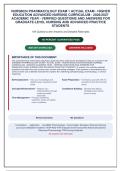
NURS8024 PHARMACOLOGY EXAM 1 ACTUAL EXAM - HIGHER
EDUCATION ADVANCED NURSING CURRICULUM - 2026/2027
ACADEMIC YEAR - VERIFIED QUESTIONS AND ANSWERS FOR
GRADUATE-LEVEL NURSING AND ADVANCED PRACTICE
STUDENTS
164 Questions with Answers and Detailed Rationales
100 PERCENT GUARANTEED PASS
INSTANT DOWNLOAD ANSWERS INCLUDED
IMPORTANCE OF THIS DOCUMENT
This comprehensive examination preparation guide has been meticulously developed to help you succeed in the
NURS8024 PHARMACOLOGY EXAM 1 ACTUAL EXAM - HIGHER EDUCATION ADVANCED NURSING
CURRICULUM - 2026/2027 ACADEMIC YEAR - VERIFIED QUESTIONS AND ANSWERS FOR
GRADUATE-LEVEL NURSING AND ADVANCED PRACTICE STUDENTS. It contains 164 carefully selected
questions that reflect the most current exam content and testing strategies. Each question is accompanied by a
correct answer and a detailed rationale that explains the underlying pathophysiology, pharmacology, or clinical
reasoning.
Self-Assessment – Test your knowledge and Exam Preparation – Familiarize yourself with the
identify areas requiring further question format and content
study areas
Concept Reinforcement – Deepen your Confidence Building – Develop test-taking
understanding through strategies and reduce
evidence-based exam anxiety
rationales
Time Management – Practice answering
questions under simulated
exam conditions
Review Summary 164 Questions
Foundations - Application - Nurs8024 Pharmacology 1 Actual Higher Education Advanced Nursing
Curriculum 2026/2027 Academic YEAR AND FOR Graduate-level Nursing AND Advanced Students
Advanced Pharmacology FOR Nursing Graduate
All answers with rationales
,Table of Contents
Content Area Questions Key Topics
Nurs8024 Pharmacology 1 1-28 Mechanism, Phenytoin, Started, Chronic, Effect
Actual Higher Education
Advanced Nursing
Curriculum 2026/2027
Academic YEAR AND FOR
Graduate-level Nursing AND
Advanced Students
Advanced Pharmacology
FOR Nursing Graduate
Chronic 29-56 Digoxin, Likely, Toxicity, Mechanism, Warfarin
Started 57-84 Interaction, Chronic, Prescribed, Likely, Toxicity
Mechanism 85-112 Medication, Prescribed, Effect, Requires, Chronic
Requires 113-140 Prescribed, Chronic, Started, Appropriate, Medication
Effect 141-164 Started, Requires, Agent, Monitoring, Prescribed
TOTAL 164 All questions include answers and detailed rationales
,Section A - Nurs8024 Pharmacology 1 Actual Higher
Education Advanced Nursing Curriculum 2026/2027
Academic YEAR AND FOR Graduate-level Nursing AND
Advanced Students Advanced Pharmacology FOR Nursing
Graduate
Q1.
A novel oral anticoagulant is a direct factor Xa inhibitor with a bioavailability of 50% that is
primarily eliminated renally. In a patient with moderate hepatic impairment (Child-Pugh B),
which pharmacokinetic parameter is most likely to be significantly altered, requiring dose
adjustment?
A. Absorption B. Distribution
C. Metabolism D. Excretion
Correct: C - Metabolism
Rationale:Hepatic impairment affects drug metabolism, particularly for drugs metabolized by
CYP enzymes. Direct factor Xa inhibitors like rivaroxaban are metabolized in the liver, so
Child-Pugh B cirrhosis can increase systemic exposure. Absorption is less affected,
distribution changes are minimal, and renal excretion is not directly impacted by hepatic
function.
Q2.
A patient on a stable dose of warfarin is started on a short course of a broad-spectrum
antibiotic for pneumonia. The INR rises from 2.3 to 4.8 within 48 hours. Which mechanism
best explains this interaction?
A. Displacement of warfarin from protein B. Inhibition of CYP2C9-mediated warfarin
binding metabolism
C. Reduction of gut flora vitamin K synthesis D. Increased warfarin absorption due to
antibiotic-induced gut changes
Correct: C - Reduction of gut flora vitamin K synthesis
Rationale:Broad-spectrum antibiotics reduce gut flora that produce vitamin K, leading to
decreased vitamin K availability and enhanced warfarin effect. While some antibiotics inhibit
CYP2C9, the rapid onset and typical pattern support the vitamin K mechanism. Protein
binding displacement is minor and transient, and absorption changes are not significant.
Page 3
, Section A - Nurs8024 Pharmacology 1 Actual Higher Education Advanced Nursing Curriculum 2026/2027 Academic YEAR AND FOR
Graduate-level Nursing AND Advanced Students Advanced Pharmacology FOR Nursing Graduate
Q3.
A patient with chronic heart failure is prescribed digoxin. Which concurrent medication is
most likely to increase the risk of digoxin toxicity by reducing its renal clearance?
A. Furosemide B. Amiodarone
C. Metformin D. Lisinopril
Correct: B - Amiodarone
Rationale:Amiodarone inhibits P-glycoprotein-mediated renal tubular secretion of digoxin,
increasing digoxin levels and toxicity risk. Furosemide may cause hypokalemia, which
potentiates digoxin toxicity but does not reduce clearance. Metformin and lisinopril do not
significantly affect digoxin clearance.
Q4.
Which pharmacodynamic principle best explains the observation that a drug's effect
reaches a plateau despite increasing the dose beyond a certain point?
A. Receptor desensitization B. Saturation of drug transporters
C. Maximal efficacy of the drug-receptor D. Competitive antagonism
system
Correct: C - Maximal efficacy of the drug-receptor system
Rationale:Maximal efficacy is the ceiling effect of a drug, determined by the number of
receptors and the efficiency of signal transduction. Once all receptors are occupied, additional
drug produces no further effect. Receptor desensitization reduces response over time, not
with dose. Transporters and competitive antagonism affect potency, not maximal efficacy.
Q5.
A patient with a history of peptic ulcer disease requires long-term NSAID therapy for
osteoarthritis. Which co-therapy is most evidence-based for reducing the risk of
NSAID-induced gastric ulcers?
A. Misoprostol B. Histamine-2 receptor antagonist
C. Antacid D. Sucralfate
Correct: A - Misoprostol
Rationale:Misoprostol is the only agent shown to significantly reduce serious NSAID-induced
ulcer complications, including perforation and bleeding. H2 receptor antagonists reduce
duodenal but not gastric ulcers. Antacids and sucralfate are not effective for prevention.
Page 4
EDUCATION ADVANCED NURSING CURRICULUM - 2026/2027
ACADEMIC YEAR - VERIFIED QUESTIONS AND ANSWERS FOR
GRADUATE-LEVEL NURSING AND ADVANCED PRACTICE
STUDENTS
164 Questions with Answers and Detailed Rationales
100 PERCENT GUARANTEED PASS
INSTANT DOWNLOAD ANSWERS INCLUDED
IMPORTANCE OF THIS DOCUMENT
This comprehensive examination preparation guide has been meticulously developed to help you succeed in the
NURS8024 PHARMACOLOGY EXAM 1 ACTUAL EXAM - HIGHER EDUCATION ADVANCED NURSING
CURRICULUM - 2026/2027 ACADEMIC YEAR - VERIFIED QUESTIONS AND ANSWERS FOR
GRADUATE-LEVEL NURSING AND ADVANCED PRACTICE STUDENTS. It contains 164 carefully selected
questions that reflect the most current exam content and testing strategies. Each question is accompanied by a
correct answer and a detailed rationale that explains the underlying pathophysiology, pharmacology, or clinical
reasoning.
Self-Assessment – Test your knowledge and Exam Preparation – Familiarize yourself with the
identify areas requiring further question format and content
study areas
Concept Reinforcement – Deepen your Confidence Building – Develop test-taking
understanding through strategies and reduce
evidence-based exam anxiety
rationales
Time Management – Practice answering
questions under simulated
exam conditions
Review Summary 164 Questions
Foundations - Application - Nurs8024 Pharmacology 1 Actual Higher Education Advanced Nursing
Curriculum 2026/2027 Academic YEAR AND FOR Graduate-level Nursing AND Advanced Students
Advanced Pharmacology FOR Nursing Graduate
All answers with rationales
,Table of Contents
Content Area Questions Key Topics
Nurs8024 Pharmacology 1 1-28 Mechanism, Phenytoin, Started, Chronic, Effect
Actual Higher Education
Advanced Nursing
Curriculum 2026/2027
Academic YEAR AND FOR
Graduate-level Nursing AND
Advanced Students
Advanced Pharmacology
FOR Nursing Graduate
Chronic 29-56 Digoxin, Likely, Toxicity, Mechanism, Warfarin
Started 57-84 Interaction, Chronic, Prescribed, Likely, Toxicity
Mechanism 85-112 Medication, Prescribed, Effect, Requires, Chronic
Requires 113-140 Prescribed, Chronic, Started, Appropriate, Medication
Effect 141-164 Started, Requires, Agent, Monitoring, Prescribed
TOTAL 164 All questions include answers and detailed rationales
,Section A - Nurs8024 Pharmacology 1 Actual Higher
Education Advanced Nursing Curriculum 2026/2027
Academic YEAR AND FOR Graduate-level Nursing AND
Advanced Students Advanced Pharmacology FOR Nursing
Graduate
Q1.
A novel oral anticoagulant is a direct factor Xa inhibitor with a bioavailability of 50% that is
primarily eliminated renally. In a patient with moderate hepatic impairment (Child-Pugh B),
which pharmacokinetic parameter is most likely to be significantly altered, requiring dose
adjustment?
A. Absorption B. Distribution
C. Metabolism D. Excretion
Correct: C - Metabolism
Rationale:Hepatic impairment affects drug metabolism, particularly for drugs metabolized by
CYP enzymes. Direct factor Xa inhibitors like rivaroxaban are metabolized in the liver, so
Child-Pugh B cirrhosis can increase systemic exposure. Absorption is less affected,
distribution changes are minimal, and renal excretion is not directly impacted by hepatic
function.
Q2.
A patient on a stable dose of warfarin is started on a short course of a broad-spectrum
antibiotic for pneumonia. The INR rises from 2.3 to 4.8 within 48 hours. Which mechanism
best explains this interaction?
A. Displacement of warfarin from protein B. Inhibition of CYP2C9-mediated warfarin
binding metabolism
C. Reduction of gut flora vitamin K synthesis D. Increased warfarin absorption due to
antibiotic-induced gut changes
Correct: C - Reduction of gut flora vitamin K synthesis
Rationale:Broad-spectrum antibiotics reduce gut flora that produce vitamin K, leading to
decreased vitamin K availability and enhanced warfarin effect. While some antibiotics inhibit
CYP2C9, the rapid onset and typical pattern support the vitamin K mechanism. Protein
binding displacement is minor and transient, and absorption changes are not significant.
Page 3
, Section A - Nurs8024 Pharmacology 1 Actual Higher Education Advanced Nursing Curriculum 2026/2027 Academic YEAR AND FOR
Graduate-level Nursing AND Advanced Students Advanced Pharmacology FOR Nursing Graduate
Q3.
A patient with chronic heart failure is prescribed digoxin. Which concurrent medication is
most likely to increase the risk of digoxin toxicity by reducing its renal clearance?
A. Furosemide B. Amiodarone
C. Metformin D. Lisinopril
Correct: B - Amiodarone
Rationale:Amiodarone inhibits P-glycoprotein-mediated renal tubular secretion of digoxin,
increasing digoxin levels and toxicity risk. Furosemide may cause hypokalemia, which
potentiates digoxin toxicity but does not reduce clearance. Metformin and lisinopril do not
significantly affect digoxin clearance.
Q4.
Which pharmacodynamic principle best explains the observation that a drug's effect
reaches a plateau despite increasing the dose beyond a certain point?
A. Receptor desensitization B. Saturation of drug transporters
C. Maximal efficacy of the drug-receptor D. Competitive antagonism
system
Correct: C - Maximal efficacy of the drug-receptor system
Rationale:Maximal efficacy is the ceiling effect of a drug, determined by the number of
receptors and the efficiency of signal transduction. Once all receptors are occupied, additional
drug produces no further effect. Receptor desensitization reduces response over time, not
with dose. Transporters and competitive antagonism affect potency, not maximal efficacy.
Q5.
A patient with a history of peptic ulcer disease requires long-term NSAID therapy for
osteoarthritis. Which co-therapy is most evidence-based for reducing the risk of
NSAID-induced gastric ulcers?
A. Misoprostol B. Histamine-2 receptor antagonist
C. Antacid D. Sucralfate
Correct: A - Misoprostol
Rationale:Misoprostol is the only agent shown to significantly reduce serious NSAID-induced
ulcer complications, including perforation and bleeding. H2 receptor antagonists reduce
duodenal but not gastric ulcers. Antacids and sucralfate are not effective for prevention.
Page 4


