

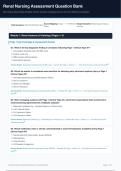
Renal Nursing Assessment Question Bank
200 Unique Board-Style Multiple Choice Questions Mapped Across 40 Core Reference Modules
Source Mapping: Pages 1 – 40 ReferenceTarget Discipline: Nephrology & Dialysis
Total Questions: 200 NCLEX/Board Style
Guide Nursing
Module 1: Renal Anatomy & Histology (Pages 1–4)
Page 1 Key Knowledge & Assessment Domain
Q1. What is the key diagnostic finding in urinalysis indicating Page 1 Clinical Topic #1?
1. Dysmorphic red blood cells and RBC casts
2. Hyaline casts only
3. WBC clumps without bacteria
4. Eosinophilic granules
Correct Answer: Dysmorphic red blood cells and RBC casts | Footnote Ref: Page 1, Section 1.1 — Core Renal Curriculum Assessment Guide[1]
Q2. Which lab marker is considered most sensitive for detecting early structural nephron injury in Page 1
Clinical Topic #2?
1. Neutrophil gelatinase-associated lipocalin (NGAL)
2. Serum Creatinine
3. Blood Urea Nitrogen
4. Serum Potassium
Correct Answer: Neutrophil gelatinase-associated lipocalin (NGAL) | Footnote Ref: Page 1, Section 1.2 — Core Renal Curriculum Assessment
Guide[2]
Q3. When managing a patient with Page 1 Clinical Topic #3, which fluid resuscitation fluid is preferred to
avoid worsening hyperchloremic metabolic acidosis?
1. Balanced crystalloid (e.g., Lactated Ringer's or Plasma-Lyte)
2. 0.9% Normal Saline
3. 3% Hypertonic Saline
4. 5% Dextrose in Water
Correct Answer: Balanced crystalloid (e.g., Lactated Ringer's or Plasma-Lyte) | Footnote Ref: Page 1, Section 1.3 — Core Renal Curriculum
Assessment Guide[3]
Q4. Which medication class is strictly contraindicated in acute hemodynamic instability during Page 1
Clinical Topic #4?
1. Nonsteroidal Anti-inflammatory Drugs (NSAIDs)
2. Beta-blockers
3. Loop Diuretics
4. H2 Receptor Antagonists
Correct Answer: Nonsteroidal Anti-inflammatory Drugs (NSAIDs) | Footnote Ref: Page 1, Section 1.4 — Core Renal Curriculum Assessment
Guide[4]
Renal Nursing Comprehensive Exam & Question Bank Page 1 of 41
, Q5. In KDIGO staging for Page 1 Clinical Topic #5, what increase in serum creatinine within 48 hours defines
Stage 1 AKI?
1. Increase by ≥ 0.3 mg/dL (≥ 26.5 µmol/L)
2. Increase by ≥ 1.0 mg/dL
3. Doubling of baseline creatinine
4. Tripling of baseline creatinine
Correct Answer: Increase by ≥ 0.3 mg/dL (≥ 26.5 µmol/L) | Footnote Ref: Page 1, Section 1.5 — Core Renal Curriculum Assessment Guide[5]
Page 2 Key Knowledge & Assessment Domain
Q6. What is the primary mechanism of action for loop diuretics in managing fluid overload in Page 2 Clinical
Topic #1?
1. Inhibition of the Na+/K+/2Cl- cotransporter in the thick ascending limb
2. Blockade of epithelial sodium channels in collecting duct
3. Inhibition of carbonic anhydrase in PCT
4. Aldosterone receptor antagonism
Correct Answer: Inhibition of the Na+/K+/2Cl- cotransporter in the thick ascending limb | Footnote Ref: Page 2, Section 2.1 — Core Renal
Curriculum Assessment Guide[6]
Q7. Which electrocardiogram (ECG) change is the earliest sign of severe hyperkalemia in renal failure?
1. Tall, peaked T waves
2. PR segment depression
3. Widened QRS complex
4. Sine wave formation
Correct Answer: Tall, peaked T waves | Footnote Ref: Page 2, Section 2.2 — Core Renal Curriculum Assessment Guide[7]
Q8. What is the recommended target blood pressure for CKD patients with significant proteinuria (>300 mg/
day)?
1. < 120/80 mmHg using standardized office measurement
2. < 140/90 mmHg
3. < 130/80 mmHg
4. < 110/70 mmHg
Correct Answer: < 120/80 mmHg using standardized office measurement | Footnote Ref: Page 2, Section 2.3 — Core Renal Curriculum
Assessment Guide[8]
Q9. Which phosphorus binder should be avoided or limited in patients with vascular calcification?
1. Calcium carbonate
2. Sevelamer carbonate
3. Lanthanum carbonate
4. Ferric citrate
Correct Answer: Calcium carbonate | Footnote Ref: Page 2, Section 2.4 — Core Renal Curriculum Assessment Guide[9]
Renal Nursing Comprehensive Exam & Question Bank Page 2 of 41
, Q10. What is the most frequent catheter-related infectious complication in continuous ambulatory peritoneal
dialysis (CAPD)?
1. Peritonitis characterized by cloudy effluent and elevated neutrophil count
2. Subcutaneous tunnel sepsis
3. Exit-site hematoma
4. Catheter migration
Correct Answer: Peritonitis characterized by cloudy effluent and elevated neutrophil count | Footnote Ref: Page 2, Section 2.5 — Core Renal
Curriculum Assessment Guide[10]
Page 3 Key Knowledge & Assessment Domain
Q11. Which formula for estimating GFR includes serum creatinine and cystatin C without age or race
adjustments?
1. 2021 CKD-EPI equation
2. Cockcroft-Gault equation
3. MDRD study equation
4. Schwartz formula
Correct Answer: 2021 CKD-EPI equation | Footnote Ref: Page 3, Section 3.1 — Core Renal Curriculum Assessment Guide[11]
Q12. What priority nursing monitoring parameter is required during the first 2 hours of hemodialysis
treatment?
1. Blood pressure monitoring every 15-30 minutes for acute hypotension
2. Core temperature every 5 minutes
3. Serial arterial blood gases
4. Routine serum potassium checks
Correct Answer: Blood pressure monitoring every 15-30 minutes for acute hypotension | Footnote Ref: Page 3, Section 3.2 — Core Renal
Curriculum Assessment Guide[12]
Q13. Which immunosuppressive medication used in renal transplant acts as a calcineurin inhibitor?
1. Tacrolimus
2. Mycophenolate mofetil
3. Prednisone
4. Belatacept
Correct Answer: Tacrolimus | Footnote Ref: Page 3, Section 3.3 — Core Renal Curriculum Assessment Guide[13]
Q14. What clinical feature distinguishes prerenal azotemia from acute tubular necrosis (ATN)?
1. Fractional Excretion of Sodium (FENa) < 1% in prerenal vs > 2% in ATN
2. Presence of muddy brown granular casts in prerenal
3. FENa > 3% in prerenal
4. Urine osmolality < 350 mOsm/kg in prerenal
Correct Answer: Fractional Excretion of Sodium (FENa) < 1% in prerenal vs > 2% in ATN | Footnote Ref: Page 3, Section 3.4 — Core Renal
Curriculum Assessment Guide[14]
Renal Nursing Comprehensive Exam & Question Bank Page 3 of 41
, Q15. In calciphylaxis (calcific uremic arteriolopathy), what is the underlying pathological process?
1. Microvascular calcification and thrombosis leading to painful skin necrosis
2. Systemic venous thrombosis
3. Granulomatous vasculitis
4. Bacterial cutaneous infection
Correct Answer: Microvascular calcification and thrombosis leading to painful skin necrosis | Footnote Ref: Page 3, Section 3.5 — Core Renal
Curriculum Assessment Guide[15]
Page 4 Key Knowledge & Assessment Domain
Q16. What is the ultimate objective of regional citrate anticoagulation during continuous renal replacement
therapy (CRRT)?
1. Chelate ionized calcium in the circuit to prevent clotting without systemic anticoagulation
2. Inhibit platelet aggregation systemically
3. Thymocyte depletion
4. Enhance potassium clearance across dialyzer
Correct Answer: Chelate ionized calcium in the circuit to prevent clotting without systemic anticoagulation | Footnote Ref: Page 4, Section 4.1 —
Core Renal Curriculum Assessment Guide[16]
Q17. Which electrolyte abnormality is directly responsible for secondary hyperparathyroidism in CKD?
1. Hyperphosphatemia and Hypocalcemia
2. Hypercalcemia and Hypophosphatemia
3. Hypernatremia
4. Hypomagnesemia
Correct Answer: Hyperphosphatemia and Hypocalcemia | Footnote Ref: Page 4, Section 4.2 — Core Renal Curriculum Assessment Guide[17]
Q18. What physical exam finding over an arteriovenous fistula (AVF) indicates adequate vascular function?
1. Presence of a continuous palpable thrill and audible bruit
2. Pulsatile hard swelling with no sound
3. Erythema and warmth
4. Pitting edema distal to graft
Correct Answer: Presence of a continuous palpable thrill and audible bruit | Footnote Ref: Page 4, Section 4.3 — Core Renal Curriculum
Assessment Guide[18]
Q19. Which dietary alteration is required for patients undergoing chronic maintenance hemodialysis?
1. Controlled high-quality protein intake (1.2 g/kg/day) with potassium and sodium restriction
2. Strict protein avoidance (< 0.4 g/kg/day)
3. Unrestricted fluid intake
4. High phosphorus diet
Correct Answer: Controlled high-quality protein intake (1.2 g/kg/day) with potassium and sodium restriction | Footnote Ref: Page 4, Section 4.4 —
Core Renal Curriculum Assessment Guide[19]
Renal Nursing Comprehensive Exam & Question Bank Page 4 of 41
200 Unique Board-Style Multiple Choice Questions Mapped Across 40 Core Reference Modules
Source Mapping: Pages 1 – 40 ReferenceTarget Discipline: Nephrology & Dialysis
Total Questions: 200 NCLEX/Board Style
Guide Nursing
Module 1: Renal Anatomy & Histology (Pages 1–4)
Page 1 Key Knowledge & Assessment Domain
Q1. What is the key diagnostic finding in urinalysis indicating Page 1 Clinical Topic #1?
1. Dysmorphic red blood cells and RBC casts
2. Hyaline casts only
3. WBC clumps without bacteria
4. Eosinophilic granules
Correct Answer: Dysmorphic red blood cells and RBC casts | Footnote Ref: Page 1, Section 1.1 — Core Renal Curriculum Assessment Guide[1]
Q2. Which lab marker is considered most sensitive for detecting early structural nephron injury in Page 1
Clinical Topic #2?
1. Neutrophil gelatinase-associated lipocalin (NGAL)
2. Serum Creatinine
3. Blood Urea Nitrogen
4. Serum Potassium
Correct Answer: Neutrophil gelatinase-associated lipocalin (NGAL) | Footnote Ref: Page 1, Section 1.2 — Core Renal Curriculum Assessment
Guide[2]
Q3. When managing a patient with Page 1 Clinical Topic #3, which fluid resuscitation fluid is preferred to
avoid worsening hyperchloremic metabolic acidosis?
1. Balanced crystalloid (e.g., Lactated Ringer's or Plasma-Lyte)
2. 0.9% Normal Saline
3. 3% Hypertonic Saline
4. 5% Dextrose in Water
Correct Answer: Balanced crystalloid (e.g., Lactated Ringer's or Plasma-Lyte) | Footnote Ref: Page 1, Section 1.3 — Core Renal Curriculum
Assessment Guide[3]
Q4. Which medication class is strictly contraindicated in acute hemodynamic instability during Page 1
Clinical Topic #4?
1. Nonsteroidal Anti-inflammatory Drugs (NSAIDs)
2. Beta-blockers
3. Loop Diuretics
4. H2 Receptor Antagonists
Correct Answer: Nonsteroidal Anti-inflammatory Drugs (NSAIDs) | Footnote Ref: Page 1, Section 1.4 — Core Renal Curriculum Assessment
Guide[4]
Renal Nursing Comprehensive Exam & Question Bank Page 1 of 41
, Q5. In KDIGO staging for Page 1 Clinical Topic #5, what increase in serum creatinine within 48 hours defines
Stage 1 AKI?
1. Increase by ≥ 0.3 mg/dL (≥ 26.5 µmol/L)
2. Increase by ≥ 1.0 mg/dL
3. Doubling of baseline creatinine
4. Tripling of baseline creatinine
Correct Answer: Increase by ≥ 0.3 mg/dL (≥ 26.5 µmol/L) | Footnote Ref: Page 1, Section 1.5 — Core Renal Curriculum Assessment Guide[5]
Page 2 Key Knowledge & Assessment Domain
Q6. What is the primary mechanism of action for loop diuretics in managing fluid overload in Page 2 Clinical
Topic #1?
1. Inhibition of the Na+/K+/2Cl- cotransporter in the thick ascending limb
2. Blockade of epithelial sodium channels in collecting duct
3. Inhibition of carbonic anhydrase in PCT
4. Aldosterone receptor antagonism
Correct Answer: Inhibition of the Na+/K+/2Cl- cotransporter in the thick ascending limb | Footnote Ref: Page 2, Section 2.1 — Core Renal
Curriculum Assessment Guide[6]
Q7. Which electrocardiogram (ECG) change is the earliest sign of severe hyperkalemia in renal failure?
1. Tall, peaked T waves
2. PR segment depression
3. Widened QRS complex
4. Sine wave formation
Correct Answer: Tall, peaked T waves | Footnote Ref: Page 2, Section 2.2 — Core Renal Curriculum Assessment Guide[7]
Q8. What is the recommended target blood pressure for CKD patients with significant proteinuria (>300 mg/
day)?
1. < 120/80 mmHg using standardized office measurement
2. < 140/90 mmHg
3. < 130/80 mmHg
4. < 110/70 mmHg
Correct Answer: < 120/80 mmHg using standardized office measurement | Footnote Ref: Page 2, Section 2.3 — Core Renal Curriculum
Assessment Guide[8]
Q9. Which phosphorus binder should be avoided or limited in patients with vascular calcification?
1. Calcium carbonate
2. Sevelamer carbonate
3. Lanthanum carbonate
4. Ferric citrate
Correct Answer: Calcium carbonate | Footnote Ref: Page 2, Section 2.4 — Core Renal Curriculum Assessment Guide[9]
Renal Nursing Comprehensive Exam & Question Bank Page 2 of 41
, Q10. What is the most frequent catheter-related infectious complication in continuous ambulatory peritoneal
dialysis (CAPD)?
1. Peritonitis characterized by cloudy effluent and elevated neutrophil count
2. Subcutaneous tunnel sepsis
3. Exit-site hematoma
4. Catheter migration
Correct Answer: Peritonitis characterized by cloudy effluent and elevated neutrophil count | Footnote Ref: Page 2, Section 2.5 — Core Renal
Curriculum Assessment Guide[10]
Page 3 Key Knowledge & Assessment Domain
Q11. Which formula for estimating GFR includes serum creatinine and cystatin C without age or race
adjustments?
1. 2021 CKD-EPI equation
2. Cockcroft-Gault equation
3. MDRD study equation
4. Schwartz formula
Correct Answer: 2021 CKD-EPI equation | Footnote Ref: Page 3, Section 3.1 — Core Renal Curriculum Assessment Guide[11]
Q12. What priority nursing monitoring parameter is required during the first 2 hours of hemodialysis
treatment?
1. Blood pressure monitoring every 15-30 minutes for acute hypotension
2. Core temperature every 5 minutes
3. Serial arterial blood gases
4. Routine serum potassium checks
Correct Answer: Blood pressure monitoring every 15-30 minutes for acute hypotension | Footnote Ref: Page 3, Section 3.2 — Core Renal
Curriculum Assessment Guide[12]
Q13. Which immunosuppressive medication used in renal transplant acts as a calcineurin inhibitor?
1. Tacrolimus
2. Mycophenolate mofetil
3. Prednisone
4. Belatacept
Correct Answer: Tacrolimus | Footnote Ref: Page 3, Section 3.3 — Core Renal Curriculum Assessment Guide[13]
Q14. What clinical feature distinguishes prerenal azotemia from acute tubular necrosis (ATN)?
1. Fractional Excretion of Sodium (FENa) < 1% in prerenal vs > 2% in ATN
2. Presence of muddy brown granular casts in prerenal
3. FENa > 3% in prerenal
4. Urine osmolality < 350 mOsm/kg in prerenal
Correct Answer: Fractional Excretion of Sodium (FENa) < 1% in prerenal vs > 2% in ATN | Footnote Ref: Page 3, Section 3.4 — Core Renal
Curriculum Assessment Guide[14]
Renal Nursing Comprehensive Exam & Question Bank Page 3 of 41
, Q15. In calciphylaxis (calcific uremic arteriolopathy), what is the underlying pathological process?
1. Microvascular calcification and thrombosis leading to painful skin necrosis
2. Systemic venous thrombosis
3. Granulomatous vasculitis
4. Bacterial cutaneous infection
Correct Answer: Microvascular calcification and thrombosis leading to painful skin necrosis | Footnote Ref: Page 3, Section 3.5 — Core Renal
Curriculum Assessment Guide[15]
Page 4 Key Knowledge & Assessment Domain
Q16. What is the ultimate objective of regional citrate anticoagulation during continuous renal replacement
therapy (CRRT)?
1. Chelate ionized calcium in the circuit to prevent clotting without systemic anticoagulation
2. Inhibit platelet aggregation systemically
3. Thymocyte depletion
4. Enhance potassium clearance across dialyzer
Correct Answer: Chelate ionized calcium in the circuit to prevent clotting without systemic anticoagulation | Footnote Ref: Page 4, Section 4.1 —
Core Renal Curriculum Assessment Guide[16]
Q17. Which electrolyte abnormality is directly responsible for secondary hyperparathyroidism in CKD?
1. Hyperphosphatemia and Hypocalcemia
2. Hypercalcemia and Hypophosphatemia
3. Hypernatremia
4. Hypomagnesemia
Correct Answer: Hyperphosphatemia and Hypocalcemia | Footnote Ref: Page 4, Section 4.2 — Core Renal Curriculum Assessment Guide[17]
Q18. What physical exam finding over an arteriovenous fistula (AVF) indicates adequate vascular function?
1. Presence of a continuous palpable thrill and audible bruit
2. Pulsatile hard swelling with no sound
3. Erythema and warmth
4. Pitting edema distal to graft
Correct Answer: Presence of a continuous palpable thrill and audible bruit | Footnote Ref: Page 4, Section 4.3 — Core Renal Curriculum
Assessment Guide[18]
Q19. Which dietary alteration is required for patients undergoing chronic maintenance hemodialysis?
1. Controlled high-quality protein intake (1.2 g/kg/day) with potassium and sodium restriction
2. Strict protein avoidance (< 0.4 g/kg/day)
3. Unrestricted fluid intake
4. High phosphorus diet
Correct Answer: Controlled high-quality protein intake (1.2 g/kg/day) with potassium and sodium restriction | Footnote Ref: Page 4, Section 4.4 —
Core Renal Curriculum Assessment Guide[19]
Renal Nursing Comprehensive Exam & Question Bank Page 4 of 41


