

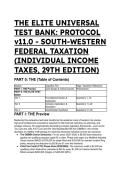
THE ELITE UNIVERSAL
TEST BANK: PROTOCOL
v11.0 - SOUTH-WESTERN
FEDERAL TAXATION
(INDIVIDUAL INCOME
TAXES, 29TH EDITION)
PART 0: THE (Table of Contents)
Section Cognitive Tier Page / Question Reference
PART I: THE Preview Core Syntax & Critical Axioms Preliminaries
PART II: THE ELITE TEST
BANK
Tier 1 Foundational Syntax & Questions 1–10
Application
Tier 2 Complex Application & Questions 11–20
Simulation
Tier 3 Grandmaster Synthesis Questions 21–30
PART I: THE Preview
Mastering this exhaustive test bank transforms the academic study of taxation into precise,
high-level professional competence required for elite financial reporting, tax planning, and
strategic advisory. By systematically dismantling complex legislative frameworks—such as the
Tax Cuts and Jobs Act (TCJA) and the One Big Beautiful Bill Act (OBBBA)—the scholar
develops an infallible methodology for resolving advanced individual income tax scenarios.
● The OBBBA Senior Deduction: For tax years 2025–2028, a $6,000 base deduction
applies per qualifying taxpayer aged 65 or older. Phase-outs begin at a Modified Adjusted
Gross Income (MAGI) of $75,000 for single filers and $150,000 for married couples filing
jointly, reducing the deduction by $0.06 per $1 over the threshold.
● Child Tax Credit (CTC) Phase-Outs (2025/2026): The maximum credit is $2,200 per
qualifying child. Reductions calculate at $50 for every $1,000 (or fraction thereof) that
MAGI exceeds $200,000 (Single) or $400,000 (MFJ).
, ● Section 199A QBI Limitations: For 2026, phase-in ranges for Specified Service Trades
or Businesses (SSTBs) occur between taxable incomes of $201,750–$276,750 (Single)
and $403,500–$553,500 (MFJ). A statutory $400 minimum deduction applies strictly if
QBI exceeds $1,000.
● Social Security Wage Base Limits: The taxable maximum limits are strictly enforced at
$176,100 for 2025 and $184,500 for 2026, applying the 6.2% OASDI tax rate exclusively
up to these thresholds.
● Standard Deduction & SALT (2025/2026): The State and Local Tax (SALT) limit is
elevated to $40,000.
Filing Status 2025 Base Standard Deduction 2026 Base Standard Deduction
Single / Married Filing $15,750 $16,100
Separately
Head of Household $23,625 $24,150
Married Filing Jointly / Surviving $31,500 $32,200
Spouse
(Source data derived from 2025
and 2026 statutory inflation
adjustments)
PART II: THE ELITE TEST BANK
Tier 1 - Foundational Syntax & Application
Q1: A single taxpayer, aged 66, prepares a 2026 federal income tax return. The taxpayer is not
blind and claims no dependents. Based on the principles of the 2026 federal standard deduction
frameworks, which base and additional standard deduction total is the MOST ACCURATE? A)
$17,750 B) $17,800 C) $18,150 D) $15,750
● The Answer: C ($18,150)
● Distractor Analysis:
○ A is incorrect: This calculation ($15,750 + $2,000) reflects the 2025 tax year
standards for a single taxpayer over 65, failing to account for the 2026 statutory
inflation adjustments.
○ B is incorrect: This synthesizes the 2026 base deduction ($16,100) but improperly
integrates an outdated or incorrect additional deduction amount.
○ D is incorrect: This represents the 2025 base standard deduction for a single filer
without incorporating the mandated additional deduction for age.
The Mentor's Analysis: Standard deductions strictly escalate through inflation indexing
annually. When facing standard deduction calculations, the immediate priority is segregating the
base tax year from the additional age or blindness modifiers. By utilizing the 2026 adjustments
($16,100 base + $2,050 additional), the practitioner bypasses the common trap of relying on
outdated legacy metrics. Professional/Academic Intuition: Always verify the specific tax
year in the scenario before applying statutory limits, as inflation indexing continuously
alters foundational thresholds.
Q2: A married couple filing jointly in 2025 reports a Modified Adjusted Gross Income (MAGI) of
$150,000. Both spouses are 67 years old. Under the One Big Beautiful Bill Act (OBBBA), which
calculation for their new senior tax deduction is the MOST ACCURATE? A) $6,000 B) $12,000
C) $3,200 D) $0
● The Answer: B ($12,000)
, ● Distractor Analysis:
○ A is incorrect: This assumes the deduction is limited per return rather than per
qualifying spouse. The OBBBA applies the $6,000 deduction per eligible individual,
generating $12,000 for a dual-qualifying couple.
○ C is incorrect: This represents the 2025 additional standard deduction for age
($1,600 x 2), which is claimed independently of the new OBBBA senior deduction.
○ D is incorrect: The taxpayers have exactly met the $150,000 phase-out threshold.
Statutory reductions do not commence until MAGI exceeds this lower bound.
The Mentor's Analysis: The OBBBA senior deduction stacks directly on top of existing
standard or itemized deductions to minimize taxable income for the elderly. When facing elderly
taxpayer scenarios, the immediate priority is assessing individual eligibility per spouse and
validating MAGI against the phase-out lower bounds. By utilizing per-spouse statutory limits, the
analyst bypasses the novice error of treating individual tax benefits as joint aggregate caps.
Professional/Academic Intuition: Statutory deductions tied to individual physiological
statuses (such as age or blindness) generally apply per qualifying person, not per tax
return.
Q3: During the 2026 tax year, an employer processes payroll for an executive earning
$250,000. Based on the statutory wage limits, what is the MOST ACCURATE maximum Social
Security tax the employer must withhold from the executive's compensation? A) $15,500.00 B)
$10,918.20 C) $11,439.00 D) $11,745.00
● The Answer: C ($11,439.00)
● Distractor Analysis:
○ A is incorrect: This erroneously applies the 6.2% tax rate to the entire $250,000
compensation, ignoring the absolute statutory wage base limit.
○ B is incorrect: This is the maximum Social Security withholding for the 2025 tax
year (6.2% of $176,100).
○ D is incorrect: This reflects a hallucinated wage base or incorrect percentage
calculation commonly found in outdated legacy payroll software testing
environments.
The Mentor's Analysis: The Old-Age, Survivors, and Disability Insurance (OASDI) program
caps taxable wages annually to prevent infinite taxation on high earners. When facing
high-income wage earners, the immediate priority is identifying the specific tax year's wage
base. By utilizing the 2026 threshold ($184,500 x 6.2%), the accountant bypasses the common
trap of taxing gross income indefinitely. Professional/Academic Intuition: Social Security
taxes possess a hard ceiling, whereas Medicare taxes apply perpetually to all earned
income.
Q4: A single taxpayer claims the Child Tax Credit (CTC) for one 10-year-old dependent in 2025.
The taxpayer has no federal income tax liability prior to the application of the credit and earned
$40,000 in wages. Which action regarding the refundable portion of the credit is the MOST
ACCURATE? A) The taxpayer receives the full $2,200 as a refund. B) The taxpayer receives
exactly $0 because the CTC is strictly nonrefundable. C) The taxpayer receives a maximum
refundable amount of $1,700. D) The taxpayer receives a maximum refundable amount of
$1,400.
● The Answer: C (The taxpayer receives a maximum refundable amount of $1,700.)
● Distractor Analysis:
○ A is incorrect: The maximum overall credit is $2,200, but refundability is capped by
statute. A taxpayer cannot receive the entire gross credit as a refund.
○ B is incorrect: The CTC is partially refundable under the designation of the
TEST BANK: PROTOCOL
v11.0 - SOUTH-WESTERN
FEDERAL TAXATION
(INDIVIDUAL INCOME
TAXES, 29TH EDITION)
PART 0: THE (Table of Contents)
Section Cognitive Tier Page / Question Reference
PART I: THE Preview Core Syntax & Critical Axioms Preliminaries
PART II: THE ELITE TEST
BANK
Tier 1 Foundational Syntax & Questions 1–10
Application
Tier 2 Complex Application & Questions 11–20
Simulation
Tier 3 Grandmaster Synthesis Questions 21–30
PART I: THE Preview
Mastering this exhaustive test bank transforms the academic study of taxation into precise,
high-level professional competence required for elite financial reporting, tax planning, and
strategic advisory. By systematically dismantling complex legislative frameworks—such as the
Tax Cuts and Jobs Act (TCJA) and the One Big Beautiful Bill Act (OBBBA)—the scholar
develops an infallible methodology for resolving advanced individual income tax scenarios.
● The OBBBA Senior Deduction: For tax years 2025–2028, a $6,000 base deduction
applies per qualifying taxpayer aged 65 or older. Phase-outs begin at a Modified Adjusted
Gross Income (MAGI) of $75,000 for single filers and $150,000 for married couples filing
jointly, reducing the deduction by $0.06 per $1 over the threshold.
● Child Tax Credit (CTC) Phase-Outs (2025/2026): The maximum credit is $2,200 per
qualifying child. Reductions calculate at $50 for every $1,000 (or fraction thereof) that
MAGI exceeds $200,000 (Single) or $400,000 (MFJ).
, ● Section 199A QBI Limitations: For 2026, phase-in ranges for Specified Service Trades
or Businesses (SSTBs) occur between taxable incomes of $201,750–$276,750 (Single)
and $403,500–$553,500 (MFJ). A statutory $400 minimum deduction applies strictly if
QBI exceeds $1,000.
● Social Security Wage Base Limits: The taxable maximum limits are strictly enforced at
$176,100 for 2025 and $184,500 for 2026, applying the 6.2% OASDI tax rate exclusively
up to these thresholds.
● Standard Deduction & SALT (2025/2026): The State and Local Tax (SALT) limit is
elevated to $40,000.
Filing Status 2025 Base Standard Deduction 2026 Base Standard Deduction
Single / Married Filing $15,750 $16,100
Separately
Head of Household $23,625 $24,150
Married Filing Jointly / Surviving $31,500 $32,200
Spouse
(Source data derived from 2025
and 2026 statutory inflation
adjustments)
PART II: THE ELITE TEST BANK
Tier 1 - Foundational Syntax & Application
Q1: A single taxpayer, aged 66, prepares a 2026 federal income tax return. The taxpayer is not
blind and claims no dependents. Based on the principles of the 2026 federal standard deduction
frameworks, which base and additional standard deduction total is the MOST ACCURATE? A)
$17,750 B) $17,800 C) $18,150 D) $15,750
● The Answer: C ($18,150)
● Distractor Analysis:
○ A is incorrect: This calculation ($15,750 + $2,000) reflects the 2025 tax year
standards for a single taxpayer over 65, failing to account for the 2026 statutory
inflation adjustments.
○ B is incorrect: This synthesizes the 2026 base deduction ($16,100) but improperly
integrates an outdated or incorrect additional deduction amount.
○ D is incorrect: This represents the 2025 base standard deduction for a single filer
without incorporating the mandated additional deduction for age.
The Mentor's Analysis: Standard deductions strictly escalate through inflation indexing
annually. When facing standard deduction calculations, the immediate priority is segregating the
base tax year from the additional age or blindness modifiers. By utilizing the 2026 adjustments
($16,100 base + $2,050 additional), the practitioner bypasses the common trap of relying on
outdated legacy metrics. Professional/Academic Intuition: Always verify the specific tax
year in the scenario before applying statutory limits, as inflation indexing continuously
alters foundational thresholds.
Q2: A married couple filing jointly in 2025 reports a Modified Adjusted Gross Income (MAGI) of
$150,000. Both spouses are 67 years old. Under the One Big Beautiful Bill Act (OBBBA), which
calculation for their new senior tax deduction is the MOST ACCURATE? A) $6,000 B) $12,000
C) $3,200 D) $0
● The Answer: B ($12,000)
, ● Distractor Analysis:
○ A is incorrect: This assumes the deduction is limited per return rather than per
qualifying spouse. The OBBBA applies the $6,000 deduction per eligible individual,
generating $12,000 for a dual-qualifying couple.
○ C is incorrect: This represents the 2025 additional standard deduction for age
($1,600 x 2), which is claimed independently of the new OBBBA senior deduction.
○ D is incorrect: The taxpayers have exactly met the $150,000 phase-out threshold.
Statutory reductions do not commence until MAGI exceeds this lower bound.
The Mentor's Analysis: The OBBBA senior deduction stacks directly on top of existing
standard or itemized deductions to minimize taxable income for the elderly. When facing elderly
taxpayer scenarios, the immediate priority is assessing individual eligibility per spouse and
validating MAGI against the phase-out lower bounds. By utilizing per-spouse statutory limits, the
analyst bypasses the novice error of treating individual tax benefits as joint aggregate caps.
Professional/Academic Intuition: Statutory deductions tied to individual physiological
statuses (such as age or blindness) generally apply per qualifying person, not per tax
return.
Q3: During the 2026 tax year, an employer processes payroll for an executive earning
$250,000. Based on the statutory wage limits, what is the MOST ACCURATE maximum Social
Security tax the employer must withhold from the executive's compensation? A) $15,500.00 B)
$10,918.20 C) $11,439.00 D) $11,745.00
● The Answer: C ($11,439.00)
● Distractor Analysis:
○ A is incorrect: This erroneously applies the 6.2% tax rate to the entire $250,000
compensation, ignoring the absolute statutory wage base limit.
○ B is incorrect: This is the maximum Social Security withholding for the 2025 tax
year (6.2% of $176,100).
○ D is incorrect: This reflects a hallucinated wage base or incorrect percentage
calculation commonly found in outdated legacy payroll software testing
environments.
The Mentor's Analysis: The Old-Age, Survivors, and Disability Insurance (OASDI) program
caps taxable wages annually to prevent infinite taxation on high earners. When facing
high-income wage earners, the immediate priority is identifying the specific tax year's wage
base. By utilizing the 2026 threshold ($184,500 x 6.2%), the accountant bypasses the common
trap of taxing gross income indefinitely. Professional/Academic Intuition: Social Security
taxes possess a hard ceiling, whereas Medicare taxes apply perpetually to all earned
income.
Q4: A single taxpayer claims the Child Tax Credit (CTC) for one 10-year-old dependent in 2025.
The taxpayer has no federal income tax liability prior to the application of the credit and earned
$40,000 in wages. Which action regarding the refundable portion of the credit is the MOST
ACCURATE? A) The taxpayer receives the full $2,200 as a refund. B) The taxpayer receives
exactly $0 because the CTC is strictly nonrefundable. C) The taxpayer receives a maximum
refundable amount of $1,700. D) The taxpayer receives a maximum refundable amount of
$1,400.
● The Answer: C (The taxpayer receives a maximum refundable amount of $1,700.)
● Distractor Analysis:
○ A is incorrect: The maximum overall credit is $2,200, but refundability is capped by
statute. A taxpayer cannot receive the entire gross credit as a refund.
○ B is incorrect: The CTC is partially refundable under the designation of the


