

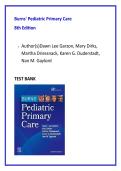
Burns' Pediatric Primary Care
8th Edition
• Author(s)Dawn Lee Garzon, Mary Dirks,
Martha Driessnack, Karen G. Duderstadt,
Nan M. Gaylord
TEST BANK
,
,Question 1
Question:
A 6-year-old child presents to a pediatric primary care clinic for a
routine health supervision visit. The child has no current illness. Which
action best represents primary care rather than primary prevention
alone?
A. Administering an age-appropriate immunization
B. Counseling the family about preventing household injuries
C. Evaluating the child's growth, development, family concerns, and
current health needs during a comprehensive visit
D. Recommending daily physical activity to reduce future cardiovascular
risk
Correct Answer: C. Evaluating the child's growth, development, family
concerns, and current health needs during a comprehensive visit
Rationale:
Primary care is broader than preventive intervention alone. It involves
ongoing, comprehensive care that includes assessment of current
health concerns, developmental surveillance, disease prevention,
health promotion, treatment, coordination, and follow-up. A routine
well-child visit integrates these functions into continuing care.
Why the Other Options Are Incorrect:
A. Immunization is an important primary prevention intervention, but
by itself it does not represent the full scope of primary care.
B. Injury-prevention counseling is a preventive service that can occur
within primary care, but it represents one component rather than the
broader primary-care process.
, C. This option correctly describes the comprehensive, longitudinal
nature of pediatric primary care.
D. Physical-activity counseling is an important preventive measure, but
it does not encompass the full responsibilities of a primary care
provider.
Question 2
Question:
A healthy 10-year-old returns annually to the same pediatric clinic. At
today's visit, the provider reviews growth trends, school functioning,
immunization status, psychosocial factors, and family concerns. Which
characteristic of pediatric primary care is most clearly demonstrated?
A. Episodic management of acute illness
B. Longitudinal, comprehensive care
C. Specialty-level disease management
D. Emergency stabilization
Correct Answer: B. Longitudinal, comprehensive care
Rationale:
Pediatric primary care emphasizes an ongoing relationship with children
and families and addresses physical, developmental, behavioral,
psychosocial, and preventive needs over time. Reviewing trends across
multiple annual visits is an example of longitudinal care.
Why the Other Options Are Incorrect:
A. Episodic care focuses on individual acute encounters rather than the
continuing relationship illustrated in the scenario.
8th Edition
• Author(s)Dawn Lee Garzon, Mary Dirks,
Martha Driessnack, Karen G. Duderstadt,
Nan M. Gaylord
TEST BANK
,
,Question 1
Question:
A 6-year-old child presents to a pediatric primary care clinic for a
routine health supervision visit. The child has no current illness. Which
action best represents primary care rather than primary prevention
alone?
A. Administering an age-appropriate immunization
B. Counseling the family about preventing household injuries
C. Evaluating the child's growth, development, family concerns, and
current health needs during a comprehensive visit
D. Recommending daily physical activity to reduce future cardiovascular
risk
Correct Answer: C. Evaluating the child's growth, development, family
concerns, and current health needs during a comprehensive visit
Rationale:
Primary care is broader than preventive intervention alone. It involves
ongoing, comprehensive care that includes assessment of current
health concerns, developmental surveillance, disease prevention,
health promotion, treatment, coordination, and follow-up. A routine
well-child visit integrates these functions into continuing care.
Why the Other Options Are Incorrect:
A. Immunization is an important primary prevention intervention, but
by itself it does not represent the full scope of primary care.
B. Injury-prevention counseling is a preventive service that can occur
within primary care, but it represents one component rather than the
broader primary-care process.
, C. This option correctly describes the comprehensive, longitudinal
nature of pediatric primary care.
D. Physical-activity counseling is an important preventive measure, but
it does not encompass the full responsibilities of a primary care
provider.
Question 2
Question:
A healthy 10-year-old returns annually to the same pediatric clinic. At
today's visit, the provider reviews growth trends, school functioning,
immunization status, psychosocial factors, and family concerns. Which
characteristic of pediatric primary care is most clearly demonstrated?
A. Episodic management of acute illness
B. Longitudinal, comprehensive care
C. Specialty-level disease management
D. Emergency stabilization
Correct Answer: B. Longitudinal, comprehensive care
Rationale:
Pediatric primary care emphasizes an ongoing relationship with children
and families and addresses physical, developmental, behavioral,
psychosocial, and preventive needs over time. Reviewing trends across
multiple annual visits is an example of longitudinal care.
Why the Other Options Are Incorrect:
A. Episodic care focuses on individual acute encounters rather than the
continuing relationship illustrated in the scenario.


