

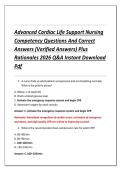
Advanced Cardiac Life Support Nursing
Competency Questions And Correct
Answers (Verified Answers) Plus
Rationales 2026 Q&A Instant Download
Pdf
1. A nurse finds an adult patient unresponsive and not breathing normally.
What is the priority action?
A. Obtain a 12-lead ECG
B. Check a blood glucose level
C. Activate the emergency response system and begin CPR
D. Administer oxygen by nasal cannula
Answer: C. Activate the emergency response system and begin CPR
Rationale: Immediate recognition of cardiac arrest, activation of emergency
assistance, and high-quality CPR are critical to improving survival.
2. What is the recommended chest-compression rate for adult CPR?
A. 60–80/min
B. 80–90/min
C. 100–120/min
D. 130–150/min
Answer: C. 100–120/min
,Rationale: Compressions at 100–120 per minute help provide adequate coronary
and cerebral perfusion while minimizing excessive rates that can reduce filling
and compression effectiveness.
3. What is the recommended adult chest-compression depth during CPR?
A. 1 cm
B. 2–3 cm
C. At least 5 cm (2 inches), while avoiding excessive depth
D. 7–8 cm
Answer: C. At least 5 cm (2 inches), while avoiding excessive depth
Rationale: Adequate depth produces effective blood flow. Excessive compression
depth can increase the risk of injury.
4. Which intervention is most important for maintaining high-quality CPR?
A. Prolonged pauses for pulse checks
B. Frequent rhythm changes
C. Minimizing interruptions in chest compressions
D. Giving large volumes of oxygen
Answer: C. Minimizing interruptions in chest compressions
Rationale: Interruptions reduce coronary and cerebral perfusion pressure and
can decrease the effectiveness of resuscitation.
5. A patient is in ventricular fibrillation. Which treatment is most important?
A. Atropine
B. Adenosine
C. Defibrillation
D. Synchronized cardioversion
Answer: C. Defibrillation
,Rationale: Ventricular fibrillation is a shockable cardiac-arrest rhythm. Early
defibrillation is essential for restoring an organized rhythm.
6. Which rhythms are considered shockable cardiac-arrest rhythms?
A. Asystole and PEA
B. Sinus bradycardia and asystole
C. Ventricular fibrillation and pulseless ventricular tachycardia
D. Atrial fibrillation and atrial flutter
Answer: C. Ventricular fibrillation and pulseless ventricular tachycardia
Rationale: VF and pulseless VT can respond to electrical defibrillation. Asystole
and PEA are treated with CPR, epinephrine, and correction of reversible causes
rather than defibrillation.
7. What is the preferred method for confirming an advanced airway
placement when available?
A. Auscultation alone
B. Chest X-ray alone
C. Continuous waveform capnography
D. Pulse oximetry alone
Answer: C. Continuous waveform capnography
Rationale: Waveform capnography provides objective evidence of tracheal
placement and can also help monitor CPR effectiveness.
8. During CPR with an advanced airway in place, how should ventilations
generally be delivered?
A. 2 breaths after every 15 compressions
B. 2 breaths after every 30 compressions
C. 1 breath every 6 seconds with continuous compressions
D. 1 breath every 15 seconds
Answer: C. 1 breath every 6 seconds with continuous compressions
, Rationale: Once an advanced airway is established, compressions are
continuous and ventilation is provided separately at approximately 10 breaths
per minute.
9. Which medication is routinely used during adult cardiac arrest?
A. Furosemide
B. Digoxin
C. Epinephrine
D. Warfarin
Answer: C. Epinephrine
Rationale: Epinephrine is used during cardiac arrest to increase peripheral
vascular resistance and improve coronary and cerebral perfusion.
10.What is the standard adult cardiac-arrest dose of epinephrine?
A. 0.1 mg IV every 10 minutes
B. 1 mg IV/IO every 3–5 minutes
C. 5 mg IV once
D. 10 mg IV every minute
Answer: B. 1 mg IV/IO every 3–5 minutes
Rationale: The standard ACLS cardiac-arrest dose is 1 mg of epinephrine
administered intravenously or intraosseously every 3–5 minutes.
11.A patient remains in ventricular fibrillation after the initial shock and CPR.
Which antiarrhythmic may be administered for refractory VF/pulseless VT?
A. Metoprolol
B. Verapamil
C. Amiodarone
D. Diltiazem
Answer: C. Amiodarone
Competency Questions And Correct
Answers (Verified Answers) Plus
Rationales 2026 Q&A Instant Download
1. A nurse finds an adult patient unresponsive and not breathing normally.
What is the priority action?
A. Obtain a 12-lead ECG
B. Check a blood glucose level
C. Activate the emergency response system and begin CPR
D. Administer oxygen by nasal cannula
Answer: C. Activate the emergency response system and begin CPR
Rationale: Immediate recognition of cardiac arrest, activation of emergency
assistance, and high-quality CPR are critical to improving survival.
2. What is the recommended chest-compression rate for adult CPR?
A. 60–80/min
B. 80–90/min
C. 100–120/min
D. 130–150/min
Answer: C. 100–120/min
,Rationale: Compressions at 100–120 per minute help provide adequate coronary
and cerebral perfusion while minimizing excessive rates that can reduce filling
and compression effectiveness.
3. What is the recommended adult chest-compression depth during CPR?
A. 1 cm
B. 2–3 cm
C. At least 5 cm (2 inches), while avoiding excessive depth
D. 7–8 cm
Answer: C. At least 5 cm (2 inches), while avoiding excessive depth
Rationale: Adequate depth produces effective blood flow. Excessive compression
depth can increase the risk of injury.
4. Which intervention is most important for maintaining high-quality CPR?
A. Prolonged pauses for pulse checks
B. Frequent rhythm changes
C. Minimizing interruptions in chest compressions
D. Giving large volumes of oxygen
Answer: C. Minimizing interruptions in chest compressions
Rationale: Interruptions reduce coronary and cerebral perfusion pressure and
can decrease the effectiveness of resuscitation.
5. A patient is in ventricular fibrillation. Which treatment is most important?
A. Atropine
B. Adenosine
C. Defibrillation
D. Synchronized cardioversion
Answer: C. Defibrillation
,Rationale: Ventricular fibrillation is a shockable cardiac-arrest rhythm. Early
defibrillation is essential for restoring an organized rhythm.
6. Which rhythms are considered shockable cardiac-arrest rhythms?
A. Asystole and PEA
B. Sinus bradycardia and asystole
C. Ventricular fibrillation and pulseless ventricular tachycardia
D. Atrial fibrillation and atrial flutter
Answer: C. Ventricular fibrillation and pulseless ventricular tachycardia
Rationale: VF and pulseless VT can respond to electrical defibrillation. Asystole
and PEA are treated with CPR, epinephrine, and correction of reversible causes
rather than defibrillation.
7. What is the preferred method for confirming an advanced airway
placement when available?
A. Auscultation alone
B. Chest X-ray alone
C. Continuous waveform capnography
D. Pulse oximetry alone
Answer: C. Continuous waveform capnography
Rationale: Waveform capnography provides objective evidence of tracheal
placement and can also help monitor CPR effectiveness.
8. During CPR with an advanced airway in place, how should ventilations
generally be delivered?
A. 2 breaths after every 15 compressions
B. 2 breaths after every 30 compressions
C. 1 breath every 6 seconds with continuous compressions
D. 1 breath every 15 seconds
Answer: C. 1 breath every 6 seconds with continuous compressions
, Rationale: Once an advanced airway is established, compressions are
continuous and ventilation is provided separately at approximately 10 breaths
per minute.
9. Which medication is routinely used during adult cardiac arrest?
A. Furosemide
B. Digoxin
C. Epinephrine
D. Warfarin
Answer: C. Epinephrine
Rationale: Epinephrine is used during cardiac arrest to increase peripheral
vascular resistance and improve coronary and cerebral perfusion.
10.What is the standard adult cardiac-arrest dose of epinephrine?
A. 0.1 mg IV every 10 minutes
B. 1 mg IV/IO every 3–5 minutes
C. 5 mg IV once
D. 10 mg IV every minute
Answer: B. 1 mg IV/IO every 3–5 minutes
Rationale: The standard ACLS cardiac-arrest dose is 1 mg of epinephrine
administered intravenously or intraosseously every 3–5 minutes.
11.A patient remains in ventricular fibrillation after the initial shock and CPR.
Which antiarrhythmic may be administered for refractory VF/pulseless VT?
A. Metoprolol
B. Verapamil
C. Amiodarone
D. Diltiazem
Answer: C. Amiodarone


