

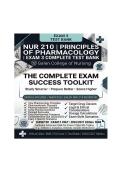
,NUR 210 Exam 3 Test Bank | Principles of
Pharmacology | Galen College of Nursing |
2026/2027 Q&A Exam Prep PDF
NUR 210 - Exam 3: Antimicrobial, Antiviral, Antifungal, and Cancer
Pharmacology
1. A patient is prescribed penicillin for a bacterial infection. Which adverse effect should the
nurse monitor for?
A) Anaphylaxis
B) Nephrotoxicity
C) Hepatotoxicity
D) Cardiotoxicity
Correct Answer: A) Anaphylaxis
Rationale: Penicillin can cause severe allergic reactions, including anaphylaxis. Patients should
be asked about penicillin allergy before administration. Anaphylaxis is a life-threatening
emergency requiring immediate epinephrine administration.
2. A patient is prescribed amoxicillin for a respiratory infection. Which instruction should the
nurse include?
A) "Take the medication with food to prevent stomach upset."
B) "Complete the full course of antibiotics as prescribed."
C) "Stop the medication when symptoms improve."
,D) "Take the medication only when symptoms occur."
Correct Answer: B) "Complete the full course of antibiotics as prescribed."
Rationale: Patients should complete the full course of antibiotics to prevent the development of
antibiotic-resistant bacteria. Stopping antibiotics early when symptoms improve can lead to
recurrence of infection and promote resistance.
3. A patient is prescribed a cephalosporin. The nurse should assess for which cross-reactivity?
A) Penicillin allergy
B) Sulfa allergy
C) Aspirin allergy
D) Iodine allergy
Correct Answer: A) Penicillin allergy
Rationale: Cephalosporins have cross-reactivity with penicillin in about 5-10% of patients.
Patients with a penicillin allergy should be monitored closely. Cross-reactivity is higher with first-
generation cephalosporins.
4. A patient is prescribed vancomycin for a MRSA infection. Which adverse effect should the
nurse monitor for?
A) Nephrotoxicity
B) Ototoxicity
, C) Both A and B
D) Neither A nor B
Correct Answer: C) Both A and B
Rationale: Vancomycin can cause nephrotoxicity and ototoxicity, particularly with high trough
levels. Trough levels should be monitored (therapeutic range 10-20 mcg/mL). Serum creatinine
should also be monitored.
5. A patient is prescribed vancomycin and develops a red rash on the face and upper torso. The
nurse should suspect:
A) Anaphylaxis
B) Red man syndrome
C) Stevens-Johnson syndrome
D) Toxic epidermal necrolysis
Correct Answer: B) Red man syndrome
Rationale: Red man syndrome is a non-allergic reaction to vancomycin characterized by flushing,
rash, and hypotension. It is caused by rapid infusion and can be prevented by slowing the
infusion rate. It is not a true allergic reaction.
6. A patient is prescribed an aminoglycoside. Which adverse effect should the nurse monitor
for?
Pharmacology | Galen College of Nursing |
2026/2027 Q&A Exam Prep PDF
NUR 210 - Exam 3: Antimicrobial, Antiviral, Antifungal, and Cancer
Pharmacology
1. A patient is prescribed penicillin for a bacterial infection. Which adverse effect should the
nurse monitor for?
A) Anaphylaxis
B) Nephrotoxicity
C) Hepatotoxicity
D) Cardiotoxicity
Correct Answer: A) Anaphylaxis
Rationale: Penicillin can cause severe allergic reactions, including anaphylaxis. Patients should
be asked about penicillin allergy before administration. Anaphylaxis is a life-threatening
emergency requiring immediate epinephrine administration.
2. A patient is prescribed amoxicillin for a respiratory infection. Which instruction should the
nurse include?
A) "Take the medication with food to prevent stomach upset."
B) "Complete the full course of antibiotics as prescribed."
C) "Stop the medication when symptoms improve."
,D) "Take the medication only when symptoms occur."
Correct Answer: B) "Complete the full course of antibiotics as prescribed."
Rationale: Patients should complete the full course of antibiotics to prevent the development of
antibiotic-resistant bacteria. Stopping antibiotics early when symptoms improve can lead to
recurrence of infection and promote resistance.
3. A patient is prescribed a cephalosporin. The nurse should assess for which cross-reactivity?
A) Penicillin allergy
B) Sulfa allergy
C) Aspirin allergy
D) Iodine allergy
Correct Answer: A) Penicillin allergy
Rationale: Cephalosporins have cross-reactivity with penicillin in about 5-10% of patients.
Patients with a penicillin allergy should be monitored closely. Cross-reactivity is higher with first-
generation cephalosporins.
4. A patient is prescribed vancomycin for a MRSA infection. Which adverse effect should the
nurse monitor for?
A) Nephrotoxicity
B) Ototoxicity
, C) Both A and B
D) Neither A nor B
Correct Answer: C) Both A and B
Rationale: Vancomycin can cause nephrotoxicity and ototoxicity, particularly with high trough
levels. Trough levels should be monitored (therapeutic range 10-20 mcg/mL). Serum creatinine
should also be monitored.
5. A patient is prescribed vancomycin and develops a red rash on the face and upper torso. The
nurse should suspect:
A) Anaphylaxis
B) Red man syndrome
C) Stevens-Johnson syndrome
D) Toxic epidermal necrolysis
Correct Answer: B) Red man syndrome
Rationale: Red man syndrome is a non-allergic reaction to vancomycin characterized by flushing,
rash, and hypotension. It is caused by rapid infusion and can be prevented by slowing the
infusion rate. It is not a true allergic reaction.
6. A patient is prescribed an aminoglycoside. Which adverse effect should the nurse monitor
for?


