

P MH N P P ROGRAM · F I N A L E X A M I N AT I O N
1 0 0 QU E S T I ON S · chamberlain
N R 5 4 6 A D VA N C E D P H A R M AC O L O G Y
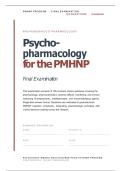
Psycho-
pharmacology
for the PMHNP
Final Examination
This examination consists of 100 multiple-choice questions covering the
pharmacology, pharmacokinetics, adverse effects, monitoring, and cl inical
reasoning of antipsychotic, antidepressant, and mood-stabilizing agents.
Single best answer format. Questions are calibrated to graduate-level
PMHNP cognitive complexity, integrating pharmacologic principles with
cl inical decision-making across the l ifespan.
E X A M I N E E I N F O R M AT I O N
NAME STU D EN T I D
D AT E SCORE
P S Y C H I AT R I C – M E N TA L H E A L T H N U R S E P R A C T I T I O N E R P R O G R A M ·
CONFIDENTIAL · DO NOT REPRODUCE
,NR546 — Advanced Pharmacology / Psychopharmacology for the PMHNP Final Examination
Final Examination — Instructions
Please read each question carefully and select the single best answer. This examination is administered as one
continuous paper; no topical sub-sections are used.
Format. 100 multiple-choice questions, each with four options (A–D). Select the single best answer.
Time. Suggested time: 150 minutes (approximately 1.5 minutes per question).
Scoring. One point per correct answer. No penalty for guessing; answer every question.
Content. The exam covers antipsychotic agents (Q1–Q35), antidepressant agents (Q36–Q70), and
mood-stabilizing agents (Q71–Q100), including pharmacology, pharmacokinetics, adverse effects,
monitoring, drug interactions, and clinical reasoning across the lifespan.
Answer key. The correct answer and a brief rationale for each question appear in the Answer Key &
Rationales section beginning after Question 100.
Level. Questions are calibrated to graduate-level PMHNP cognitive complexity and integrate pharmacologic
principles with clinical decision-making.
Examination Questions
100 multiple-choice questions. Select the single best answer for each.
Answer key at the end
1.A 24-year-old man with newly diagnosed schizophrenia is started on
haloperidol 5 mg PO BID. Three days later he presents with stiff neck, jaw
clenching, and difficulty swallowing. Vital signs are normal. Which mechanism
best explains his presentation?
A. Dopamine D2 blockade in the nigrostriatal pathway causing acute dystonia
B. Dopamine D2 blockade in the mesolimbic pathway causing akathisia
C. Histamine H1 blockade causing sedation and pseudoparkinsonism
D. Alpha-1 adrenergic blockade causing orthostatic hypotension
2. A patient on long-term haloperidol develops lip-smacking, tongue protrusion,
and choreoathetoid movements of the fingers. The PMHNP recognizes this as
tardive dyskinesia (TD). Which medication is FDA-approved to treat TD caused
by this underlying pathophysiology?
A. Propranolol 20 mg PO daily
B. Valbenazine 80 mg PO daily
C. Amantadine 100 mg PO BID
D. Diphenhydramine 25 mg PO TID
NR546 Final Exam · Advanced Pharmacology / Psychopharmacology Page 2
,NR546 — Advanced Pharmacology / Psychopharmacology for the PMHNP Final Examination
3. A 32-year-old woman with treatment-resistant schizophrenia has been on
clozapine 400 mg/day for 6 months. Her most recent ANC is 1,700/mmS.
According to FDA REMS monitoring requirements, what is the appropriate next
step?
A. Discontinue clozapine immediately and never re-challenge
B. Continue clozapine and monitor ANC weekly; do not escalate dose
C. Increase clozapine to 450 mg/day and recheck ANC in 2 weeks
NR546 Final Exam · Advanced Pharmacology / Psychopharmacology Page 3
, NR546 — Advanced Pharmacology / Psychopharmacology for the PMHNP Final Examination
D. Switch to olanzapine and recheck CBC in 1 month
4.Which finding is most specific to neuroleptic malignant syndrome (NMS) and
helps distinguish it from serotonin syndrome?
A. Hyperreflexia and clonus in the lower extremities
B. Lead-pipe rigidity with elevated creatine kinase and leukocytosis
C. Mydriasis, diaphoresis, and rapid bowel sounds
D. Tachycardia and agitation developing within hours of a dose change
5. A 28-year-old man with schizophrenia is started on risperidone 2 mg PO daily.
At his 4-week follow-up, he reports galactorrhea and decreased libido. Prolactin
level returns at 88 ng/mL (reference 4–23). What is the most appropriate
pharmacologic intervention?
A. Add bromocriptine 2.5 mg PO daily to suppress prolactin
B. Switch to aripiprazole 10 mg PO daily, which has partial agonist activity at
D2 receptors
C. Discontinue risperidone and start haloperidol 5 mg PO daily
D. Continue risperidone and recheck prolactin in 6 months
6. A patient with schizophrenia and a known QTc of 470 ms requires
antipsychotic therapy. Which agent carries the lowest QTc-prolongation risk and
would be most appropriate?
A. IV haloperidol 5 mg every 8 hours
B. Ziprasidone 80 mg PO BID
C. Lurasidone 80 mg PO daily with ≥350 kcal food
D. Thioridazine 200 mg PO daily
7.A 45-year-old with schizophrenia on olanzapine 20 mg/day has gained 15 kg
over 8 months. Fasting glucose is 132 mg/dL, LDL 145 mg/dL, triglycerides 290
mg/dL. The PMHNP plans to switch antipsychotics to reduce metabolic risk.
Which strategy is best supported by evidence?
A. Cross-titrate to aripiprazole 15 mg daily, with metabolic monitoring
B. Add metformin 1,000 mg/day and continue olanzapine at the same dose
C. Cross-titrate to clozapine, which has lower metabolic liability
D. Add orlistat 120 mg TID and continue olanzapine
8. A patient is receiving paliperidone palmitate (Invega Sustenna) 156 mg
NR546 Final Exam · Advanced Pharmacology / Psychopharmacology Page 4
1 0 0 QU E S T I ON S · chamberlain
N R 5 4 6 A D VA N C E D P H A R M AC O L O G Y
Psycho-
pharmacology
for the PMHNP
Final Examination
This examination consists of 100 multiple-choice questions covering the
pharmacology, pharmacokinetics, adverse effects, monitoring, and cl inical
reasoning of antipsychotic, antidepressant, and mood-stabilizing agents.
Single best answer format. Questions are calibrated to graduate-level
PMHNP cognitive complexity, integrating pharmacologic principles with
cl inical decision-making across the l ifespan.
E X A M I N E E I N F O R M AT I O N
NAME STU D EN T I D
D AT E SCORE
P S Y C H I AT R I C – M E N TA L H E A L T H N U R S E P R A C T I T I O N E R P R O G R A M ·
CONFIDENTIAL · DO NOT REPRODUCE
,NR546 — Advanced Pharmacology / Psychopharmacology for the PMHNP Final Examination
Final Examination — Instructions
Please read each question carefully and select the single best answer. This examination is administered as one
continuous paper; no topical sub-sections are used.
Format. 100 multiple-choice questions, each with four options (A–D). Select the single best answer.
Time. Suggested time: 150 minutes (approximately 1.5 minutes per question).
Scoring. One point per correct answer. No penalty for guessing; answer every question.
Content. The exam covers antipsychotic agents (Q1–Q35), antidepressant agents (Q36–Q70), and
mood-stabilizing agents (Q71–Q100), including pharmacology, pharmacokinetics, adverse effects,
monitoring, drug interactions, and clinical reasoning across the lifespan.
Answer key. The correct answer and a brief rationale for each question appear in the Answer Key &
Rationales section beginning after Question 100.
Level. Questions are calibrated to graduate-level PMHNP cognitive complexity and integrate pharmacologic
principles with clinical decision-making.
Examination Questions
100 multiple-choice questions. Select the single best answer for each.
Answer key at the end
1.A 24-year-old man with newly diagnosed schizophrenia is started on
haloperidol 5 mg PO BID. Three days later he presents with stiff neck, jaw
clenching, and difficulty swallowing. Vital signs are normal. Which mechanism
best explains his presentation?
A. Dopamine D2 blockade in the nigrostriatal pathway causing acute dystonia
B. Dopamine D2 blockade in the mesolimbic pathway causing akathisia
C. Histamine H1 blockade causing sedation and pseudoparkinsonism
D. Alpha-1 adrenergic blockade causing orthostatic hypotension
2. A patient on long-term haloperidol develops lip-smacking, tongue protrusion,
and choreoathetoid movements of the fingers. The PMHNP recognizes this as
tardive dyskinesia (TD). Which medication is FDA-approved to treat TD caused
by this underlying pathophysiology?
A. Propranolol 20 mg PO daily
B. Valbenazine 80 mg PO daily
C. Amantadine 100 mg PO BID
D. Diphenhydramine 25 mg PO TID
NR546 Final Exam · Advanced Pharmacology / Psychopharmacology Page 2
,NR546 — Advanced Pharmacology / Psychopharmacology for the PMHNP Final Examination
3. A 32-year-old woman with treatment-resistant schizophrenia has been on
clozapine 400 mg/day for 6 months. Her most recent ANC is 1,700/mmS.
According to FDA REMS monitoring requirements, what is the appropriate next
step?
A. Discontinue clozapine immediately and never re-challenge
B. Continue clozapine and monitor ANC weekly; do not escalate dose
C. Increase clozapine to 450 mg/day and recheck ANC in 2 weeks
NR546 Final Exam · Advanced Pharmacology / Psychopharmacology Page 3
, NR546 — Advanced Pharmacology / Psychopharmacology for the PMHNP Final Examination
D. Switch to olanzapine and recheck CBC in 1 month
4.Which finding is most specific to neuroleptic malignant syndrome (NMS) and
helps distinguish it from serotonin syndrome?
A. Hyperreflexia and clonus in the lower extremities
B. Lead-pipe rigidity with elevated creatine kinase and leukocytosis
C. Mydriasis, diaphoresis, and rapid bowel sounds
D. Tachycardia and agitation developing within hours of a dose change
5. A 28-year-old man with schizophrenia is started on risperidone 2 mg PO daily.
At his 4-week follow-up, he reports galactorrhea and decreased libido. Prolactin
level returns at 88 ng/mL (reference 4–23). What is the most appropriate
pharmacologic intervention?
A. Add bromocriptine 2.5 mg PO daily to suppress prolactin
B. Switch to aripiprazole 10 mg PO daily, which has partial agonist activity at
D2 receptors
C. Discontinue risperidone and start haloperidol 5 mg PO daily
D. Continue risperidone and recheck prolactin in 6 months
6. A patient with schizophrenia and a known QTc of 470 ms requires
antipsychotic therapy. Which agent carries the lowest QTc-prolongation risk and
would be most appropriate?
A. IV haloperidol 5 mg every 8 hours
B. Ziprasidone 80 mg PO BID
C. Lurasidone 80 mg PO daily with ≥350 kcal food
D. Thioridazine 200 mg PO daily
7.A 45-year-old with schizophrenia on olanzapine 20 mg/day has gained 15 kg
over 8 months. Fasting glucose is 132 mg/dL, LDL 145 mg/dL, triglycerides 290
mg/dL. The PMHNP plans to switch antipsychotics to reduce metabolic risk.
Which strategy is best supported by evidence?
A. Cross-titrate to aripiprazole 15 mg daily, with metabolic monitoring
B. Add metformin 1,000 mg/day and continue olanzapine at the same dose
C. Cross-titrate to clozapine, which has lower metabolic liability
D. Add orlistat 120 mg TID and continue olanzapine
8. A patient is receiving paliperidone palmitate (Invega Sustenna) 156 mg
NR546 Final Exam · Advanced Pharmacology / Psychopharmacology Page 4


