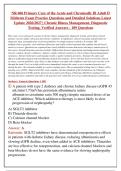
NR 606 Primary Care of the Acute and Chronically Ill Adult II
Midterm Exam Practice Questions and Detailed Solutions Latest
Update 2026/2027 | Chronic Illness Management, Diagnostic
Testing, Verified Answers - 189 Questions
This exam covers advanced concepts in chronic illness management, diagnostic testing, and evidence-based
primary care for adults with acute and chronic conditions. It emphasizes clinical reasoning, interpretation of
diagnostic data, and application of current guidelines in complex patient scenarios. It contains 189
multiple-choice questions, each with four distractors and a fully worked rationale that explains why the keyed
answer is correct. Questions are organized into clearly labelled sections that mirror the major content areas of
the course. Targeted learning outcomes include: Differentiate between appropriate and inappropriate diagnostic
tests for common chronic conditions.; Analyze complex clinical scenarios to select evidence-based management
strategies.; Interpret laboratory and imaging results to guide treatment decisions.; Evaluate the safety and
efficacy of pharmacological and non-pharmacological interventions.. Every item has been reviewed for clinical
accuracy, current guidelines, and clarity so that students can study with confidence and self-correct as they work
through the bank. Use it as a high-yield review immediately before the exam, or as a structured practice tool
during the unit - the rationales double as concise teaching notes. The recommended writing time is 3 hours, with a
passing score of 80%. Aligned with This exam complies with the standards of the Commission on Collegiate
Nursing Education (CCNE) and the American Association of Colleges of Nursing (AACN) for graduate-level
nursing education. standards and reflects the question style commonly seen on accredited program examinations.
Section 1: General (Questions 1-189)
1 A patient with type 2 diabetes and chronic kidney disease (eGFR 45
mL/min/1.73m²) has persistent albuminuria (urine
albumin-to-creatinine ratio 300 mg/g) despite maximal doses of an
ACE inhibitor. Which addition to therapy is most likely to slow
progression of nephropathy?
A) SGLT2 inhibitor
B) Thiazide diuretic
C) Calcium channel blocker
D) Beta-blocker
Answer: A
Rationale: SGLT2 inhibitors have demonstrated renoprotective effects
in patients with diabetic kidney disease, reducing albuminuria and
slowing eGFR decline, even when added to ACE inhibitors. Thiazides
are less effective for renoprotection, and calcium channel blockers and
beta-blockers do not have the same evidence for slowing nephropathy
progression.
, 2 Which of the following best explains the rationale for using a
fixed-dose combination pill (polypill) in secondary prevention of
cardiovascular disease?
A) It reduces pill burden and improves adherence, leading to better
risk factor control.
B) It eliminates the need for lifestyle modifications.
C) It is more effective than individual drugs in lowering LDL
cholesterol.
D) It reduces the risk of drug-drug interactions.
Answer: A
Rationale: Fixed-dose combinations improve medication adherence by
reducing pill burden, which is a major barrier in chronic disease
management. Improved adherence leads to better control of blood
pressure and cholesterol, and consequently lower cardiovascular
events. The polypill does not eliminate lifestyle changes, is not
inherently more effective per drug, and does not necessarily reduce
drug interactions.
3 A patient with COPD (FEV1 45% predicted) reports increasing
dyspnea and frequent exacerbations despite regular use of a
long-acting muscarinic antagonist (LAMA). According to GOLD
guidelines, what is the next recommended step in management?
A) Add an inhaled corticosteroid (ICS) to the LAMA
B) Switch to a long-acting beta-agonist (LABA) monotherapy
C) Add a phosphodiesterase-4 inhibitor
D) Initiate chronic oral corticosteroids
Answer: A
Rationale: In patients with persistent exacerbations despite LAMA
monotherapy, GOLD recommends escalating to a LAMA + ICS
combination, as this reduces exacerbations and improves lung
function. LABA monotherapy is not preferred as an escalation,
phosphodiesterase-4 inhibitors are for specific phenotypes, and
,chronic oral corticosteroids are not recommended due to adverse
effects.
4 A patient with heart failure with reduced ejection fraction (HFrEF,
EF 30%) is on optimal medical therapy including an ACE inhibitor,
beta-blocker, and mineralocorticoid receptor antagonist. Which
laboratory finding would most warrant reconsideration of the
mineralocorticoid receptor antagonist?
A) Serum potassium 5.2 mmol/L
B) Serum creatinine 1.3 mg/dL
C) Hemoglobin 10 g/dL
D) BNP 800 pg/mL
Answer: A
Rationale: Mineralocorticoid receptor antagonists (MRAs) can cause
hyperkalemia, especially in patients with renal impairment. A
potassium of 5.2 mmol/L is above the upper limit of normal and
requires careful evaluation; if >5.5, the MRA should be stopped. Mild
creatinine elevation may be acceptable, anemia is not a
contraindication, and elevated BNP indicates heart failure severity, not
a contraindication to MRA.
5 Which of the following is the most appropriate initial diagnostic test
for a patient presenting with acute-onset atrial fibrillation and
hemodynamic instability?
A) 12-lead ECG
B) Transthoracic echocardiogram
C) Serum troponin
D) Transesophageal echocardiogram
Answer: A
Rationale: A 12-lead ECG should be obtained immediately to confirm
the rhythm and guide emergency management, including
cardioversion. While echocardiography and troponin may be useful in
the workup, they are not the initial test for a hemodynamically
, unstable patient. TEE is used to rule out atrial thrombus before
cardioversion in stable patients.
6 A patient with chronic kidney disease (eGFR 30 mL/min/1.73m²)
and anemia (Hb 9 g/dL) is being evaluated for
erythropoiesis-stimulating agent (ESA) therapy. Which iron study
result would indicate the need for iron supplementation before
starting ESA?
A) Ferritin 100 ng/mL, transferrin saturation 15%
B) Ferritin 500 ng/mL, transferrin saturation 30%
C) Ferritin 200 ng/mL, transferrin saturation 25%
D) Ferritin 50 ng/mL, transferrin saturation 10%
Answer: D
Rationale: In CKD anemia, iron deficiency is defined as ferritin <100
ng/mL and transferrin saturation <20%. Option D shows absolute iron
deficiency, which requires iron supplementation before ESA therapy
to ensure an adequate response. Options A and C have suboptimal
TSAT but ferritin >100, and B indicates adequate iron stores.
7 A patient with cirrhosis (MELD score 18) presents with tense
ascites. Which initial therapeutic approach is most appropriate?
A) Large-volume paracentesis with albumin infusion
B) Transjugular intrahepatic portosystemic shunt (TIPS)
C) Liver transplantation evaluation
D) Peritoneovenous shunt placement
Answer: A
Rationale: For tense ascites, large-volume paracentesis with albumin
infusion is the first-line treatment to relieve symptoms and prevent
post-paracentesis circulatory dysfunction. TIPS and peritoneovenous
shunts are reserved for refractory ascites, and liver transplantation is
considered after optimizing medical management.
Midterm Exam Practice Questions and Detailed Solutions Latest
Update 2026/2027 | Chronic Illness Management, Diagnostic
Testing, Verified Answers - 189 Questions
This exam covers advanced concepts in chronic illness management, diagnostic testing, and evidence-based
primary care for adults with acute and chronic conditions. It emphasizes clinical reasoning, interpretation of
diagnostic data, and application of current guidelines in complex patient scenarios. It contains 189
multiple-choice questions, each with four distractors and a fully worked rationale that explains why the keyed
answer is correct. Questions are organized into clearly labelled sections that mirror the major content areas of
the course. Targeted learning outcomes include: Differentiate between appropriate and inappropriate diagnostic
tests for common chronic conditions.; Analyze complex clinical scenarios to select evidence-based management
strategies.; Interpret laboratory and imaging results to guide treatment decisions.; Evaluate the safety and
efficacy of pharmacological and non-pharmacological interventions.. Every item has been reviewed for clinical
accuracy, current guidelines, and clarity so that students can study with confidence and self-correct as they work
through the bank. Use it as a high-yield review immediately before the exam, or as a structured practice tool
during the unit - the rationales double as concise teaching notes. The recommended writing time is 3 hours, with a
passing score of 80%. Aligned with This exam complies with the standards of the Commission on Collegiate
Nursing Education (CCNE) and the American Association of Colleges of Nursing (AACN) for graduate-level
nursing education. standards and reflects the question style commonly seen on accredited program examinations.
Section 1: General (Questions 1-189)
1 A patient with type 2 diabetes and chronic kidney disease (eGFR 45
mL/min/1.73m²) has persistent albuminuria (urine
albumin-to-creatinine ratio 300 mg/g) despite maximal doses of an
ACE inhibitor. Which addition to therapy is most likely to slow
progression of nephropathy?
A) SGLT2 inhibitor
B) Thiazide diuretic
C) Calcium channel blocker
D) Beta-blocker
Answer: A
Rationale: SGLT2 inhibitors have demonstrated renoprotective effects
in patients with diabetic kidney disease, reducing albuminuria and
slowing eGFR decline, even when added to ACE inhibitors. Thiazides
are less effective for renoprotection, and calcium channel blockers and
beta-blockers do not have the same evidence for slowing nephropathy
progression.
, 2 Which of the following best explains the rationale for using a
fixed-dose combination pill (polypill) in secondary prevention of
cardiovascular disease?
A) It reduces pill burden and improves adherence, leading to better
risk factor control.
B) It eliminates the need for lifestyle modifications.
C) It is more effective than individual drugs in lowering LDL
cholesterol.
D) It reduces the risk of drug-drug interactions.
Answer: A
Rationale: Fixed-dose combinations improve medication adherence by
reducing pill burden, which is a major barrier in chronic disease
management. Improved adherence leads to better control of blood
pressure and cholesterol, and consequently lower cardiovascular
events. The polypill does not eliminate lifestyle changes, is not
inherently more effective per drug, and does not necessarily reduce
drug interactions.
3 A patient with COPD (FEV1 45% predicted) reports increasing
dyspnea and frequent exacerbations despite regular use of a
long-acting muscarinic antagonist (LAMA). According to GOLD
guidelines, what is the next recommended step in management?
A) Add an inhaled corticosteroid (ICS) to the LAMA
B) Switch to a long-acting beta-agonist (LABA) monotherapy
C) Add a phosphodiesterase-4 inhibitor
D) Initiate chronic oral corticosteroids
Answer: A
Rationale: In patients with persistent exacerbations despite LAMA
monotherapy, GOLD recommends escalating to a LAMA + ICS
combination, as this reduces exacerbations and improves lung
function. LABA monotherapy is not preferred as an escalation,
phosphodiesterase-4 inhibitors are for specific phenotypes, and
,chronic oral corticosteroids are not recommended due to adverse
effects.
4 A patient with heart failure with reduced ejection fraction (HFrEF,
EF 30%) is on optimal medical therapy including an ACE inhibitor,
beta-blocker, and mineralocorticoid receptor antagonist. Which
laboratory finding would most warrant reconsideration of the
mineralocorticoid receptor antagonist?
A) Serum potassium 5.2 mmol/L
B) Serum creatinine 1.3 mg/dL
C) Hemoglobin 10 g/dL
D) BNP 800 pg/mL
Answer: A
Rationale: Mineralocorticoid receptor antagonists (MRAs) can cause
hyperkalemia, especially in patients with renal impairment. A
potassium of 5.2 mmol/L is above the upper limit of normal and
requires careful evaluation; if >5.5, the MRA should be stopped. Mild
creatinine elevation may be acceptable, anemia is not a
contraindication, and elevated BNP indicates heart failure severity, not
a contraindication to MRA.
5 Which of the following is the most appropriate initial diagnostic test
for a patient presenting with acute-onset atrial fibrillation and
hemodynamic instability?
A) 12-lead ECG
B) Transthoracic echocardiogram
C) Serum troponin
D) Transesophageal echocardiogram
Answer: A
Rationale: A 12-lead ECG should be obtained immediately to confirm
the rhythm and guide emergency management, including
cardioversion. While echocardiography and troponin may be useful in
the workup, they are not the initial test for a hemodynamically
, unstable patient. TEE is used to rule out atrial thrombus before
cardioversion in stable patients.
6 A patient with chronic kidney disease (eGFR 30 mL/min/1.73m²)
and anemia (Hb 9 g/dL) is being evaluated for
erythropoiesis-stimulating agent (ESA) therapy. Which iron study
result would indicate the need for iron supplementation before
starting ESA?
A) Ferritin 100 ng/mL, transferrin saturation 15%
B) Ferritin 500 ng/mL, transferrin saturation 30%
C) Ferritin 200 ng/mL, transferrin saturation 25%
D) Ferritin 50 ng/mL, transferrin saturation 10%
Answer: D
Rationale: In CKD anemia, iron deficiency is defined as ferritin <100
ng/mL and transferrin saturation <20%. Option D shows absolute iron
deficiency, which requires iron supplementation before ESA therapy
to ensure an adequate response. Options A and C have suboptimal
TSAT but ferritin >100, and B indicates adequate iron stores.
7 A patient with cirrhosis (MELD score 18) presents with tense
ascites. Which initial therapeutic approach is most appropriate?
A) Large-volume paracentesis with albumin infusion
B) Transjugular intrahepatic portosystemic shunt (TIPS)
C) Liver transplantation evaluation
D) Peritoneovenous shunt placement
Answer: A
Rationale: For tense ascites, large-volume paracentesis with albumin
infusion is the first-line treatment to relieve symptoms and prevent
post-paracentesis circulatory dysfunction. TIPS and peritoneovenous
shunts are reserved for refractory ascites, and liver transplantation is
considered after optimizing medical management.