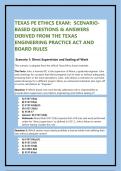
TEXAS PE ETHICS EXAM: SCENARIO-
BASED QUESTIONS & ANSWERS
DERIVED FROM THE TEXAS
ENGINEERING PRACTICE ACT AND
BOARD RULES
Scenario 1: Direct Supervision and Sealing of Work
This scenario is adapted from the official Texas Ethics Exam materials .
The Facts: John, a licensed PE, is the supervisor of Maria, a graduate engineer. John
seals drawings for a project that Maria prepared, but he does so without adequately
reviewing them or the load calculations. Later, John allows a contractor to use these
sealed drawings for a different project. Maria, an unlicensed individual, also signs off
on some calculations as "Engineer."
Question 1: Which board rule most directly addresses John's responsibility to
provide direct supervision over Maria's engineering work before sealing it?
• A) §137.55(a)
• B) §137.59(a)
• C) §137.63(b)(2)
• D) §137.33(b)
• E) §139.17
• Answer: D) §137.33(b)
• Rationale: Board Rule §137.33(b) requires that a PE only seal work performed
under his "direct supervision" as defined in §131.2. John's failure to review
before sealing violates this rule .
Question 2: Which section most clearly prohibits a license holder from affixing their
seal without adequate review?
• A) §137.63(c)(1)
• B) §137.33(f)
• C) §137.55(b)
• D) §1001.004
• E) §137.65(a)
, • Answer: B) §137.33(f)
• Rationale: §137.33(f) requires that the seal and signature be placed on the
"final version" of the work. Sealing without adequate review means it is not a
final version for which the engineer can take professional responsibility .
Question 3: By allowing a contractor to use sealed drawings prepared for a different
project, John may have violated which provision?
• A) §137.63(a)
• B) §137.33(i)
• C) §137.59(a)
• D) §137.65(b)
• E) §139.13
• Answer: B) §137.33(i)
• Rationale: §137.33(i) prohibits the misuse of engineering documents,
including using them outside the scope for which they were prepared without
proper authorization .
Question 4: If Maria, an unlicensed graduate engineer, signs off on calculations as
"Engineer," which part of the Act is most directly violated?
• A) §1001.301
• B) §137.59(a)
• C) §137.63(c)(1)
• D) §137.65(a)
• E) §139.17
• Answer: A) §1001.301
• Rationale: Texas Occupations Code §1001.301 prohibits the practice of
engineering without a license. Signing off as "Engineer" constitutes
unauthorized practice .
🤝 Scenario 2: Conflicts of Interest and Gifts
This scenario explores the rules surrounding gifts and impartiality.
The Facts: Rachelle, a licensed engineer and corporate officer, receives a Request for
Proposal (RFP) from a county official for a hydrology study. She reminds the official
that competitive bidding for engineering services in the public sector is prohibited.
Later, her firm prepares a Statement of Qualifications (SOQ) and considers
embellishing their local capabilities. David, a PE, is on a selection committee and is
offered tickets to a sporting event by a bidder .
,Question 5: Under Board Rule §137.57(a), accepting gifts or favors from bidders is:
• A) Permissible if disclosed to the employer.
• B) Strictly prohibited as it may influence professional judgment.
• C) Allowed if the value is under $50.
• D) Permissible if the PE abstains from voting on that bidder.
• Answer: B) Strictly prohibited as it may influence professional judgment.
• Rationale: The prohibition on accepting gifts from bidders is absolute to
prevent any conflict of interest or appearance of impropriety, as per
§137.57(a) .
Question 6: If David's supervisor allows him to keep the tickets, what must David do
to remain fully compliant?
• A) Abstain from decision-making related to the bidder.
• B) Return the tickets and decline.
• C) Document the acceptance and supervisor's approval.
• D) Request the bidder withdraw their bid.
• E) None; accepting tickets is strictly prohibited regardless of disclosure.
• Answer: E) None; accepting tickets is strictly prohibited regardless of
disclosure.
• Rationale: The prohibition under §137.57(a) is absolute; it cannot be
overridden by a supervisor's permission or an employer's policy .
Question 7: Which board rule gives guidance to engineers on the matter of
"inducements" in securing work?
• A) §137.57(b)
• B) §137.57(c)
• C) §137.57(d)
• D) §137.63(c)(4)
• E) §137.63(c)(5)
• Answer: C) §137.57(d)
• Rationale: §137.57(d) provides guidance on conflicts of interest and prohibits
using inducements to secure engineering work .
Question 8: Which Section of the Act or board rule most clearly directs Rachelle and
her firm regarding representations in the SOQ?
• A) §1001.203
• B) §1001.402
• C) §1001.407
• D) §137.57(a)
• E) §137.53(a)
• Answer: D) §137.57(a)
, • Rationale: This rule requires engineers to be objective and truthful in their
professional statements, which applies to representations in an SOQ .
🧭 Scenario 3: Foundational Concepts and Competence
These questions focus on core principles and the scope of practice.
The Facts: Ahmed is a licensed PE with expertise in transportation engineering. He is
asked to design a high-rise building, a field outside his competence. He considers
taking the project and relying on software he is unfamiliar with .
Question 9: Which rule requires engineers to practice only in their areas of
competence?
• A) §137.59(a)
• B) §137.57(b)
• C) §137.63(a)
• D) §1001.004
• E) §137.65(a)
• Answer: A) §137.59(a)
• Rationale: Board Rule §137.59(a) requires that engineers perform services
only in areas where they are competent by education or experience .
Question 10: If Ahmed takes the project anyway and relies on computer software
without understanding its limitations, what rule is violated?
• A) §137.59(b) – Not performing assignments for which not qualified.
• B) §137.57(a) – Gifts.
• C) §137.63(c)(1) – Professional conduct.
• D) §1001.301 – License.
• E) §137.33(b) – Supervision.
• Answer: A) §137.59(b)
• Rationale: §137.59(b) prohibits accepting assignments beyond one's
competence without obtaining proper expertise .
Question 11: What is the primary purpose of the Texas Engineering Practice Act?
• A) To benefit the engineering profession.
• B) To protect the public from the unauthorized and unqualified practice
of engineering.
• C) To establish fees for engineering licenses.
• D) To promote the engineering profession.
BASED QUESTIONS & ANSWERS
DERIVED FROM THE TEXAS
ENGINEERING PRACTICE ACT AND
BOARD RULES
Scenario 1: Direct Supervision and Sealing of Work
This scenario is adapted from the official Texas Ethics Exam materials .
The Facts: John, a licensed PE, is the supervisor of Maria, a graduate engineer. John
seals drawings for a project that Maria prepared, but he does so without adequately
reviewing them or the load calculations. Later, John allows a contractor to use these
sealed drawings for a different project. Maria, an unlicensed individual, also signs off
on some calculations as "Engineer."
Question 1: Which board rule most directly addresses John's responsibility to
provide direct supervision over Maria's engineering work before sealing it?
• A) §137.55(a)
• B) §137.59(a)
• C) §137.63(b)(2)
• D) §137.33(b)
• E) §139.17
• Answer: D) §137.33(b)
• Rationale: Board Rule §137.33(b) requires that a PE only seal work performed
under his "direct supervision" as defined in §131.2. John's failure to review
before sealing violates this rule .
Question 2: Which section most clearly prohibits a license holder from affixing their
seal without adequate review?
• A) §137.63(c)(1)
• B) §137.33(f)
• C) §137.55(b)
• D) §1001.004
• E) §137.65(a)
, • Answer: B) §137.33(f)
• Rationale: §137.33(f) requires that the seal and signature be placed on the
"final version" of the work. Sealing without adequate review means it is not a
final version for which the engineer can take professional responsibility .
Question 3: By allowing a contractor to use sealed drawings prepared for a different
project, John may have violated which provision?
• A) §137.63(a)
• B) §137.33(i)
• C) §137.59(a)
• D) §137.65(b)
• E) §139.13
• Answer: B) §137.33(i)
• Rationale: §137.33(i) prohibits the misuse of engineering documents,
including using them outside the scope for which they were prepared without
proper authorization .
Question 4: If Maria, an unlicensed graduate engineer, signs off on calculations as
"Engineer," which part of the Act is most directly violated?
• A) §1001.301
• B) §137.59(a)
• C) §137.63(c)(1)
• D) §137.65(a)
• E) §139.17
• Answer: A) §1001.301
• Rationale: Texas Occupations Code §1001.301 prohibits the practice of
engineering without a license. Signing off as "Engineer" constitutes
unauthorized practice .
🤝 Scenario 2: Conflicts of Interest and Gifts
This scenario explores the rules surrounding gifts and impartiality.
The Facts: Rachelle, a licensed engineer and corporate officer, receives a Request for
Proposal (RFP) from a county official for a hydrology study. She reminds the official
that competitive bidding for engineering services in the public sector is prohibited.
Later, her firm prepares a Statement of Qualifications (SOQ) and considers
embellishing their local capabilities. David, a PE, is on a selection committee and is
offered tickets to a sporting event by a bidder .
,Question 5: Under Board Rule §137.57(a), accepting gifts or favors from bidders is:
• A) Permissible if disclosed to the employer.
• B) Strictly prohibited as it may influence professional judgment.
• C) Allowed if the value is under $50.
• D) Permissible if the PE abstains from voting on that bidder.
• Answer: B) Strictly prohibited as it may influence professional judgment.
• Rationale: The prohibition on accepting gifts from bidders is absolute to
prevent any conflict of interest or appearance of impropriety, as per
§137.57(a) .
Question 6: If David's supervisor allows him to keep the tickets, what must David do
to remain fully compliant?
• A) Abstain from decision-making related to the bidder.
• B) Return the tickets and decline.
• C) Document the acceptance and supervisor's approval.
• D) Request the bidder withdraw their bid.
• E) None; accepting tickets is strictly prohibited regardless of disclosure.
• Answer: E) None; accepting tickets is strictly prohibited regardless of
disclosure.
• Rationale: The prohibition under §137.57(a) is absolute; it cannot be
overridden by a supervisor's permission or an employer's policy .
Question 7: Which board rule gives guidance to engineers on the matter of
"inducements" in securing work?
• A) §137.57(b)
• B) §137.57(c)
• C) §137.57(d)
• D) §137.63(c)(4)
• E) §137.63(c)(5)
• Answer: C) §137.57(d)
• Rationale: §137.57(d) provides guidance on conflicts of interest and prohibits
using inducements to secure engineering work .
Question 8: Which Section of the Act or board rule most clearly directs Rachelle and
her firm regarding representations in the SOQ?
• A) §1001.203
• B) §1001.402
• C) §1001.407
• D) §137.57(a)
• E) §137.53(a)
• Answer: D) §137.57(a)
, • Rationale: This rule requires engineers to be objective and truthful in their
professional statements, which applies to representations in an SOQ .
🧭 Scenario 3: Foundational Concepts and Competence
These questions focus on core principles and the scope of practice.
The Facts: Ahmed is a licensed PE with expertise in transportation engineering. He is
asked to design a high-rise building, a field outside his competence. He considers
taking the project and relying on software he is unfamiliar with .
Question 9: Which rule requires engineers to practice only in their areas of
competence?
• A) §137.59(a)
• B) §137.57(b)
• C) §137.63(a)
• D) §1001.004
• E) §137.65(a)
• Answer: A) §137.59(a)
• Rationale: Board Rule §137.59(a) requires that engineers perform services
only in areas where they are competent by education or experience .
Question 10: If Ahmed takes the project anyway and relies on computer software
without understanding its limitations, what rule is violated?
• A) §137.59(b) – Not performing assignments for which not qualified.
• B) §137.57(a) – Gifts.
• C) §137.63(c)(1) – Professional conduct.
• D) §1001.301 – License.
• E) §137.33(b) – Supervision.
• Answer: A) §137.59(b)
• Rationale: §137.59(b) prohibits accepting assignments beyond one's
competence without obtaining proper expertise .
Question 11: What is the primary purpose of the Texas Engineering Practice Act?
• A) To benefit the engineering profession.
• B) To protect the public from the unauthorized and unqualified practice
of engineering.
• C) To establish fees for engineering licenses.
• D) To promote the engineering profession.