
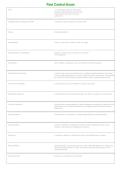
Pest Control Exam
Pest an undesirable organism that injures
humans, desirable plants and animals,
manufactured products, or natural
substances
Integrated pest management (IPM) a balanced, tactical approach to pest control
Weeds Undesirable plants
Invertebrates Insects, mites, ticks, spiders, snails, and slugs
Disease agents or pathogens bacteria, viruses, fungi, roundworms, and other
microorganisms
Vertebrates birds, reptiles, amphibians, fish, and rodents and other mammals
Restricted Use Pesticide a product that can be purchased only by certified pesticide applicators and used
only by certified applicators or persons under their direct supervision. Not available
for use by the public because of high toxicities and/or environmental hazards
General Use Pesticide a product that can be purchased and used by the public
Mandatory Statement Label directions that a pesticide handler must follow to legally use the pesticide.
Advisory Statement Manufacturer recommendations or best management practices for optimal use of a
pesticide product. Pesticide handlers are not legally required to follow advisory
statements.
Active Ingredient The chemical or chemicals in a product responsible for pesticidal activity.
Inert Ingredient Inactive materials in a pesticide formulation without pesticidal activity. Some,
however, may be toxic or hazardous to humans.
Adjuvants a substance added to a pesticide to improve its effectiveness or safety.
Allergic Effects Hypersensitivity to a specific substance, often called the allergen. An allergy may
cause dermatitis, blisters, or hives. It could also cause illness, asthma, or life-
threatening shock.
Acute Exposure Exposure to a single dose of pesticide
, Pest Control Exam
Delayed Effects Illnesses or injuries that do not appear immediately (within 24 hours) after exposure
to a pesticide. The effects may be delayed for weeks, months, or even years.
Fit Test (QUALITATIVE) A method to assess whether a particular size and brand of respirator adequately fits
an individual's face
using a test agent. If the person can detect inside the mask an agent that is outside
the mask, there is leakage at the seal and the mask does not fit properly.
Acute Effects Illnesses or injuries that occur shortly (within 24 hours) after exposure to a pesticide
Pesticide Allergy Symptoms Similar to other allergy symptoms—reddening and
itching of the eyes, respiratory discomfort, and asthma-like symptoms
Acute Toxicity An injury or illness produced from a single pesticide exposure. LD50 and LC50 are
common indicators of the degree of acute toxicity.
Biological Control Pest management using predators, parasites, and disease-causing organisms. It
may be naturally occurring or introduced.
Chronic Toxicity The ability of small amounts of pesticide from repeated, prolonged exposure to
cause injury.
Contact Effects or Local Effects Injury at the point of contact, including skin discoloration and irritation (dermatitis),
such as itching, redness, rashes, blisters, and burns. Swelling; stinging; and burning
of the eyes, nose, mouth, or throat are all contact effects.
Dermal Toxicity The ability of a pesticide to injure a human or animal when absorbed through the
skin.
Directed Application A pesticide precisely applied to a specific area or site. Examples include a basal
application to woody plants or a crack-and-crevice treatment in a building.
Fit Test (QUANTITATIVE) A method to assess whether a particular size and brand of respirator adequately fits
an individual's face
using instrumentation to numerically measure leakage into the respirator.
Band Application A pesticide or other material applied in or beside a crop row instead of over the
entire field.
Basal Application An herbicide applied to plant stems or trunks at or just above the ground line.
Broadcast Application A pesticide or other material uniformly applied over an entire field or area.
Crack and Crevice Application Small amounts of pesticide placed into cracks and crevices in buildings (such as
along baseboards and in
cabinets).
Pest an undesirable organism that injures
humans, desirable plants and animals,
manufactured products, or natural
substances
Integrated pest management (IPM) a balanced, tactical approach to pest control
Weeds Undesirable plants
Invertebrates Insects, mites, ticks, spiders, snails, and slugs
Disease agents or pathogens bacteria, viruses, fungi, roundworms, and other
microorganisms
Vertebrates birds, reptiles, amphibians, fish, and rodents and other mammals
Restricted Use Pesticide a product that can be purchased only by certified pesticide applicators and used
only by certified applicators or persons under their direct supervision. Not available
for use by the public because of high toxicities and/or environmental hazards
General Use Pesticide a product that can be purchased and used by the public
Mandatory Statement Label directions that a pesticide handler must follow to legally use the pesticide.
Advisory Statement Manufacturer recommendations or best management practices for optimal use of a
pesticide product. Pesticide handlers are not legally required to follow advisory
statements.
Active Ingredient The chemical or chemicals in a product responsible for pesticidal activity.
Inert Ingredient Inactive materials in a pesticide formulation without pesticidal activity. Some,
however, may be toxic or hazardous to humans.
Adjuvants a substance added to a pesticide to improve its effectiveness or safety.
Allergic Effects Hypersensitivity to a specific substance, often called the allergen. An allergy may
cause dermatitis, blisters, or hives. It could also cause illness, asthma, or life-
threatening shock.
Acute Exposure Exposure to a single dose of pesticide
, Pest Control Exam
Delayed Effects Illnesses or injuries that do not appear immediately (within 24 hours) after exposure
to a pesticide. The effects may be delayed for weeks, months, or even years.
Fit Test (QUALITATIVE) A method to assess whether a particular size and brand of respirator adequately fits
an individual's face
using a test agent. If the person can detect inside the mask an agent that is outside
the mask, there is leakage at the seal and the mask does not fit properly.
Acute Effects Illnesses or injuries that occur shortly (within 24 hours) after exposure to a pesticide
Pesticide Allergy Symptoms Similar to other allergy symptoms—reddening and
itching of the eyes, respiratory discomfort, and asthma-like symptoms
Acute Toxicity An injury or illness produced from a single pesticide exposure. LD50 and LC50 are
common indicators of the degree of acute toxicity.
Biological Control Pest management using predators, parasites, and disease-causing organisms. It
may be naturally occurring or introduced.
Chronic Toxicity The ability of small amounts of pesticide from repeated, prolonged exposure to
cause injury.
Contact Effects or Local Effects Injury at the point of contact, including skin discoloration and irritation (dermatitis),
such as itching, redness, rashes, blisters, and burns. Swelling; stinging; and burning
of the eyes, nose, mouth, or throat are all contact effects.
Dermal Toxicity The ability of a pesticide to injure a human or animal when absorbed through the
skin.
Directed Application A pesticide precisely applied to a specific area or site. Examples include a basal
application to woody plants or a crack-and-crevice treatment in a building.
Fit Test (QUANTITATIVE) A method to assess whether a particular size and brand of respirator adequately fits
an individual's face
using instrumentation to numerically measure leakage into the respirator.
Band Application A pesticide or other material applied in or beside a crop row instead of over the
entire field.
Basal Application An herbicide applied to plant stems or trunks at or just above the ground line.
Broadcast Application A pesticide or other material uniformly applied over an entire field or area.
Crack and Crevice Application Small amounts of pesticide placed into cracks and crevices in buildings (such as
along baseboards and in
cabinets).


