
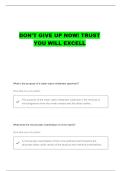
What is the purpose of a clean-catch midstream specimen?
Give this one a try later!
The purpose of the clean-catch midstream collection is the removal of
microorganisms from the urinary meatus and the distal urethra.
What does the microscopic examination of urine clarify?
Give this one a try later!
A microscopic examination of the urine sediment performed by the
physician helps clarify results of the physical and chemical examinations.
, When performed correctly, how accurate are urine pregnancy tests?
Give this one a try later!
When performed correctly, most urine pregnancy tests are 99% accurate
with low occurrences of false-positive test results.
What are the guidelines the MA must follow when using reagent strips for urine
testing?
Give this one a try later!
1. Type of specimen: The best results are obtained with a freshly voided and
thoroughly mixed urine specimen. If the MA is unable to test the specimen
within 1 hour of voiding, the specimen should be refrigerated immediately
and then allowed to return to room temperature before testing.
2. Type of collection: Most reagent strips are designed to be used with a
random specimen collection; however, clean-catch midstream and first-
voided morning specimens are suggested for specific tests. The nitrite test
results are optimized with a first-voided morning specimen, whereas a
clean-catch midstream collection is recommended for the leukocyte test.
3. Specimen container: The specimen container must be throughly clean
and free from any detergent or disinfectant residue because cleansing
agents contain oxidants that react with the chemicals on the reagent strip,
leading to inaccurate test results. The container should be large enough to
allow for complete immersion of all reagent strip areas.
4. Time intervals: Read the test results at the exact time intervals specified
on the color chart. Don not read any test results after 2 minutes.
5. Interpretation of results: Of particular importance is the comparison of
the reagent strip with the color chart. The reagent strip must be compared
with the color chart in good lighting to obtain a good visual match of the
color reactions with the color chart provided with the test kit.
6. Storage of reagent strips: The reagents on the strips are sensitive to light,
heat, and moisture, and the bottle containing the strips must be stored in a
cool, dry area away from direct sunlight, with the cap tightly closed to
maintain reactivity of the reagent. The bottle may contain a desiccant that
Give this one a try later!
The purpose of the clean-catch midstream collection is the removal of
microorganisms from the urinary meatus and the distal urethra.
What does the microscopic examination of urine clarify?
Give this one a try later!
A microscopic examination of the urine sediment performed by the
physician helps clarify results of the physical and chemical examinations.
, When performed correctly, how accurate are urine pregnancy tests?
Give this one a try later!
When performed correctly, most urine pregnancy tests are 99% accurate
with low occurrences of false-positive test results.
What are the guidelines the MA must follow when using reagent strips for urine
testing?
Give this one a try later!
1. Type of specimen: The best results are obtained with a freshly voided and
thoroughly mixed urine specimen. If the MA is unable to test the specimen
within 1 hour of voiding, the specimen should be refrigerated immediately
and then allowed to return to room temperature before testing.
2. Type of collection: Most reagent strips are designed to be used with a
random specimen collection; however, clean-catch midstream and first-
voided morning specimens are suggested for specific tests. The nitrite test
results are optimized with a first-voided morning specimen, whereas a
clean-catch midstream collection is recommended for the leukocyte test.
3. Specimen container: The specimen container must be throughly clean
and free from any detergent or disinfectant residue because cleansing
agents contain oxidants that react with the chemicals on the reagent strip,
leading to inaccurate test results. The container should be large enough to
allow for complete immersion of all reagent strip areas.
4. Time intervals: Read the test results at the exact time intervals specified
on the color chart. Don not read any test results after 2 minutes.
5. Interpretation of results: Of particular importance is the comparison of
the reagent strip with the color chart. The reagent strip must be compared
with the color chart in good lighting to obtain a good visual match of the
color reactions with the color chart provided with the test kit.
6. Storage of reagent strips: The reagents on the strips are sensitive to light,
heat, and moisture, and the bottle containing the strips must be stored in a
cool, dry area away from direct sunlight, with the cap tightly closed to
maintain reactivity of the reagent. The bottle may contain a desiccant that


