
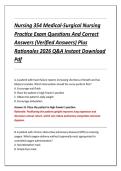
Nursing 354 Medical-Surgical Nursing
Practice Exam Questions And Correct
Answers (Verified Answers) Plus
Rationales 2026 Q&A Instant Download
Pdf
1. A patient with heart failure reports increasing shortness of breath and has
bilateral crackles. Which intervention should the nurse perform first?
A. Encourage oral fluids
B. Place the patient in high-Fowler’s position
C. Obtain the patient’s daily weight
D. Encourage ambulation
Answer: B. Place the patient in high-Fowler’s position
Rationale: Positioning the patient upright improves lung expansion and
decreases venous return, which can reduce pulmonary congestion and ease
dyspnea.
2. A patient with chronic obstructive pulmonary disease (COPD) is receiving
oxygen. Which oxygen-delivery method is generally most appropriate for
controlled oxygen administration?
A. Nonrebreather mask
B. Simple face mask
,C. Venturi mask
D. Partial-rebreather mask
Answer: C. Venturi mask
Rationale: A Venturi mask delivers a precise, controlled fraction of inspired
oxygen, making it useful for patients with COPD who require carefully titrated
oxygen therapy.
3. A patient with diabetes mellitus is diaphoretic, shaky, and confused. Which
action should the nurse take first if the patient is awake and able to swallow?
A. Administer long-acting insulin
B. Give a rapid source of glucose
C. Restrict oral fluids
D. Place the patient on bed rest for 2 hours
Answer: B. Give a rapid source of glucose
Rationale: These findings are consistent with hypoglycemia. An alert patient
who can swallow should receive a rapid-acting carbohydrate.
4. Which finding is most characteristic of left-sided heart failure?
A. Peripheral edema
B. Jugular venous distention
C. Pulmonary crackles
D. Enlarged liver
Answer: C. Pulmonary crackles
Rationale: Left-sided heart failure causes pulmonary congestion, which may
produce crackles, dyspnea, and orthopnea.
5. A patient with a suspected myocardial infarction reports severe chest pressure.
Which prescribed medication should the nurse anticipate administering promptly
unless contraindicated?
,A. Aspirin
B. Warfarin
C. Furosemide
D. Potassium chloride
Answer: A. Aspirin
Rationale: Aspirin inhibits platelet aggregation and is an important early
treatment for suspected acute coronary syndrome when there is no
contraindication.
6. A patient with chronic kidney disease has a potassium level of 6.4 mEq/L. Which
finding requires the most immediate attention?
A. Fatigue
B. Muscle weakness
C. Cardiac dysrhythmia
D. Mild nausea
Answer: C. Cardiac dysrhythmia
Rationale: Severe hyperkalemia can cause life-threatening cardiac conduction
abnormalities and dysrhythmias.
7. Which assessment finding is most concerning in a patient with increased
intracranial pressure?
A. Mild headache
B. Decreased level of consciousness
C. Increased appetite
D. Warm, flushed skin
Answer: B. Decreased level of consciousness
Rationale: A declining level of consciousness is an important indicator of
worsening neurologic function and potentially increasing intracranial pressure.
, 8. A patient is admitted with an acute ischemic stroke. Which assessment is the
priority before oral medications or food are given?
A. Hearing ability
B. Swallowing ability
C. Skin turgor
D. Peripheral pulses
Answer: B. Swallowing ability
Rationale: Dysphagia is common after stroke and increases the risk for
aspiration. Swallowing should be assessed before oral intake.
9. A patient with a spinal cord injury develops sudden hypertension, severe
headache, and diaphoresis. What should the nurse suspect?
A. Septic shock
B. Autonomic dysreflexia
C. Hypoglycemia
D. Pulmonary embolism
Answer: B. Autonomic dysreflexia
Rationale: Autonomic dysreflexia can occur after spinal cord injury and is
characterized by sudden severe hypertension, headache, sweating, and other
autonomic responses.
10. Which laboratory value is most important for the nurse to monitor in a patient
receiving warfarin therapy?
A. INR
B. Serum sodium
C. Serum amylase
D. Hemoglobin A1c
Answer: A. INR
Rationale: The international normalized ratio (INR) is used to monitor the
anticoagulant effect of warfarin and guide dosing.
Practice Exam Questions And Correct
Answers (Verified Answers) Plus
Rationales 2026 Q&A Instant Download
1. A patient with heart failure reports increasing shortness of breath and has
bilateral crackles. Which intervention should the nurse perform first?
A. Encourage oral fluids
B. Place the patient in high-Fowler’s position
C. Obtain the patient’s daily weight
D. Encourage ambulation
Answer: B. Place the patient in high-Fowler’s position
Rationale: Positioning the patient upright improves lung expansion and
decreases venous return, which can reduce pulmonary congestion and ease
dyspnea.
2. A patient with chronic obstructive pulmonary disease (COPD) is receiving
oxygen. Which oxygen-delivery method is generally most appropriate for
controlled oxygen administration?
A. Nonrebreather mask
B. Simple face mask
,C. Venturi mask
D. Partial-rebreather mask
Answer: C. Venturi mask
Rationale: A Venturi mask delivers a precise, controlled fraction of inspired
oxygen, making it useful for patients with COPD who require carefully titrated
oxygen therapy.
3. A patient with diabetes mellitus is diaphoretic, shaky, and confused. Which
action should the nurse take first if the patient is awake and able to swallow?
A. Administer long-acting insulin
B. Give a rapid source of glucose
C. Restrict oral fluids
D. Place the patient on bed rest for 2 hours
Answer: B. Give a rapid source of glucose
Rationale: These findings are consistent with hypoglycemia. An alert patient
who can swallow should receive a rapid-acting carbohydrate.
4. Which finding is most characteristic of left-sided heart failure?
A. Peripheral edema
B. Jugular venous distention
C. Pulmonary crackles
D. Enlarged liver
Answer: C. Pulmonary crackles
Rationale: Left-sided heart failure causes pulmonary congestion, which may
produce crackles, dyspnea, and orthopnea.
5. A patient with a suspected myocardial infarction reports severe chest pressure.
Which prescribed medication should the nurse anticipate administering promptly
unless contraindicated?
,A. Aspirin
B. Warfarin
C. Furosemide
D. Potassium chloride
Answer: A. Aspirin
Rationale: Aspirin inhibits platelet aggregation and is an important early
treatment for suspected acute coronary syndrome when there is no
contraindication.
6. A patient with chronic kidney disease has a potassium level of 6.4 mEq/L. Which
finding requires the most immediate attention?
A. Fatigue
B. Muscle weakness
C. Cardiac dysrhythmia
D. Mild nausea
Answer: C. Cardiac dysrhythmia
Rationale: Severe hyperkalemia can cause life-threatening cardiac conduction
abnormalities and dysrhythmias.
7. Which assessment finding is most concerning in a patient with increased
intracranial pressure?
A. Mild headache
B. Decreased level of consciousness
C. Increased appetite
D. Warm, flushed skin
Answer: B. Decreased level of consciousness
Rationale: A declining level of consciousness is an important indicator of
worsening neurologic function and potentially increasing intracranial pressure.
, 8. A patient is admitted with an acute ischemic stroke. Which assessment is the
priority before oral medications or food are given?
A. Hearing ability
B. Swallowing ability
C. Skin turgor
D. Peripheral pulses
Answer: B. Swallowing ability
Rationale: Dysphagia is common after stroke and increases the risk for
aspiration. Swallowing should be assessed before oral intake.
9. A patient with a spinal cord injury develops sudden hypertension, severe
headache, and diaphoresis. What should the nurse suspect?
A. Septic shock
B. Autonomic dysreflexia
C. Hypoglycemia
D. Pulmonary embolism
Answer: B. Autonomic dysreflexia
Rationale: Autonomic dysreflexia can occur after spinal cord injury and is
characterized by sudden severe hypertension, headache, sweating, and other
autonomic responses.
10. Which laboratory value is most important for the nurse to monitor in a patient
receiving warfarin therapy?
A. INR
B. Serum sodium
C. Serum amylase
D. Hemoglobin A1c
Answer: A. INR
Rationale: The international normalized ratio (INR) is used to monitor the
anticoagulant effect of warfarin and guide dosing.


