

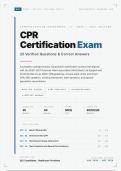
BLS EXAM / DOC ID: CPR-2026-25Q-V1 CONFIDENTIAL TRAINING USE
CERTIFICATION ASSESSMENT // 2026 / 2027 EDITION
CPR
Certification Exam
25 Verified Questions & Correct Answers
A complete cardiopulmonary resuscitation certification assessment aligned
with the 2026–2027 American Heart Association (AHA) Basic Life Support and
American Red Cross (ARC) CPR guidelines. Covers adult, child, and infant
CPR, AED operation, choking maneuvers, team dynamics, and special-
population resuscitation.
AHA BLS ALIGNED ARC COMPLIANT SCENARIO-BASED
VERIFIED ANSWERS
QUESTIONS SECTIONS FORMAT COGNITIVE
25 04 MCQ 30/50/20
Verified Domains A–D R/A/An%
— SECTION MAP —
SEC 01 Adult CPR and AED Q1 – Q10
SEC 02 Child and Infant CPR Q11 – Q16
SEC 03 Choking and Airway Obstruction Q17 – Q20
SEC 04 Team Dynamics and Special Circumstances Q21 – Q25
PREPARED FOR GUIDELINE EDITION
BLS Candidates · Healthcare Providers AHA 2026 · ARC 2026
, CPR CERTIFICATION EXAM | AHA BLS · ARC Aligned · 25 Verified Questions
CPR Certification Exam
Actual Exam — 25 Verified Questions and Correct Answers
QUESTIONS SECTIONS FORMAT COGNITIVE MIX GUIDELINES
25 04 MCQ (A–D) / 20 AHA + ARC
Examination Overview
This complete certification assessment is aligned with the 2026–2027 American Heart Association (AHA) Basic Life
Support (BLS) and American Red Cross (ARC) Cardiopulmonary Resuscitation (CPR) guidelines. It is structured
across four core domains: Adult CPR and AED operation, Child and Infant CPR adaptations, Choking and Airway
Obstruction maneuvers, and Team Dynamics with Special Circumstances such as pregnancy, obesity, and
opioid-associated emergencies. Each question is paired with a verified correct answer and a concise clinical rationale
citing the underlying AHA/ARC resuscitation principles, technique specifics, and critical safety considerations.
The cognitive level distribution is calibrated to certification standards: approximately 30% recall, 50% application, and
20% analysis. Approximately 70% of the items are scenario-based, testing the candidate’s ability to translate guideline
knowledge into real-world resuscitation decisions, while 30% are direct-recall items targeting high-frequency,
gatekeeping concepts such as compression rate, depth, ratio, AED safety, and pulse-check location. Distractors are
designed to mirror the most common certification-exam pitfalls — ratio confusion between adult/child/infant, depth
confusion, conscious-versus-unconscious choking sequencing errors, and AED touch-during-shock violations — so
that candidates who master this exam are positioned to pass on the first attempt.
Adult CPR and AED
01
Q1 – Q10
Adult Chain of Survival, Scene Safety, Assessment, Compression/Rescue Breath Ratios, AED Use, and Rescue
Breathing for adult victims (≥ puberty).
Q01 · SCENARIO · CHAIN OF SURVIVAL
You are walking through a shopping mall when a man in his 50s suddenly collapses in front
of you, clutching his chest before becoming unresponsive. Bystanders begin to gather.
Which sequence of actions most accurately reflects the first three links of the Adult
Out-of-Hospital Chain of Survival as defined by the 2026 AHA BLS guidelines?
A. Begin chest compressions, then call 911, then attach an AED
B. Activate the emergency response system, begin high-quality CPR, and provide rapid
defibrillation [CORRECT]
C. Wait for the AED to arrive before touching the victim
D. Call 911, perform rescue breathing only, and wait for advanced life support
Correct Answer: B
Rationale
The Adult Chain of Survival begins with immediate recognition of cardiac arrest and activation of the emergency
response system, followed by early high-quality CPR and rapid defibrillation. AHA 2026 BLS reinforces that
recognition and activation must precede compressions so that EMS and an AED are mobilized concurrently with
bystander CPR. Option A reverses the activation/compression sequence and delays 911. Option C wastes critical
minutes, as compressions should begin immediately while the AED is being retrieved. Option D ignores the priority of
Cardiopulmonary Resuscitation · Complete Certification Assessment PAGE 02
CERTIFICATION ASSESSMENT // 2026 / 2027 EDITION
CPR
Certification Exam
25 Verified Questions & Correct Answers
A complete cardiopulmonary resuscitation certification assessment aligned
with the 2026–2027 American Heart Association (AHA) Basic Life Support and
American Red Cross (ARC) CPR guidelines. Covers adult, child, and infant
CPR, AED operation, choking maneuvers, team dynamics, and special-
population resuscitation.
AHA BLS ALIGNED ARC COMPLIANT SCENARIO-BASED
VERIFIED ANSWERS
QUESTIONS SECTIONS FORMAT COGNITIVE
25 04 MCQ 30/50/20
Verified Domains A–D R/A/An%
— SECTION MAP —
SEC 01 Adult CPR and AED Q1 – Q10
SEC 02 Child and Infant CPR Q11 – Q16
SEC 03 Choking and Airway Obstruction Q17 – Q20
SEC 04 Team Dynamics and Special Circumstances Q21 – Q25
PREPARED FOR GUIDELINE EDITION
BLS Candidates · Healthcare Providers AHA 2026 · ARC 2026
, CPR CERTIFICATION EXAM | AHA BLS · ARC Aligned · 25 Verified Questions
CPR Certification Exam
Actual Exam — 25 Verified Questions and Correct Answers
QUESTIONS SECTIONS FORMAT COGNITIVE MIX GUIDELINES
25 04 MCQ (A–D) / 20 AHA + ARC
Examination Overview
This complete certification assessment is aligned with the 2026–2027 American Heart Association (AHA) Basic Life
Support (BLS) and American Red Cross (ARC) Cardiopulmonary Resuscitation (CPR) guidelines. It is structured
across four core domains: Adult CPR and AED operation, Child and Infant CPR adaptations, Choking and Airway
Obstruction maneuvers, and Team Dynamics with Special Circumstances such as pregnancy, obesity, and
opioid-associated emergencies. Each question is paired with a verified correct answer and a concise clinical rationale
citing the underlying AHA/ARC resuscitation principles, technique specifics, and critical safety considerations.
The cognitive level distribution is calibrated to certification standards: approximately 30% recall, 50% application, and
20% analysis. Approximately 70% of the items are scenario-based, testing the candidate’s ability to translate guideline
knowledge into real-world resuscitation decisions, while 30% are direct-recall items targeting high-frequency,
gatekeeping concepts such as compression rate, depth, ratio, AED safety, and pulse-check location. Distractors are
designed to mirror the most common certification-exam pitfalls — ratio confusion between adult/child/infant, depth
confusion, conscious-versus-unconscious choking sequencing errors, and AED touch-during-shock violations — so
that candidates who master this exam are positioned to pass on the first attempt.
Adult CPR and AED
01
Q1 – Q10
Adult Chain of Survival, Scene Safety, Assessment, Compression/Rescue Breath Ratios, AED Use, and Rescue
Breathing for adult victims (≥ puberty).
Q01 · SCENARIO · CHAIN OF SURVIVAL
You are walking through a shopping mall when a man in his 50s suddenly collapses in front
of you, clutching his chest before becoming unresponsive. Bystanders begin to gather.
Which sequence of actions most accurately reflects the first three links of the Adult
Out-of-Hospital Chain of Survival as defined by the 2026 AHA BLS guidelines?
A. Begin chest compressions, then call 911, then attach an AED
B. Activate the emergency response system, begin high-quality CPR, and provide rapid
defibrillation [CORRECT]
C. Wait for the AED to arrive before touching the victim
D. Call 911, perform rescue breathing only, and wait for advanced life support
Correct Answer: B
Rationale
The Adult Chain of Survival begins with immediate recognition of cardiac arrest and activation of the emergency
response system, followed by early high-quality CPR and rapid defibrillation. AHA 2026 BLS reinforces that
recognition and activation must precede compressions so that EMS and an AED are mobilized concurrently with
bystander CPR. Option A reverses the activation/compression sequence and delays 911. Option C wastes critical
minutes, as compressions should begin immediately while the AED is being retrieved. Option D ignores the priority of
Cardiopulmonary Resuscitation · Complete Certification Assessment PAGE 02


